 Add to Chrome
 Add to Firefox
 Add to Edge
Polarizable atomic multipoles for learning long-range electrostatics
May 07, 2026
Long-range electrostatics and polarization remain central obstacles to extending machine learning interatomic potentials (MLIPs) to ionic, polar, and interfacial systems. Here, we introduce a semi-local framework for learning electrostatics from energies and forces using polarizable atomic multipoles. Local equivariant descriptors predict environment-dependent latent monopoles, dipoles, and quadrupoles, while residual non-local charge transfer and polarization are captured by non-self-consistent linear response in induced charges and dipoles. Across four diverse benchmarks and four short-range MLIP architectures, the multipole hierarchy and response terms systematically improve potential energy surface accuracy, with the largest gains in systems where long-range effects are essential. More importantly, the learned latent variables recover physically meaningful electrical responses: accurate Born effective charge tensors, emergent polarizabilities, infrared spectra in close agreement with experiments, and semi-quantitative Raman spectra for bulk water and hybrid MAPbI$_3$ perovskite. This systematically improvable, physically transparent framework enables MLIPs trained on standard energy and force labels to predict polarization-sensitive observables.

A probabilistic foundation model for crystal structure denoising, phase classification, and order parameters
Dec 21, 2025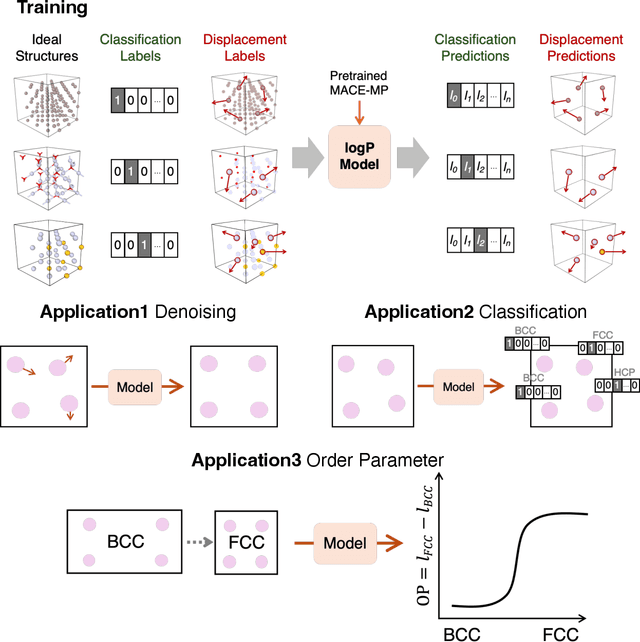
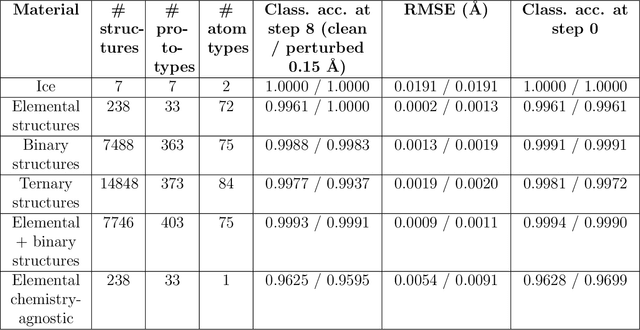
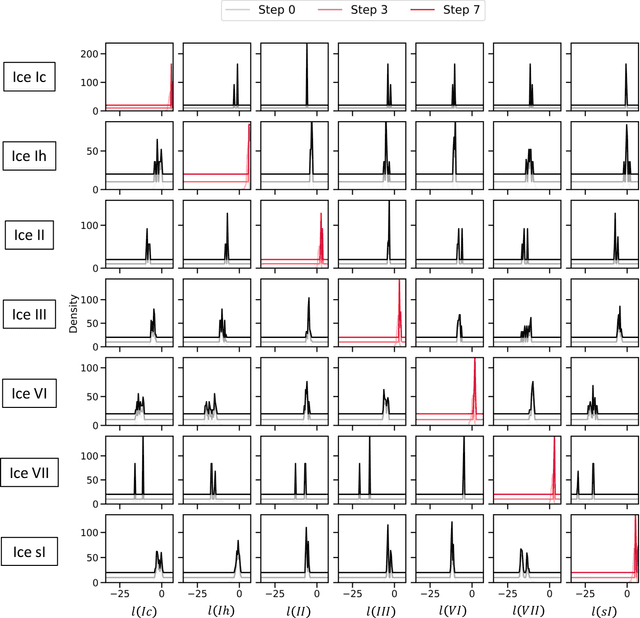
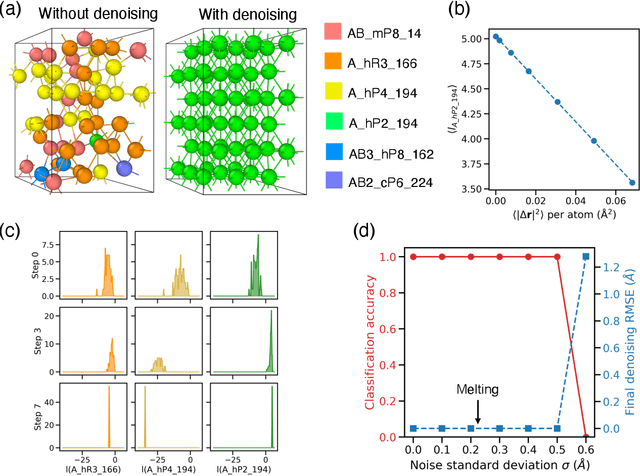
Atomistic simulations generate large volumes of noisy structural data, but extracting phase labels, order parameters (OPs), and defect information in a way that is universal, robust, and interpretable remains challenging. Existing tools such as PTM and CNA are restricted to a small set of hand-crafted lattices (e.g.\ FCC/BCC/HCP), degrade under strong thermal disorder or defects, and produce hard, template-based labels without per-atom probability or confidence scores. Here we introduce a log-probability foundation model that unifies denoising, phase classification, and OP extraction within a single probabilistic framework. We reuse the MACE-MP foundation interatomic potential on crystal structures mapped to AFLOW prototypes, training it to predict per-atom, per-phase logits $l$ and to aggregate them into a global log-density $\log \hat{P}_θ(\boldsymbol{r})$ whose gradient defines a conservative score field. Denoising corresponds to gradient ascent on this learned log-density, phase labels follow from $\arg\max_c l_{ac}$, and the $l$ values act as continuous, defect-sensitive and interpretable OPs quantifying the Euclidean distance to ideal phases. We demonstrate universality across hundreds of prototypes, robustness under strong thermal and defect-induced disorder, and accurate treatment of complex systems such as ice polymorphs, ice--water interfaces, and shock-compressed Ti.
Information theory unifies atomistic machine learning, uncertainty quantification, and materials thermodynamics
Apr 18, 2024An accurate description of information is relevant for a range of problems in atomistic modeling, such as sampling methods, detecting rare events, analyzing datasets, or performing uncertainty quantification (UQ) in machine learning (ML)-driven simulations. Although individual methods have been proposed for each of these tasks, they lack a common theoretical background integrating their solutions. Here, we introduce an information theoretical framework that unifies predictions of phase transformations, kinetic events, dataset optimality, and model-free UQ from atomistic simulations, thus bridging materials modeling, ML, and statistical mechanics. We first demonstrate that, for a proposed representation, the information entropy of a distribution of atom-centered environments is a surrogate value for thermodynamic entropy. Using molecular dynamics (MD) simulations, we show that information entropy differences from trajectories can be used to build phase diagrams, identify rare events, and recover classical theories of nucleation. Building on these results, we use this general concept of entropy to quantify information in datasets for ML interatomic potentials (IPs), informing compression, explaining trends in testing errors, and evaluating the efficiency of active learning strategies. Finally, we propose a model-free UQ method for MLIPs using information entropy, showing it reliably detects extrapolation regimes, scales to millions of atoms, and goes beyond model errors. This method is made available as the package QUESTS: Quick Uncertainty and Entropy via STructural Similarity, providing a new unifying theory for data-driven atomistic modeling and combining efforts in ML, first-principles thermodynamics, and simulations.