 Add to Chrome
 Add to Firefox
 Add to Edge
NEUROSYMLAND: Neuro-Symbolic Landing-Site Assessment for Robust and Edge-Deployable UAV Autonomy
Jul 02, 2026
Safe landing-site assessment in unstructured environments remains a key challenge for autonomous UAV deployment, as vision-only learning approaches often degrade under terrain variability and provide limited transparency in safety decisions. We present NEUROSYMLAND, a neuro-symbolic landing-site assessment system that integrates lightweight perception with explicit safety reasoning. The framework constructs a probabilistic semantic scene graph from onboard visual input and evaluates candidate landing regions using symbolic constraints capturing terrain flatness, obstacle clearance, and spatial consistency, enabling structured reasoning under perceptual uncertainty while maintaining edge-feasible execution. Across 72 simulated landing scenarios spanning diverse terrains, NEUROSYMLAND achieves 61 successful assessments, outperforming four competitive baselines (37-57 successes). To evaluate deployability, we further conduct 100 hardware-in-the-loop trials with randomized initial poses, profiling end-to-end latency, stage-wise execution time, and system-level metrics including CPU/GPU utilization, memory footprint, and power consumption. Results demonstrate improved robustness and interpretability with bounded edge-resource usage. Profiling shows that symbolic reasoning contributes only a small fraction of end-to-end latency, while the main computational cost arises from perception and PSSG construction. These results demonstrate the feasibility of deploying the landing-site assessment stack on edge-constrained UAV hardware, and all source code, datasets, prompts, and symbolic rule refinement examples are released in an open-source repository
* Accepted to the IROS 2026

A Step-by-Step Guide to Creating a Robust Autonomous Drone Testing Pipeline
Jun 13, 2025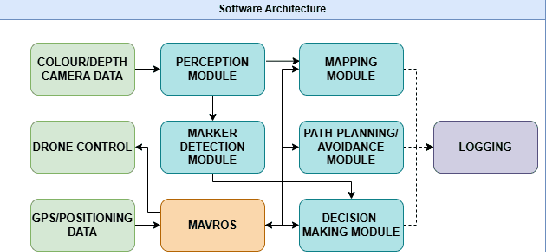
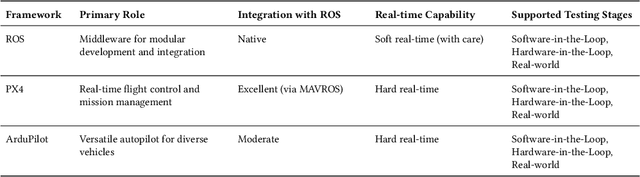
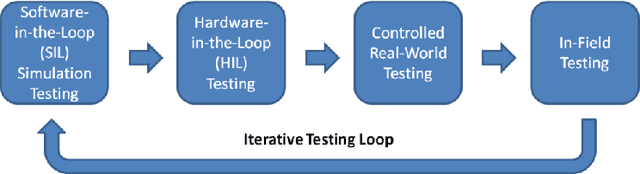

Autonomous drones are rapidly reshaping industries ranging from aerial delivery and infrastructure inspection to environmental monitoring and disaster response. Ensuring the safety, reliability, and efficiency of these systems is paramount as they transition from research prototypes to mission-critical platforms. This paper presents a step-by-step guide to establishing a robust autonomous drone testing pipeline, covering each critical stage: Software-in-the-Loop (SIL) Simulation Testing, Hardware-in-the-Loop (HIL) Testing, Controlled Real-World Testing, and In-Field Testing. Using practical examples, including the marker-based autonomous landing system, we demonstrate how to systematically verify drone system behaviors, identify integration issues, and optimize performance. Furthermore, we highlight emerging trends shaping the future of drone testing, including the integration of Neurosymbolic and LLMs, creating co-simulation environments, and Digital Twin-enabled simulation-based testing techniques. By following this pipeline, developers and researchers can achieve comprehensive validation, minimize deployment risks, and prepare autonomous drones for safe and reliable real-world operations.
Towards Robust Autonomous Landing Systems: Iterative Solutions and Key Lessons Learned
May 18, 2025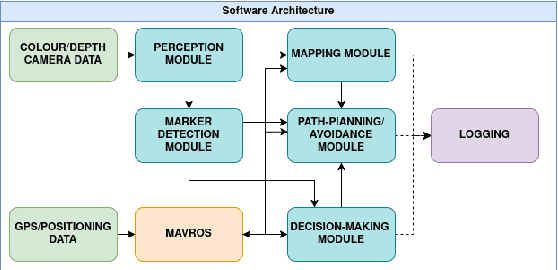
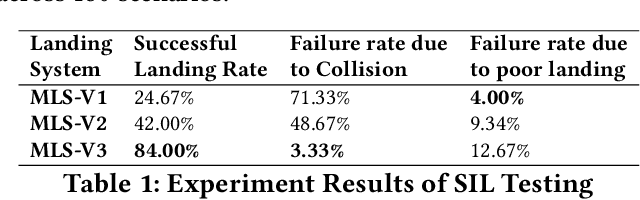
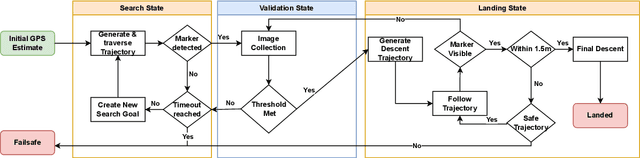
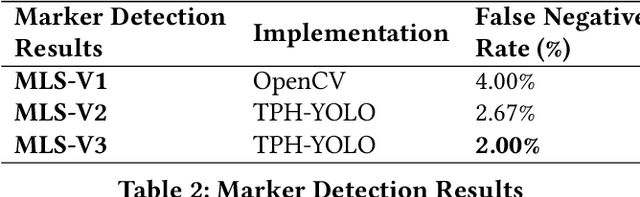
Uncrewed Aerial Vehicles (UAVs) have become a focal point of research, with both established companies and startups investing heavily in their development. This paper presents our iterative process in developing a robust autonomous marker-based landing system, highlighting the key challenges encountered and the solutions implemented. It reviews existing systems for autonomous landing processes, and through this aims to contribute to the community by sharing insights and challenges faced during development and testing.