 Add to Chrome
 Add to Firefox
 Add to Edge
A Reward-Petri-Net Interpretation of Temporal Behavior Trees
Jun 19, 2026
This paper introduces an interpretation of Temporal Behavior Trees (TBTs) as Reward-Petri-Nets (RPNs) for reinforcement learning (RL). Designing reward functions for complex, long-horizon robotic tasks is notoriously difficult, especially when tasks have hierarchical structure and temporal constraints. TBTs extend conventional behavior trees (BTs) used in robotic applications by incorporating temporal properties into their leaf nodes. This allows TBTs to represents not only the behavioral task structure defined by BT operators such as Sequence, Fallback, and Parallel, but also the task's temporal constraints. In this work, the constraints are specified in the leaf nodes using Linear Temporal Logic. In order to inform RL rewards using TBTs, we provide a translation from TBT into a Petri Net (PN) and show how rewards can be automatically assigned based on the TBT's structure, resulting in a RPN. In a series of increasingly challenging environments, we demonstrate how TBT-based rewards enable learning where vanilla RL fails, improve sample efficiency, and offer flexible, intuitive control over the learning progress. We showcase the learning impact by using different reward distribution schemes and TBT structures.

RTLola Cleared for Take-Off: Monitoring Autonomous Aircraft
Apr 28, 2020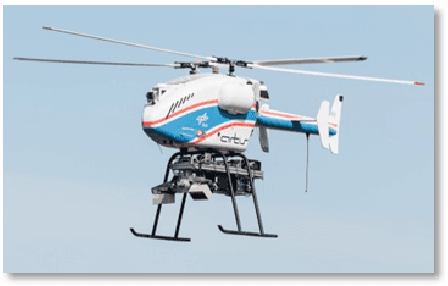
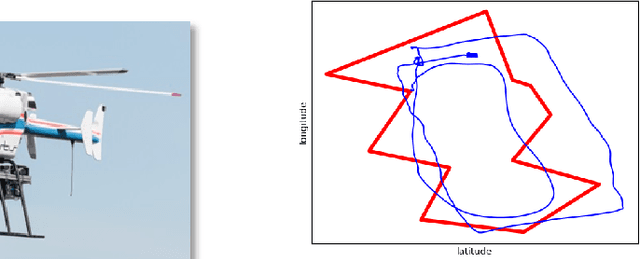
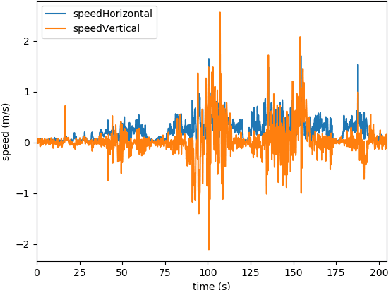
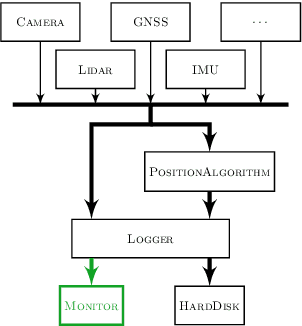
The autonomous control of unmanned aircraft is a highly safety-critical domain with great economic potential in a wide range of application areas, including logistics, agriculture, civil engineering, and disaster recovery. We report on the development of a dynamic monitoring framework for the DLR ARTIS (Autonomous Rotorcraft Testbed for Intelligent Systems) family of unmanned aircraft based on the formal specification language RTLola. RTLola is a stream-based specification language for real-time properties. An RTLola specification of hazardous situations and system failures is statically analyzed in terms of consistency and resource usage and then automatically translated into an FPGA-based monitor. Our approach leads to highly efficient, parallelized monitors with formal guarantees on the noninterference of the monitor with the normal operation of the autonomous system.