 Add to Chrome
 Add to Firefox
 Add to Edge
Clinician-Level Agreement Without Clinical Caution: LLM Evaluator Limits in Medical AI Benchmarking
Jul 01, 2026
Open-response evaluation provides stronger clinical validity than multiple-choice benchmarks but creates a scoring bottleneck that motivates automated LLM-asa-Judge approaches. Whether such evaluators replicate clinical calibration and caution, however, remains untested. We introduce MedQADE, the first standardised open-response clinical benchmark for German, a major clinical language lacking native evaluation infrastructure, comprising 3,800 items annotated by ten practising physicians and nine Large Language Model (LLM) evaluators. The top-performing evaluator model, Gemini 3 Flash, reached alignment consistent with the physician ceiling (\k{appa} = 0.694 vs. \k{appa} = 0.709), though wide confidence intervals limit interpretation. Despite this statistical alignment, automated evaluators exhibited near-absent clinical metacognition: physicians scaled abstention with item difficulty, while frontier models assigned definitive scores in every case. We additionally quantified systematic lineage-dependent biases, where models preferentially scored architectural siblings, an effect independent of language. These results show that statistical alignment does not ensure clinical caution, and that evaluator independence requires explicit verification.

Image-based Quantification of Postural Deviations on Patients with Cervical Dystonia: A Machine Learning Approach Using Synthetic Training Data
Mar 27, 2026Cervical dystonia (CD) is the most common form of dystonia, yet current assessment relies on subjective clinical rating scales, such as the Toronto Western Spasmodic Torticollis Rating Scale (TWSTRS), which requires expertise, is subjective and faces low inter-rater reliability some items of the score. To address the lack of established objective tools for monitoring disease severity and treatment response, this study validates an automated image-based head pose and shift estimation system for patients with CD. We developed an assessment tool that combines a pretrained head-pose estimation algorithm for rotational symptoms with a deep learning model trained exclusively on ~16,000 synthetic avatar images to evaluate rare translational symptoms, specifically lateral shift. This synthetic data approach overcomes the scarcity of clinical training examples. The system's performance was validated in a multicenter study by comparing its predicted scores against the consensus ratings of 20 clinical experts using a dataset of 100 real patient images and 100 labeled synthetic avatars. The automated system demonstrated strong agreement with expert clinical ratings for rotational symptoms, achieving high correlations for torticollis (r=0.91), laterocollis (r=0.81), and anteroretrocollis (r=0.78). For lateral shift, the tool achieved a moderate correlation (r=0.55) with clinical ratings and demonstrated higher accuracy than human raters in controlled benchmark tests on avatars. By leveraging synthetic training data to bridge the clinical data gap, this model successfully generalizes to real-world patients, providing a validated, objective tool for CD postural assessment that can enable standardized clinical decision-making and trial evaluation.
A modified Genetic Algorithm for continuous estimation of CPR quality parameters from wrist-worn inertial sensor data
Oct 11, 2019
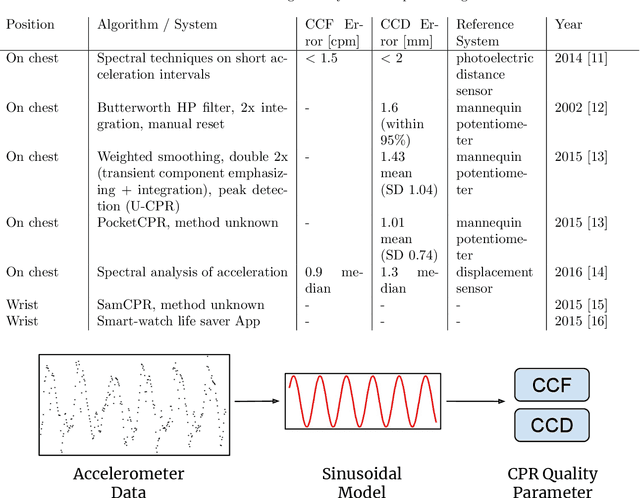

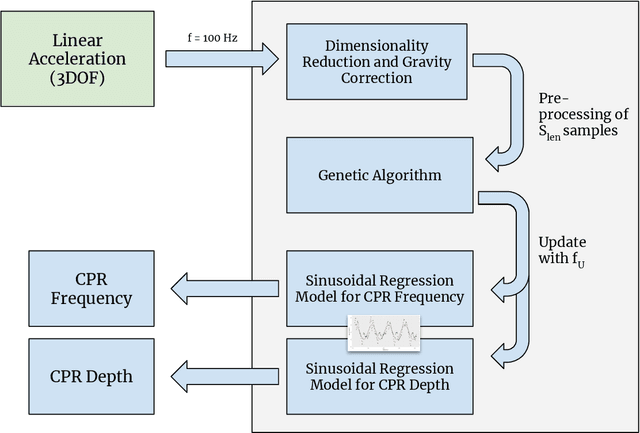
Cardiopulmonary resuscitation (CPR) is the most important emergency intervention for sudden cardiac arrest. In this paper, a robust sinusoidal model fitting method based on a modified Genetic Algorithm for CPR quality parameters - naming chest compression frequency and depth - as measured by an inertial sensor placed at the wrist is presented. Once included into a smartphone or smartwatch app, the proposed algorithm will enable bystanders to improve CPR (as part of a continuous closed-loop support-system). By evaluating the precision of the model with both, simulated data and data recorded by a Laerdal Resusci Anne mannequin as reference standard, a variance for compression frequency of +-3.7 cpm has been found for the sensor placed at the wrist. Thereby, this previously unconsidered position and consequently the use of smartwatches was shown to be a suitable alternative to the typical placement of phones in the hand for CPR training.
Transportation Mode Classification from Smartphone Sensors via a Long-Short-Term-Memory Network
Oct 10, 2019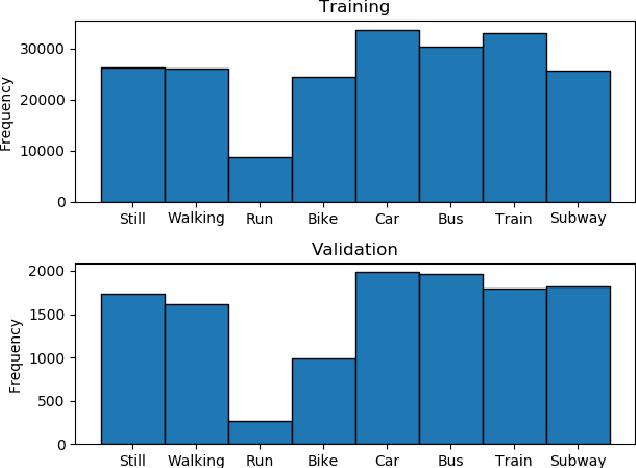
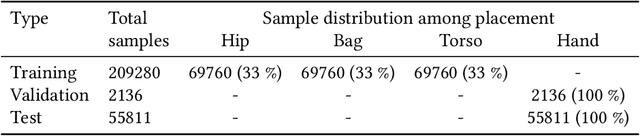

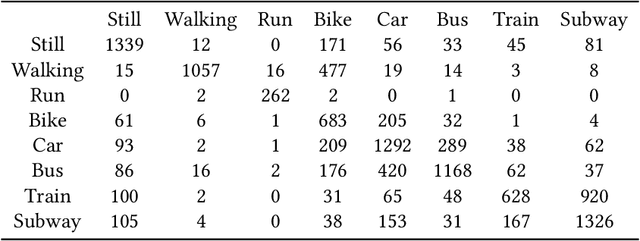
This article introduces the architecture of a Long-Short-Term Memory network for classifying transportation-modes via Smartphone data and evaluates its accuracy. By using a Long-Short-Term-Memory Network with common preprocessing steps such as normalisation for classification tasks a F1-Score accuracy of 63.68\% was achieved with an internal test dataset. We participated as Team 'GanbareAM' in the 'SHL recognition challenge'.
Cardiopulmonary Resuscitation Quality Parameters from Inertial Sensor Data using Differential Evolution Fitting of Sinusoids
Aug 31, 2018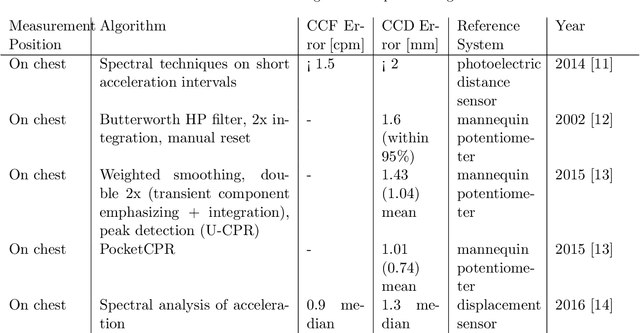
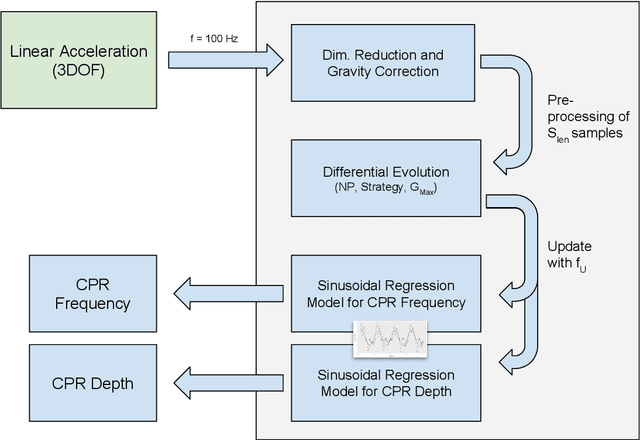
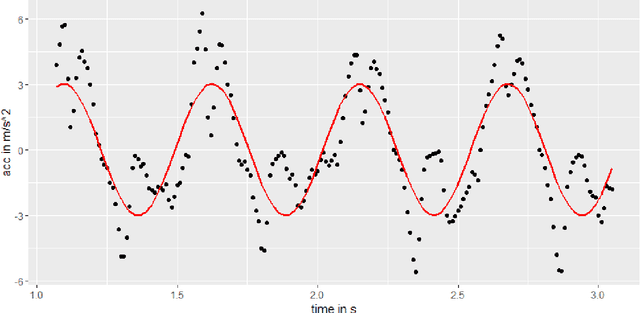
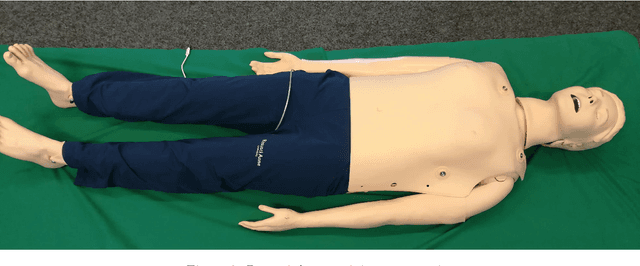
In this paper, we present a robust sinusoidal model fitting method based on the Differential Evolution (DE) algorithm for determining cardiopulmonary resuscitation (CPR) quality-parameters - naming chest compression frequency and depth - as measured by an inertial sensor placed at the wrist. Once included into a smartphone or smartwatch app, our proposed algorithm will enable laypersons to improve cardiopulmonary resuscitation (as part of a continuous closed-loop support-system). By evaluating the sensitivity of the model with data recorded by a Laerdal Resusci Anne mannequin as reference standard, a low variance for compression frequency of +-2.7 cpm (2.5 %) has been found for the sensor placed at the wrist, making this previously not evaluated position a suitable alternative to the typical smartphone placement in the hand.
Cardiopulmonary Resuscitation Quality Parameters from Motion Capture Data using Differential Evolution Fitting of Sinusoids
Jun 26, 2018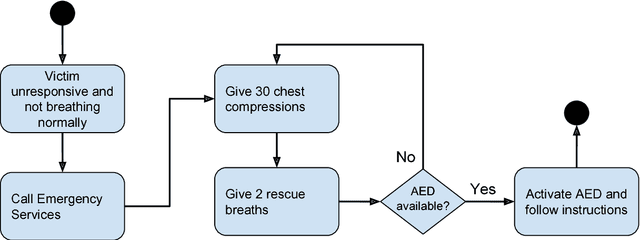
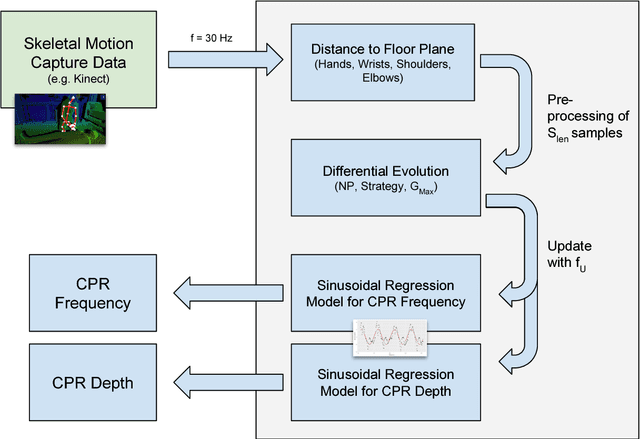
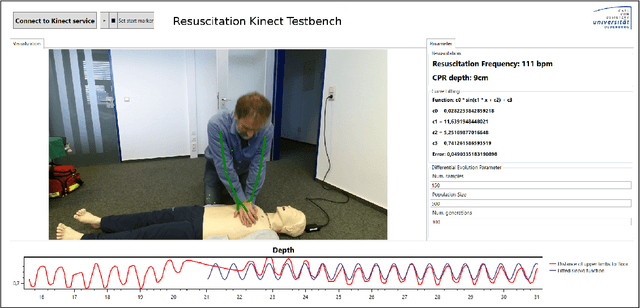
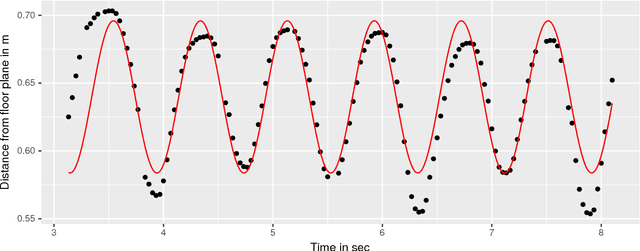
Cardiopulmonary resuscitation (CPR) is alongside with electrical defibrillation the most important treatment for sudden cardiac arrest, which affects thousands of individuals every year. In this paper, we present a robust sinusoid model that uses skeletal motion data from an RGB-D (Kinect) sensor and the Differential Evolution (DE) optimization algorithm to dynamically fit sinusoidal curves to derive frequency and depth parameters for cardiopulmonary resuscitation training. It is intended to be part of a robust and easy-to-use feedback system for CPR training, allowing its use for unsupervised training. The accuracy of this DE-based approach is evaluated in comparison with data recorded by a state-of-the-art training mannequin. We optimized the DE algorithm constants and have shown that with these optimized parameters the frequency of the CPR is recognized with a median error of 2.55 (2.4%) compressions per minute compared to the reference training mannequin.