 Add to Chrome
 Add to Firefox
 Add to Edge
Simple, Safe, and Overlooked: Reclaiming Sustainable Domain Generalization with Statistical Color Matching
Aug 19, 2026
Hardware shifts, color variations, and changing patient characteristics between development and deployment routinely break trained medical image classifiers. Existing remedies fall short: standard color jittering provides insufficient diversity, while deep generative style transfer algorithms hallucinate features, destroy clinically relevant structures, and waste massive compute resources. To address this, we revisit classical statistical color matching and repurpose it as Colorist, a highly efficient data augmentation strategy that applies global mean-standard deviation matching directly in the RGB color space. We demonstrate that this training-free, fully interpretable approach safely generates structurally intact domain variations, outperforming deep generative models in structural fidelity and color alignment. Across out-of-distribution histopathology, peripheral blood, dermatology, and retinal datasets, it improves balanced accuracy by up to +9% over state-of-the-art domain generalization regularizers and by +13% over an unaugmented baseline. Moreover, by avoiding neural networks in the augmentation loop, Colorist preserves anatomical structure, minimizes carbon footprint, and integrates seamlessly into standard dataloaders. Together, these findings establish statistical matching as a safe, interpretable, yet overlooked alternative to deep architectures for clinical robustness. Source code is available at https://github.com/sdoerrich97/colorist.

TRUE-Colon: Exposing a Consistent Transfer Asymmetry in Real-Time Polyp Detection
Aug 13, 2026Computer-aided detection (CADe) systems for colonoscopy promise to reduce clinical miss rates, yet reliable real-world deployment remains elusive. This translational gap stems in part from a structural flaw in model development: the reliance on curated datasets that under-represent the long negative stretches and procedure-related artifacts characteristic of routine examinations. Training and evaluating architectures strictly on these lesion-centric benchmarks creates an illusion of success, since such benchmarks cannot capture clinically crucial metrics. To expose this gap, we establish TRUE-Colon, a standardized benchmarking protocol that measures key deployment characteristics alongside localization accuracy, and evaluate four real-time architectures (Faster R-CNN, YOLOv8, YOLOv11, RT-DETR) across curated benchmarks (SUN, PICCOLO) and 60 unedited, full-length procedures (REAL-Colon). We observe a consistent transfer asymmetry: models trained strictly on curated clips suffer a severe performance collapse when evaluated on full procedures, whereas procedure-trained models substantially improve rejection of non-polyp content on REAL-Colon, and largely retain their accuracy on curated benchmarks. Beyond transferability, we find that the Transformer detector attains the strongest sensitivity and the earliest, most persistent detections, while the convolutional detectors stay competitive at a higher throughput. Together, these results indicate that both training and benchmarking for deployable CADe should shift from curated, lesion-centric clips toward full-procedure data and deployment-relevant operating points. Source code is available at https://github.com/sdoerrich97/true-colon.
MoPET: Parameter-Efficient Mixture-of-Experts for Unified Medical Image Classification
Aug 03, 2026Adapting deep learning models to profound clinical heterogeneity typically relies on parameter-efficient fine-tuning (PEFT) to avoid the severe overfitting associated with full end-to-end network updates. Although PEFT successfully navigates limited data scenarios, it inherently forces the training of a separate, isolated adapter for every specific diagnostic task. Consolidating these isolated adapters into a single generalist network risks negative transfer, as optimization gradients from conflicting visual domains interfere. To address this, we propose MoPET, a mixture-of-experts (MoE) method that uses a learned sparse router to direct each input through a small subset of low-rank PEFT experts injected into a frozen foundation model, sharing capacity across datasets while limiting cross-domain gradient conflict. Through selected evaluations on the MedMNIST benchmark, we first establish that PEFT outperforms full network updates, improving average accuracy from 86.50% to 88.97%. We then show that a single MoPET model consolidates four heterogeneous datasets into one network, improving average accuracy over the best isolated PEFT adapters (93.46% versus 92.83%). Finally, we show that co-training with auxiliary datasets improves accuracy on data-constrained clinical targets, raising average target accuracy over the strongest isolated adapter from 81.58% to 83.58%. Our source code is publicly available at https://github.com/sdoerrich97/mopet.
Vertical Fusion: Condensing Internal Representations for Robust ViT Classification
Jul 11, 2026Despite exposing rich intermediate representations, Vision Transformers (ViTs) are almost exclusively utilized as black-box feature extractors, where only the last layer is considered for downstream tasks. We challenge this convention by introducing the notion of recoverability: the capacity of intermediate representations to correct last-layer failures. By evaluating independent classification probes at every model depth across 16 datasets, we observe that intermediate probes correctly classify 18% to 76% of samples that the last-layer probe misclassifies. We show that these gains are not primarily driven by predictive diversity, but by a redundancy-correctness correspondence, where the internal hierarchy acts as a series of stable, redundant probes of a shared discriminative signal. While established horizontal ensemble strategies (i.e., across multiple models) can improve performance, they incur high computational cost and ignore this vertical signal within a single model. To bridge this gap, we propose VFusion, a principled vertical aggregation strategy employing a learnable mapping into a low-dimensional latent space that synthesizes features across the internal ViT hierarchy. VFusion substantially outperforms established aggregation baselines in both in-distribution and out-of-distribution settings, notably closing 45% of the accuracy gap between the best individual layer and a theoretical oracle performance. Our gains consistently generalize across model sizes and pre-training regimes, confirming that VFusion offers a robust and efficient alternative to horizontal ensemble methods. The code is available at https://github.com/francescodisalvo05/vit-vertical-fusion.
MaRS: Robust Out-of-Distribution Detection via Mahalanobis Residual Scoring
Jun 21, 2026Foundation models provide highly descriptive representations for medical images, yet their reliability degrades under distribution shifts arising from changes in patients, devices, or acquisition conditions. Reliable out-of-distribution (OOD) detection is therefore essential for safe deployment. Recent post-hoc detectors efficiently exploit frozen embeddings (\emph{e.g.}, kNN), whereas reconstruction-based OOD detection in latent feature space has seen limited adoption due to inconsistent performance. In this work, we show that the limitation of reconstruction-based methods in latent space does not stem from poor reconstruction quality, but from how reconstruction errors are scored. Standard $L_2$ residual norms collapse the anisotropic residual structure, thereby suppressing informative deviations. To address this limitation, we introduce \texttt{MaRS} (Mahalanobis Residual Scoring), a label-free OOD detector that learns an in-distribution manifold using a lightweight autoencoder and measures deviation via a Mahalanobis distance on reconstruction residuals, yielding variance-aware OOD scores. Across three imaging modalities, multiple types of distribution shift, and different model families and scales, \texttt{MaRS} outperforms established confidence-, distance-, and reconstruction-based baselines, while remaining fully post-hoc and lightweight. The code is available at https://github.com/francescodisalvo05/mars.
HypCBC: Domain-Invariant Hyperbolic Cross-Branch Consistency for Generalizable Medical Image Analysis
Feb 03, 2026Robust generalization beyond training distributions remains a critical challenge for deep neural networks. This is especially pronounced in medical image analysis, where data is often scarce and covariate shifts arise from different hardware devices, imaging protocols, and heterogeneous patient populations. These factors collectively hinder reliable performance and slow down clinical adoption. Despite recent progress, existing learning paradigms primarily rely on the Euclidean manifold, whose flat geometry fails to capture the complex, hierarchical structures present in clinical data. In this work, we exploit the advantages of hyperbolic manifolds to model complex data characteristics. We present the first comprehensive validation of hyperbolic representation learning for medical image analysis and demonstrate statistically significant gains across eleven in-distribution datasets and three ViT models. We further propose an unsupervised, domain-invariant hyperbolic cross-branch consistency constraint. Extensive experiments confirm that our proposed method promotes domain-invariant features and outperforms state-of-the-art Euclidean methods by an average of $+2.1\%$ AUC on three domain generalization benchmarks: Fitzpatrick17k, Camelyon17-WILDS, and a cross-dataset setup for retinal imaging. These datasets span different imaging modalities, data sizes, and label granularities, confirming generalization capabilities across substantially different conditions. The code is available at https://github.com/francescodisalvo05/hyperbolic-cross-branch-consistency .
Stylizing ViT: Anatomy-Preserving Instance Style Transfer for Domain Generalization
Jan 24, 2026Deep learning models in medical image analysis often struggle with generalizability across domains and demographic groups due to data heterogeneity and scarcity. Traditional augmentation improves robustness, but fails under substantial domain shifts. Recent advances in stylistic augmentation enhance domain generalization by varying image styles but fall short in terms of style diversity or by introducing artifacts into the generated images. To address these limitations, we propose Stylizing ViT, a novel Vision Transformer encoder that utilizes weight-shared attention blocks for both self- and cross-attention. This design allows the same attention block to maintain anatomical consistency through self-attention while performing style transfer via cross-attention. We assess the effectiveness of our method for domain generalization by employing it for data augmentation on three distinct image classification tasks in the context of histopathology and dermatology. Results demonstrate an improved robustness (up to +13% accuracy) over the state of the art while generating perceptually convincing images without artifacts. Additionally, we show that Stylizing ViT is effective beyond training, achieving a 17% performance improvement during inference when used for test-time augmentation. The source code is available at https://github.com/sdoerrich97/stylizing-vit .
An Embedding is Worth a Thousand Noisy Labels
Aug 26, 2024The performance of deep neural networks scales with dataset size and label quality, rendering the efficient mitigation of low-quality data annotations crucial for building robust and cost-effective systems. Existing strategies to address label noise exhibit severe limitations due to computational complexity and application dependency. In this work, we propose WANN, a Weighted Adaptive Nearest Neighbor approach that builds on self-supervised feature representations obtained from foundation models. To guide the weighted voting scheme, we introduce a reliability score, which measures the likelihood of a data label being correct. WANN outperforms reference methods, including a linear layer trained with robust loss functions, on diverse datasets of varying size and under various noise types and severities. WANN also exhibits superior generalization on imbalanced data compared to both Adaptive-NNs (ANN) and fixed k-NNs. Furthermore, the proposed weighting scheme enhances supervised dimensionality reduction under noisy labels. This yields a significant boost in classification performance with 10x and 100x smaller image embeddings, minimizing latency and storage requirements. Our approach, emphasizing efficiency and explainability, emerges as a simple, robust solution to overcome the inherent limitations of deep neural network training. The code is available at https://github.com/francescodisalvo05/wann-noisy-labels .
Privacy-preserving datasets by capturing feature distributions with Conditional VAEs
Aug 01, 2024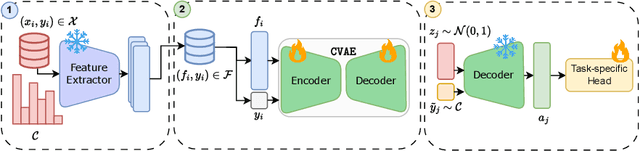
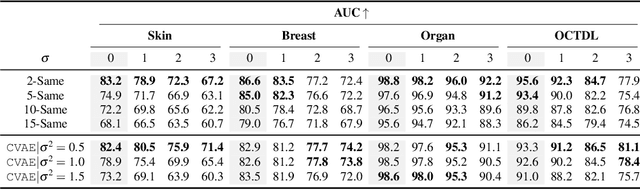
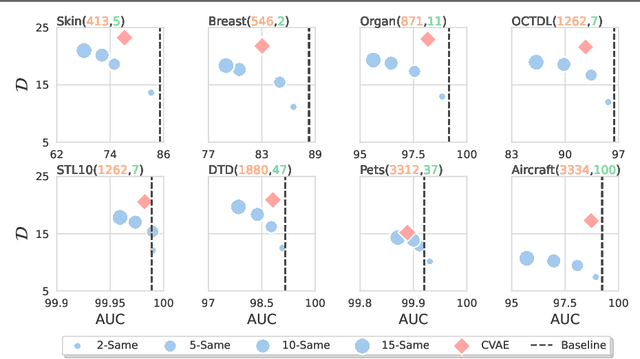
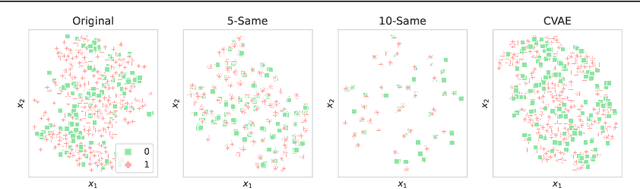
Large and well-annotated datasets are essential for advancing deep learning applications, however often costly or impossible to obtain by a single entity. In many areas, including the medical domain, approaches relying on data sharing have become critical to address those challenges. While effective in increasing dataset size and diversity, data sharing raises significant privacy concerns. Commonly employed anonymization methods based on the k-anonymity paradigm often fail to preserve data diversity, affecting model robustness. This work introduces a novel approach using Conditional Variational Autoencoders (CVAEs) trained on feature vectors extracted from large pre-trained vision foundation models. Foundation models effectively detect and represent complex patterns across diverse domains, allowing the CVAE to faithfully capture the embedding space of a given data distribution to generate (sample) a diverse, privacy-respecting, and potentially unbounded set of synthetic feature vectors. Our method notably outperforms traditional approaches in both medical and natural image domains, exhibiting greater dataset diversity and higher robustness against perturbations while preserving sample privacy. These results underscore the potential of generative models to significantly impact deep learning applications in data-scarce and privacy-sensitive environments. The source code is available at https://github.com/francescodisalvo05/cvae-anonymization .
Self-supervised Vision Transformer are Scalable Generative Models for Domain Generalization
Jul 03, 2024Despite notable advancements, the integration of deep learning (DL) techniques into impactful clinical applications, particularly in the realm of digital histopathology, has been hindered by challenges associated with achieving robust generalization across diverse imaging domains and characteristics. Traditional mitigation strategies in this field such as data augmentation and stain color normalization have proven insufficient in addressing this limitation, necessitating the exploration of alternative methodologies. To this end, we propose a novel generative method for domain generalization in histopathology images. Our method employs a generative, self-supervised Vision Transformer to dynamically extract characteristics of image patches and seamlessly infuse them into the original images, thereby creating novel, synthetic images with diverse attributes. By enriching the dataset with such synthesized images, we aim to enhance its holistic nature, facilitating improved generalization of DL models to unseen domains. Extensive experiments conducted on two distinct histopathology datasets demonstrate the effectiveness of our proposed approach, outperforming the state of the art substantially, on the Camelyon17-wilds challenge dataset (+2%) and on a second epithelium-stroma dataset (+26%). Furthermore, we emphasize our method's ability to readily scale with increasingly available unlabeled data samples and more complex, higher parametric architectures. Source code is available at https://github.com/sdoerrich97/vits-are-generative-models .