 Add to Chrome
 Add to Firefox
 Add to Edge
Influence of Depth Camera Noise Models on Respiration Estimation
Nov 15, 2024
Depth cameras are an interesting modality for capturing vital signs such as respiratory rate. Plenty approaches exist to extract vital signs in a controlled setting, but in order to apply them more flexibly for example in multi-camera settings, a simulated environment is needed to generate enough data for training and testing of new algorithms. We show first results of a 3D-rendering simulation pipeline that focuses on different noise models in order to generate realistic, depth-camera based respiratory signals using both synthetic and real respiratory signals as a baseline. While most noise can be accurately modelled as Gaussian in this context, we can show that as soon as the available image resolution is too low, the differences between different noise models surface.

mnmDTW: An extension to Dynamic Time Warping for Camera-based Movement Error Localization
Oct 13, 2023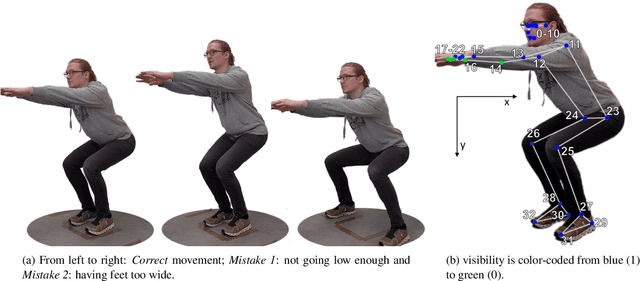
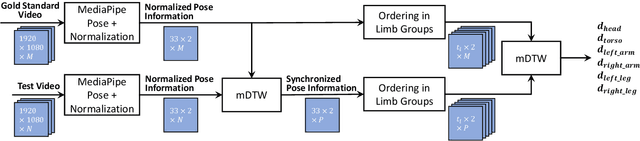
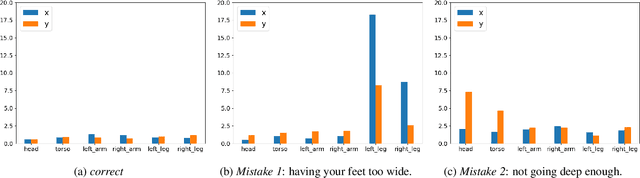
In this proof of concept, we use Computer Vision (CV) methods to extract pose information out of exercise videos. We then employ a modified version of Dynamic Time Warping (DTW) to calculate the deviation from a gold standard execution of the exercise. Specifically, we calculate the distance between each body part individually to get a more precise measure for exercise accuracy. We can show that exercise mistakes are clearly visible, identifiable and localizable through this metric.