 Add to Chrome
 Add to Firefox
 Add to Edge
Sequential Transfer Learning to Decode Heard and Imagined Timbre from fMRI Data
May 22, 2023
We present a sequential transfer learning framework for transformers on functional Magnetic Resonance Imaging (fMRI) data and demonstrate its significant benefits for decoding musical timbre. In the first of two phases, we pre-train our stacked-encoder transformer architecture on Next Thought Prediction, a self-supervised task of predicting whether or not one sequence of fMRI data follows another. This phase imparts a general understanding of the temporal and spatial dynamics of neural activity, and can be applied to any fMRI dataset. In the second phase, we fine-tune the pre-trained models and train additional fresh models on the supervised task of predicting whether or not two sequences of fMRI data were recorded while listening to the same musical timbre. The fine-tuned models achieve significantly higher accuracy with shorter training times than the fresh models, demonstrating the efficacy of our framework for facilitating transfer learning on fMRI data. Additionally, our fine-tuning task achieves a level of classification granularity beyond standard methods. This work contributes to the growing literature on transformer architectures for sequential transfer learning on fMRI data, and provides evidence that our framework is an improvement over current methods for decoding timbre.

Self-Supervised Pretraining on Paired Sequences of fMRI Data for Transfer Learning to Brain Decoding Tasks
May 15, 2023In this work we introduce a self-supervised pretraining framework for transformers on functional Magnetic Resonance Imaging (fMRI) data. First, we pretrain our architecture on two self-supervised tasks simultaneously to teach the model a general understanding of the temporal and spatial dynamics of human auditory cortex during music listening. Our pretraining results are the first to suggest a synergistic effect of multitask training on fMRI data. Second, we finetune the pretrained models and train additional fresh models on a supervised fMRI classification task. We observe significantly improved accuracy on held-out runs with the finetuned models, which demonstrates the ability of our pretraining tasks to facilitate transfer learning. This work contributes to the growing body of literature on transformer architectures for pretraining and transfer learning with fMRI data, and serves as a proof of concept for our pretraining tasks and multitask pretraining on fMRI data.
Sentence Level Curriculum Learning for Improved Neural Conversational Models
May 15, 2023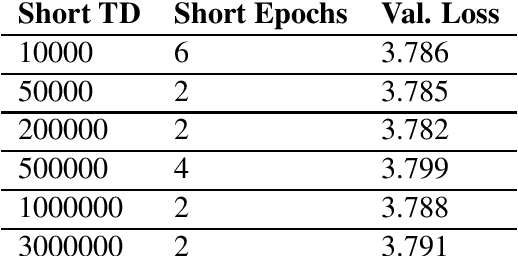
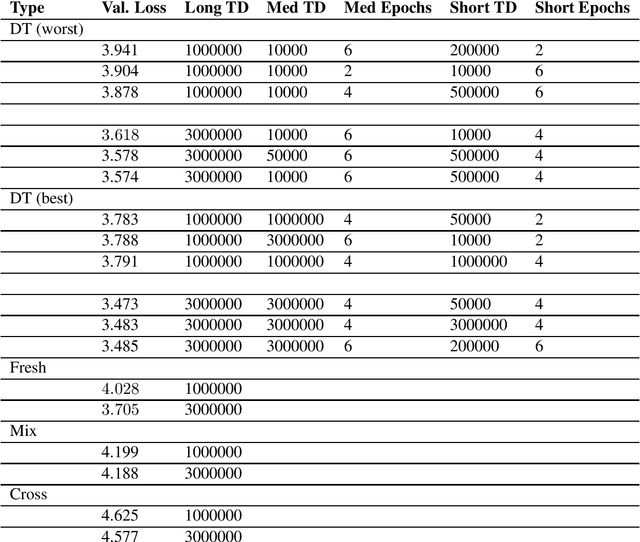
Designing machine intelligence to converse with a human user necessarily requires an understanding of how humans participate in conversation, and thus conversation modeling is an important task in natural language processing. New breakthroughs in architecture and data gathering continue to push the performance of such conversational AI models. However, designs neglect the gradual buildup in sentence structure and complexity experienced by humans as we learn to communicate. During training, our model accepts one or more sentences as input and attempts to predict the next sentence in the conversation one word at a time, so our goal is to separate training into segments, with each segment's corpus comprised of longer sentence pairs than the previous one. This will mimic the desired "buildup" component of human learning. We begin with only "short" length sentence pairs, then only "medium" length pairs, and so on. A majority of our experiments were toward optimizing this technique, ensuring a proper representation of the technique's potential, since many of the details were new questions. Our segment-trained models were then able to achieve lower validation loss at the end of training than models trained with standard text preparation. This segmented training is straightforward to implement and our results provide a general direction for future research to implement and improve it.