 Add to Chrome
 Add to Firefox
 Add to Edge
SP$^3$: Spherical Priors for Plug-and-Play Restoration
Jun 15, 2026
In this paper, we introduce SP$^3$, a novel Plug-and-Play algorithm that accelerates maximum a posteriori image restoration by replacing denoisers with Spherical Encoders (SE) as generative priors. SP$^3$ approximates the intractable proximal prior step by utilizing the SE tightly structured latent space as a robust projection onto the natural image manifold. Alternating this projection with a closed-form data-consistency step, via Half-Quadratic Splitting, achieves stable convergence without requiring gradient computation during inference. This unique formulation unlocks "anytime" restoration capabilities, producing sharp, plausible images from the first iteration. Evaluations across a variety of image restoration tasks demonstrate that SP$^3$ achieves perceptual quality comparable to state-of-the-art zero-shot diffusion and flow methods while being $3$-$630\times$ faster.

DODO: Discrete OCR Diffusion Models
Feb 18, 2026Optical Character Recognition (OCR) is a fundamental task for digitizing information, serving as a critical bridge between visual data and textual understanding. While modern Vision-Language Models (VLM) have achieved high accuracy in this domain, they predominantly rely on autoregressive decoding, which becomes computationally expensive and slow for long documents as it requires a sequential forward pass for every generated token. We identify a key opportunity to overcome this bottleneck: unlike open-ended generation, OCR is a highly deterministic task where the visual input strictly dictates a unique output sequence, theoretically enabling efficient, parallel decoding via diffusion models. However, we show that existing masked diffusion models fail to harness this potential; those introduce structural instabilities that are benign in flexible tasks, like captioning, but catastrophic for the rigid, exact-match requirements of OCR. To bridge this gap, we introduce DODO, the first VLM to utilize block discrete diffusion and unlock its speedup potential for OCR. By decomposing generation into blocks, DODO mitigates the synchronization errors of global diffusion. Empirically, our method achieves near state-of-the-art accuracy while enabling up to 3x faster inference compared to autoregressive baselines.
Proxies for Distortion and Consistency with Applications for Real-World Image Restoration
Jan 21, 2025Real-world image restoration deals with the recovery of images suffering from an unknown degradation. This task is typically addressed while being given only degraded images, without their corresponding ground-truth versions. In this hard setting, designing and evaluating restoration algorithms becomes highly challenging. This paper offers a suite of tools that can serve both the design and assessment of real-world image restoration algorithms. Our work starts by proposing a trained model that predicts the chain of degradations a given real-world measured input has gone through. We show how this estimator can be used to approximate the consistency -- the match between the measurements and any proposed recovered image. We also use this estimator as a guiding force for the design of a simple and highly-effective plug-and-play real-world image restoration algorithm, leveraging a pre-trained diffusion-based image prior. Furthermore, this work proposes no-reference proxy measures of MSE and LPIPS, which, without access to the ground-truth images, allow ranking of real-world image restoration algorithms according to their (approximate) MSE and LPIPS. The proposed suite provides a versatile, first of its kind framework for evaluating and comparing blind image restoration algorithms in real-world scenarios.
SILO: Solving Inverse Problems with Latent Operators
Jan 20, 2025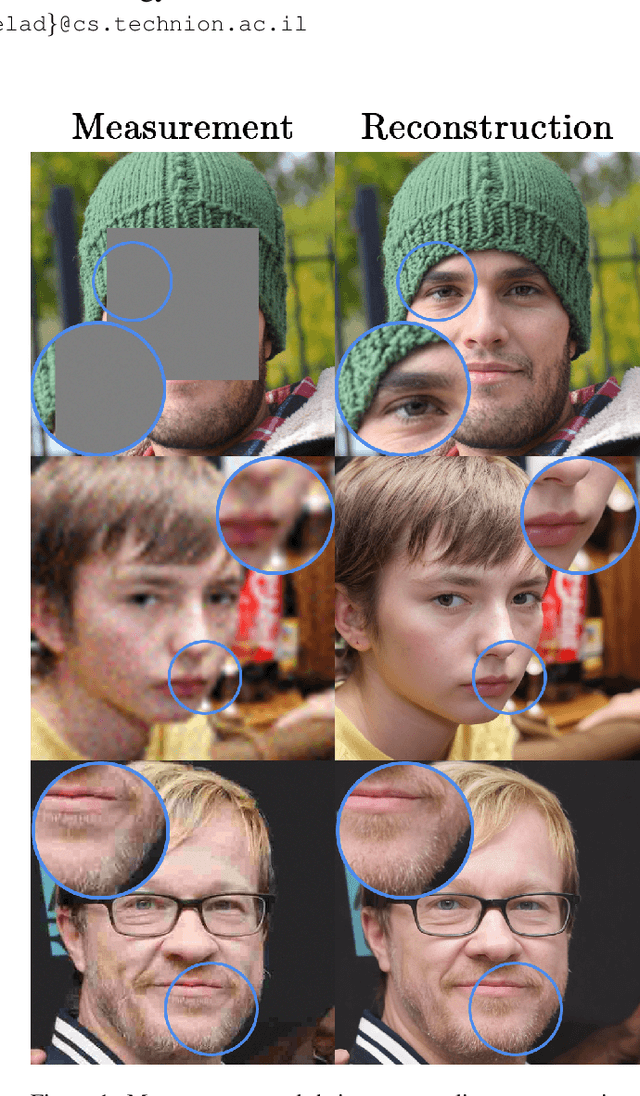
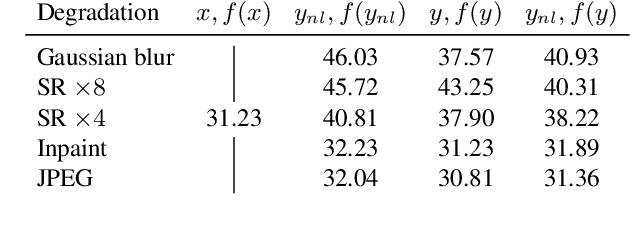
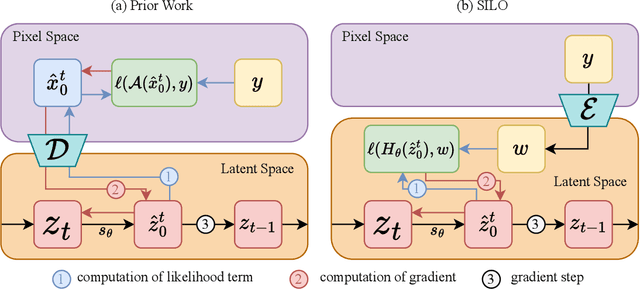
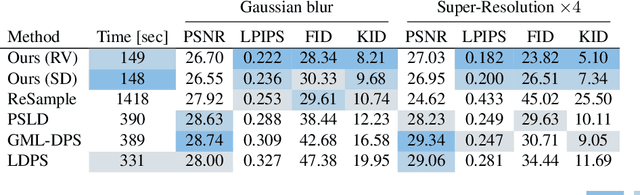
Consistent improvement of image priors over the years has led to the development of better inverse problem solvers. Diffusion models are the newcomers to this arena, posing the strongest known prior to date. Recently, such models operating in a latent space have become increasingly predominant due to their efficiency. In recent works, these models have been applied to solve inverse problems. Working in the latent space typically requires multiple applications of an Autoencoder during the restoration process, which leads to both computational and restoration quality challenges. In this work, we propose a new approach for handling inverse problems with latent diffusion models, where a learned degradation function operates within the latent space, emulating a known image space degradation. Usage of the learned operator reduces the dependency on the Autoencoder to only the initial and final steps of the restoration process, facilitating faster sampling and superior restoration quality. We demonstrate the effectiveness of our method on a variety of image restoration tasks and datasets, achieving significant improvements over prior art.
High-Perceptual Quality JPEG Decoding via Posterior Sampling
Nov 21, 2022
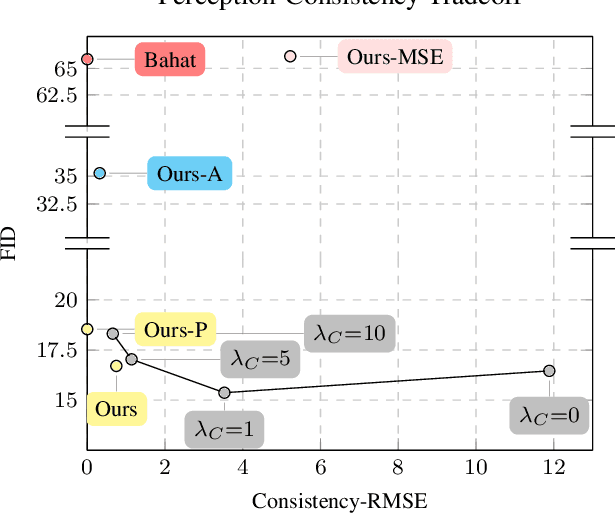
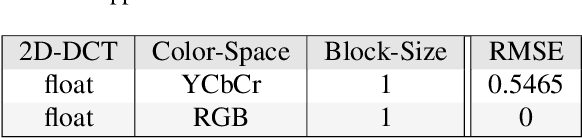
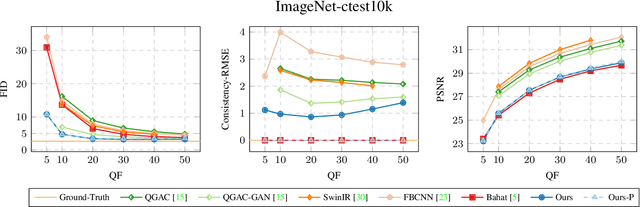
JPEG is arguably the most popular image coding format, achieving high compression ratios via lossy quantization that may create visual artifacts degradation. Numerous attempts to remove these artifacts were conceived over the years, and common to most of these is the use of deterministic post-processing algorithms that optimize some distortion measure (e.g., PSNR, SSIM). In this paper we propose a different paradigm for JPEG artifact correction: Our method is stochastic, and the objective we target is high perceptual quality -- striving to obtain sharp, detailed and visually pleasing reconstructed images, while being consistent with the compressed input. These goals are achieved by training a stochastic conditional generator (conditioned on the compressed input), accompanied by a theoretically well-founded loss term, resulting in a sampler from the posterior distribution. Our solution offers a diverse set of plausible and fast reconstructions for a given input with perfect consistency. We demonstrate our scheme's unique properties and its superiority to a variety of alternative methods on the FFHQ and ImageNet datasets.