 Add to Chrome
 Add to Firefox
 Add to Edge
CubeSounder: Low SWaP-C 180 GHz Radiometer for Atmospheric Sensing Tested on High Altitude Balloons
Feb 26, 2026
Microwave sounding is the leading driver of global numerical weather forecasting, but is limited by the scalability of such instruments. With modern machining and commercial microwave components, it is now possible to design low size, weight, power, and cost (SWaP-C) microwave spectrometers while maintaining wide bandwidth performance. Here we report on the status of CubeSounder, a spectrometer tailored for water vapor radiometry that utilizes passive wave guide filter banks. After developing a prototype and high altitude balloon payload, we demonstrated CubeSounder on commercial stratospheric balloon flights. We report on our design process, especially the simulation and fabrication of the custom millimeter-wave filter banks. We also report the initial results of the data collected from the balloon flights.

Robust Joint Estimation of Galaxy Redshift and Spectral Templates using Online Dictionary Learning
Nov 24, 2023
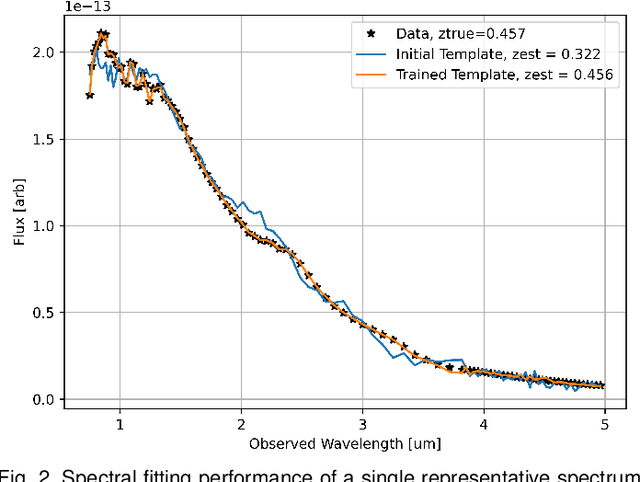


We present a novel approach to analyzing astronomical spectral survey data using our non-linear extension of an online dictionary learning algorithm. Current and upcoming surveys such as SPHEREx will use spectral data to build a 3D map of the universe by estimating the redshifts of millions of galaxies. Existing algorithms rely on hand-curated external templates and have limited performance due to model mismatch error. Our algorithm addresses this limitation by jointly estimating both the underlying spectral features in common across the entire dataset, as well as the redshift of each galaxy. Our online approach scales well to large datasets since we only process a single spectrum in memory at a time. Our algorithm performs better than a state-of-the-art existing algorithm when analyzing a mock SPHEREx dataset, achieving a NMAD standard deviation of 0.18% and a catastrophic error rate of 0.40% when analyzing noiseless data. Our algorithm also performs well over a wide range of signal to noise ratios (SNR), delivering sub-percent NMAD and catastrophic error above median SNR of 20. We released our algorithm publicly at github.com/HyperspectralDictionaryLearning/BryanEtAl2023 .