 Add to Chrome
 Add to Firefox
 Add to Edge
Improving Richardson--Lucy Deconvolution with Diffusion Priors for Fluorescence Microscopy
Jun 24, 2026
Richardson--Lucy (RL) deconvolution improves fluorescence microscopy images by recovering details lost to diffraction. It estimates the original fluorescence signal that most likely produced the measured photon counts under a Poisson imaging model. Although RL incorporates a physical model of fluorescence image formation and can improve contrast, deconvolution remains fundamentally ill-posed, and the measurements alone provide limited evidence for reliably reconstructing fine biological structure. Without additional structural guidance, RL can amplify noise and exhibit unstable convergence in low-photon regimes. Regularizers such as total variation (TV) reduce this instability but often introduce oversmoothing. Here, we investigate learned generative priors as a form of structural guidance for RL by integrating a score-based diffusion prior into a decoupled inverse-problem framework for fluorescence microscopy deconvolution. The diffusion prior is used during the RL optimization iterations, while RL retains Poisson data consistency. We validate the framework across diverse biological samples and cellular morphologies. The results show reduced RL noise amplification with improved preservation of weak filamentous and punctate structures under low photon counts.

Machine learning for faster and smarter fluorescence lifetime imaging microscopy
Aug 05, 2020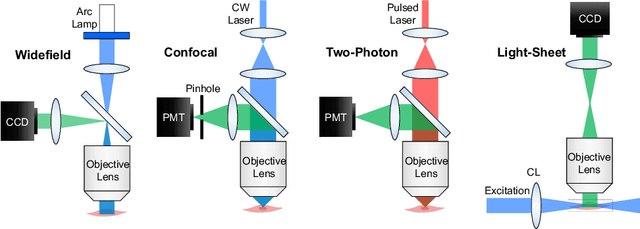
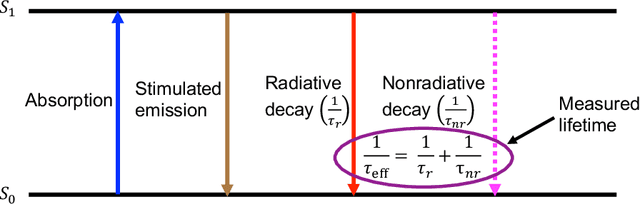
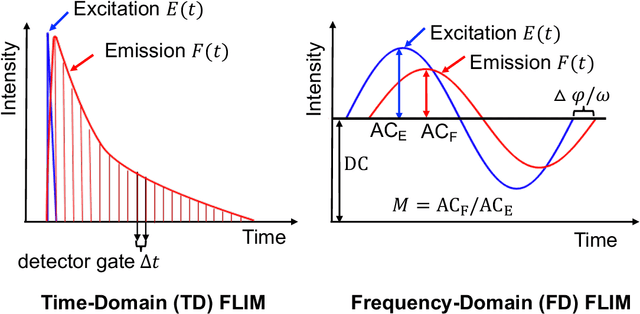
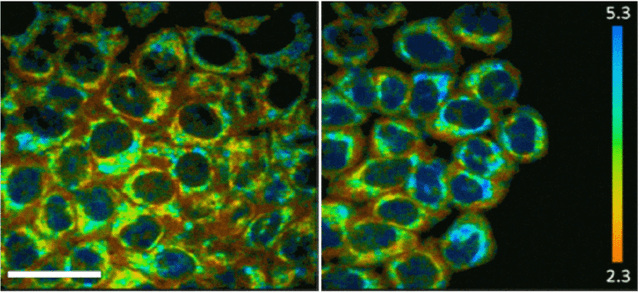
Fluorescence lifetime imaging microscopy (FLIM) is a powerful technique in biomedical research that uses the fluorophore decay rate to provide additional contrast in fluorescence microscopy. However, at present, the calculation, analysis, and interpretation of FLIM is a complex, slow, and computationally expensive process. Machine learning (ML) techniques are well suited to extract and interpret measurements from multi-dimensional FLIM data sets with substantial improvement in speed over conventional methods. In this topical review, we first discuss the basics of FILM and ML. Second, we provide a summary of lifetime extraction strategies using ML and its applications in classifying and segmenting FILM images with higher accuracy compared to conventional methods. Finally, we discuss two potential directions to improve FLIM with ML with proof of concept demonstrations.