 Add to Chrome
 Add to Firefox
 Add to Edge
Fast, accurate, and differentiable: a neural-network surrogate for NRSur7dq4 precessing binary black hole waveforms
Jul 27, 2026
We present a neural network surrogate model that emulates the NRSur7dq4 gravitational waveform model for precessing binary black hole mergers. The surrogate decomposes the waveform into constituent quantities and trains an independent multilayer perceptron (MLP) for each. We validate the surrogate against NRSur7dq4 on 10,000 waveforms spanning its full parameter space ($1 \leq q \leq 4$, $|χ_{A,B}| \leq 0.8$). For representative total masses between 60 and 300 $M_\odot$, median sky-averaged frequency-domain mismatches range from $8.0 \times 10^{-5}$ to $1.7 \times 10^{-4}$, with 95th percentiles below $10^{-3}$. On an NVIDIA L40S GPU the JAX surrogate evaluates a single waveform in about 1 ms end-to-end, roughly 10 times faster than the LALSimulation C implementation of NRSur7dq4, and sustains about 140 times the LALSimulation throughput at batch size 64, making it well suited for both low-latency parameter-estimation samplers and large-scale waveform generation. The full NRSur7dq4 NN waveform-to-likelihood pipeline is implemented in JAX and is differentiable. This is the first neural-network surrogate of a precessing numerical-relativity waveform model to combine validated NR-faithful accuracy with a fully differentiable, GPU-accelerated inference pipeline, enabling gradient-based inference approaches via automatic differentiation including Fisher information matrices, GPU-accelerated nested sampling, gradient-based MCMC and importance sampling.

Orbital dynamics of binary black hole systems can be learned from gravitational wave measurements
Feb 25, 2021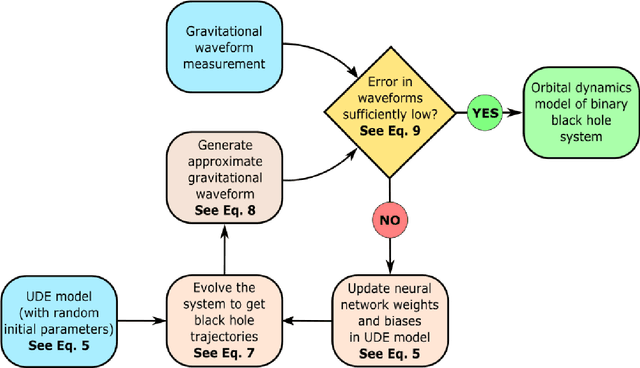
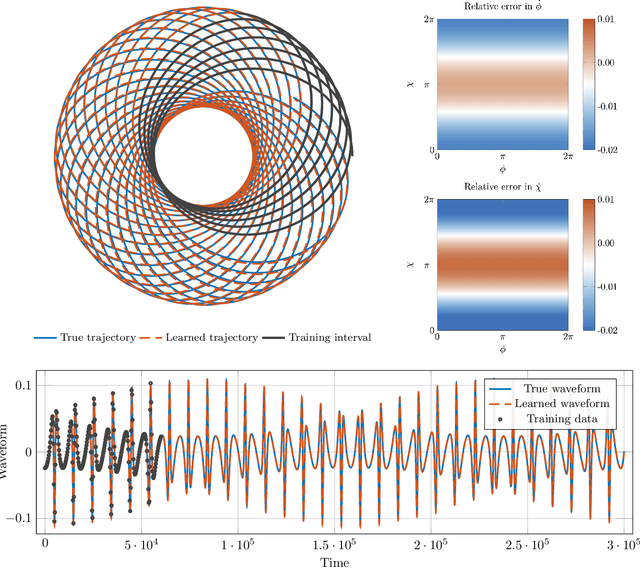
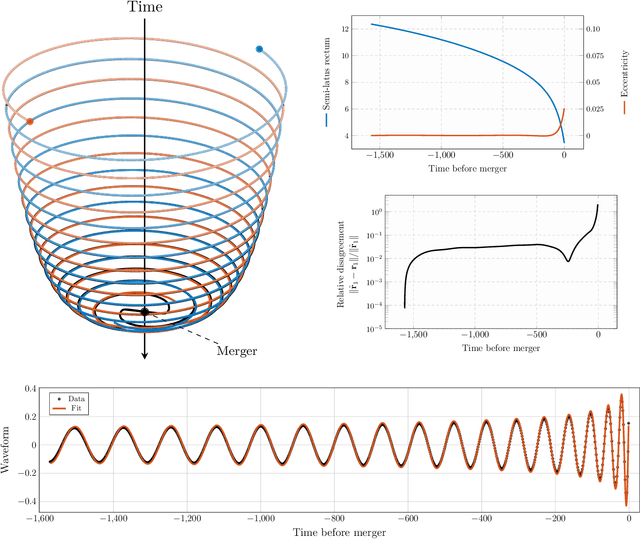
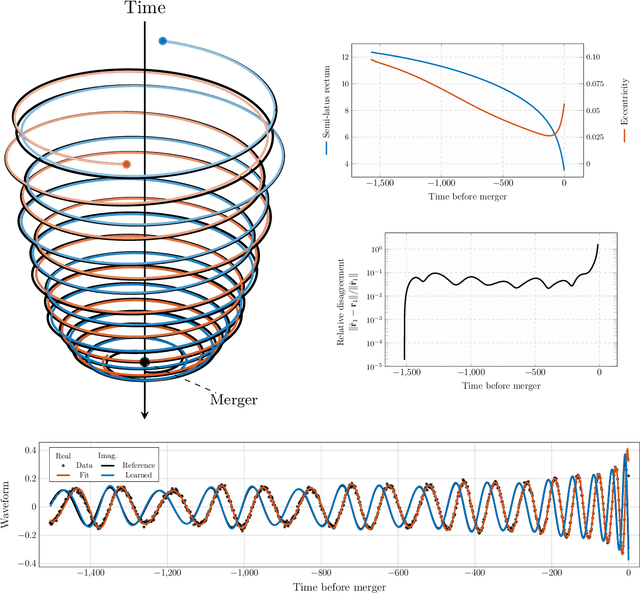
We introduce a gravitational waveform inversion strategy that discovers mechanical models of binary black hole (BBH) systems. We show that only a single time series of (possibly noisy) waveform data is necessary to construct the equations of motion for a BBH system. Starting with a class of universal differential equations parameterized by feed-forward neural networks, our strategy involves the construction of a space of plausible mechanical models and a physics-informed constrained optimization within that space to minimize the waveform error. We apply our method to various BBH systems including extreme and comparable mass ratio systems in eccentric and non-eccentric orbits. We show the resulting differential equations apply to time durations longer than the training interval, and relativistic effects, such as perihelion precession, radiation reaction, and orbital plunge, are automatically accounted for. The methods outlined here provide a new, data-driven approach to studying the dynamics of binary black hole systems.
Genetic-algorithm-optimized neural networks for gravitational wave classification
Oct 09, 2020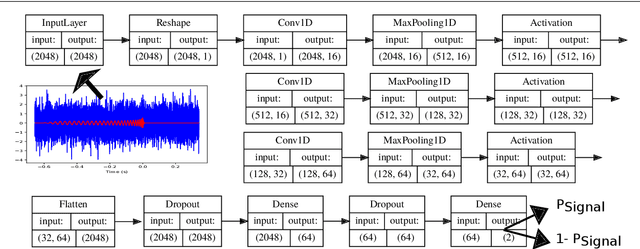
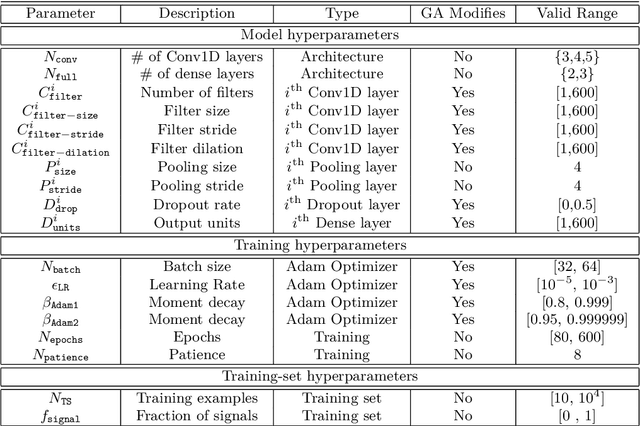
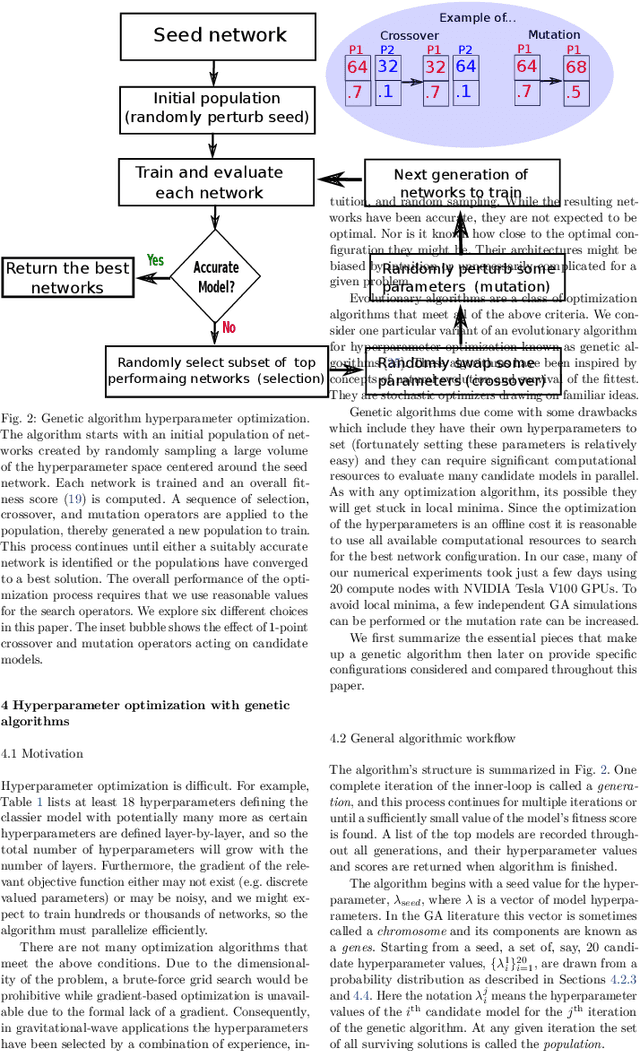
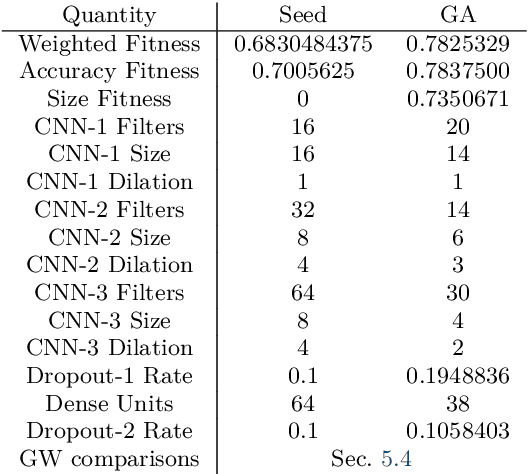
Gravitational-wave detection strategies are based on a signal analysis technique known as matched filtering. Matched filtering is known to be optimal under certain conditions, yet in practice, these conditions are only approximately satisfied while the algorithm is computationally expensive. Despite the success of matched filtering for signal detection, due to these limitations, there has been recent interest in developing deep convolutional neural networks (CNNs) for signal detection. Designing these networks remains a challenge as most procedures adopt a trial and error strategy to set the hyperparameter values. We propose and develop a new method for hyperparameter optimization based on genetic algorithms (GAs). We compare six different GA variants and explore different choices for the GA-optimized fitness score. We show that the GA can discover high-quality architectures when the initial hyperparameter seed values are far from a good solution as well as refining already good networks. For example, when starting from the architecture proposed by George and Huerta, the network optimized over the 20-dimensional hyperparameter space has 78% fewer trainable parameters while obtaining an 11% increase in accuracy for our test problem. Using genetic algorithm optimization to refine an existing network should be especially useful if the problem context (e.g. statistical properties of the noise, signal model, etc) changes and one needs to rebuild a network. In all of our experiments, we find the GA discovers significantly less complicated networks as compared to the seed network, suggesting it can be used to prune wasteful network structures. While we have restricted our attention to CNN classifiers, GA hyperparameter optimization can be applied within other machine learning settings, including alternative architectures for signal classification, parameter inference, or other tasks.