 Add to Chrome
 Add to Firefox
 Add to Edge
Attacking the First-Principle: A Black-Box, Query-Free Targeted Mimicry Attack on Binary Function Classifiers
May 18, 2026
Binary function classifiers play a crucial role in maintaining the security and integrity of software systems by detecting malicious code and unauthorized modifications. However, machine learning-based classifiers are vulnerable to adversarial attacks that can evade detection. In this study, we present Kelpie, a novel framework for executing mimicry attacks, a stronger type of targeted evasion attacks, on binary function classifiers in a black-box, zero-query setting. Unlike previous approaches that rely on querying the target classifier to refine untargeted evasion attacks, Kelpie leverages code transformations that preserve the functionality of malicious payloads while causing them to be misclassified as we want. Through extensive experimentation, we demonstrate that Kelpie can successfully execute mimicry attacks against six state-of-the-art binary function classifiers representing different model architectures without requiring direct interaction with them. We further validate our approach with a practical demonstration, involving a keylogger and a wiper concealed within benign-looking functions embedded in an application. This work, to our best knowledge, is the first to demonstrate such a mimicry attack in a black-box, zero-query context, raising important questions about the reliability and security of existing machine learning-based binary function classifiers.

Impeding LLM-assisted Cheating in Introductory Programming Assignments via Adversarial Perturbation
Oct 15, 2024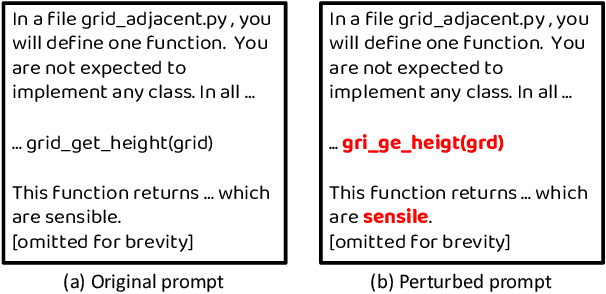
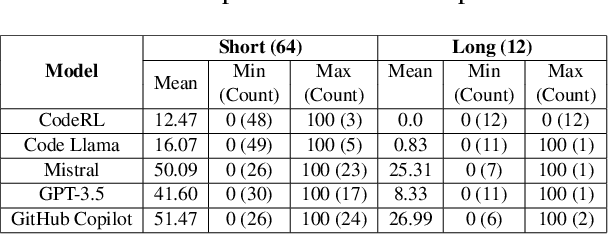
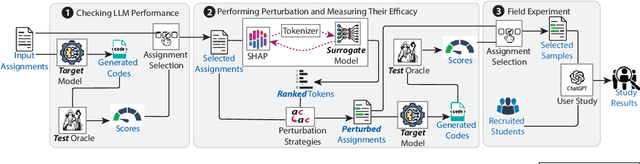
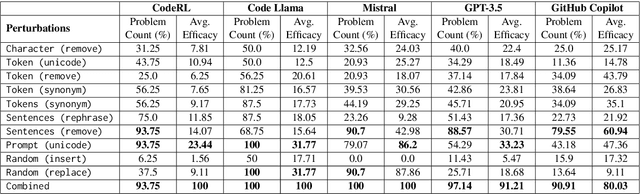
While Large language model (LLM)-based programming assistants such as CoPilot and ChatGPT can help improve the productivity of professional software developers, they can also facilitate cheating in introductory computer programming courses. Assuming instructors have limited control over the industrial-strength models, this paper investigates the baseline performance of 5 widely used LLMs on a collection of introductory programming problems, examines adversarial perturbations to degrade their performance, and describes the results of a user study aimed at understanding the efficacy of such perturbations in hindering actual code generation for introductory programming assignments. The user study suggests that i) perturbations combinedly reduced the average correctness score by 77%, ii) the drop in correctness caused by these perturbations was affected based on their detectability.