 Add to Chrome
 Add to Firefox
 Add to Edge
Federated Learning for Multivariate Time Series Anomaly Detection in Industrial Automation
May 26, 2026
Federated learning (FL) has broadened the horizon for multivariate time series anomaly detection (MTSAD). However, benchmarking such anomaly detection methods within FL paradigm poses data-centric challenges. The existing datasets do not counteract these challenges since they do not simultaneously provide sufficient scale, accurate labels, and freedom from common flaws. In addition, the role of cyclic process behavior, which is common in discrete industrial automation, remains underexplored for MTSAD for the current state of research. This paper aims to shed more light on the literature and address these gaps by introducing a dataset designed with cyclic dynamics arising from the repetitive nature of discrete automation processes and evaluates selected MTSAD methods on both the proposed dataset and a public benchmark dataset.

Generative Modeling of Approximately Periodic Time Series by a Posterior-Weighted Gaussian Process
May 13, 2026Discrete automated processes in industrial and cyber-physical systems often exhibit a repetitive structure in which successive repetitions follow a common trajectory while differing in duration, amplitude, and fine-scale dynamics. Such \emph{approximately periodic} behavior poses a challenge for Gaussian Processes (GP) modeling: strictly periodic models suppress inter-repetition variability, while non-periodic models fail to capture the strong structural regularities required for generation. In this work, we propose a stochastic generative model for approximately periodic time series. The model is based on a GP whose posterior is modulated by a novel kernel. Our approach decouples intra-repetition structure from inter-repetition variability through a two-stage construction which yields a generative distribution with a identical mean function across repetitions, while allowing smooth variation between repetitions. The modeling choices are supported by an implementation in which realistic synthetic trajectories are generated from toy datasets.
Topology-driven identification of repetitions in multi-variate time series
May 15, 2025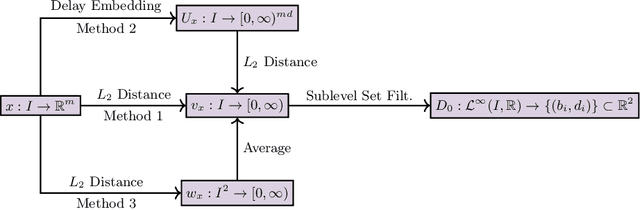
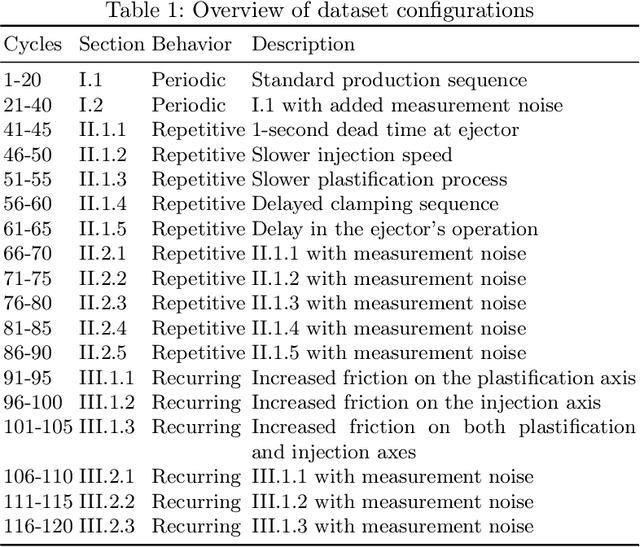
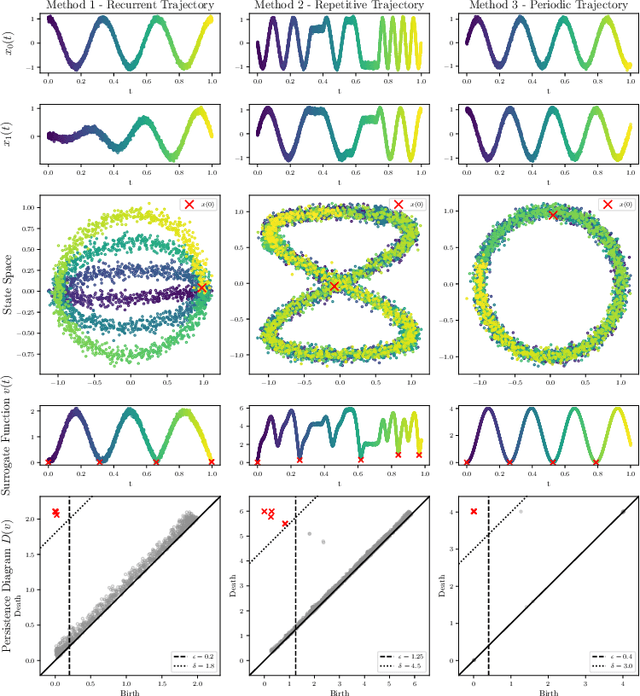
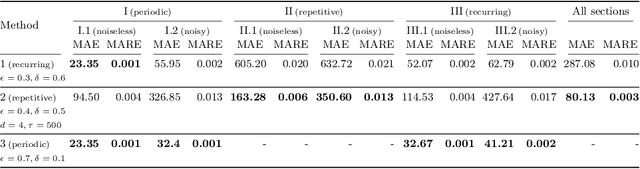
Many multi-variate time series obtained in the natural sciences and engineering possess a repetitive behavior, as for instance state-space trajectories of industrial machines in discrete automation. Recovering the times of recurrence from such a multi-variate time series is of a fundamental importance for many monitoring and control tasks. For a periodic time series this is equivalent to determining its period length. In this work we present a persistent homology framework to estimate recurrence times in multi-variate time series with different generalizations of cyclic behavior (periodic, repetitive, and recurring). To this end, we provide three specialized methods within our framework that are provably stable and validate them using real-world data, including a new benchmark dataset from an injection molding machine.
Persistence-based Hough Transform for Line Detection
Apr 18, 2025The Hough transform is a popular and classical technique in computer vision for the detection of lines (or more general objects). It maps a pixel into a dual space -- the Hough space: each pixel is mapped to the set of lines through this pixel, which forms a curve in Hough space. The detection of lines then becomes a voting process to find those lines that received many votes by pixels. However, this voting is done by thresholding, which is susceptible to noise and other artifacts. In this work, we present an alternative voting technique to detect peaks in the Hough space based on persistent homology, which very naturally addresses limitations of simple thresholding. Experiments on synthetic data show that our method significantly outperforms the original method, while also demonstrating enhanced robustness. This work seeks to inspire future research in two key directions. First, we highlight the untapped potential of Topological Data Analysis techniques and advocate for their broader integration into existing methods, including well-established ones. Secondly, we initiate a discussion on the mathematical stability of the Hough transform, encouraging exploration of mathematically grounded improvements to enhance its robustness.