 Add to Chrome
 Add to Firefox
 Add to Edge
ARMA-C3: A Contrastive ARMA Convolutional Framework for Unsupervised and Semi-supervised Classification
May 25, 2026
In biomedical and neurodegenerative disorders, accurate and early disease identification remains challenging due to the scarcity of labeled data and the complexity of imaging patterns. To address these challenges, we introduce ARMA-C3, a unified unsupervised and semi-supervised graph learning framework for node classification based on contrastive learning and graph-cut regularization to learn structurally meaningful and discriminative representations. By modeling samples or images as graph nodes and exploiting inter-sample relationships, the proposed framework captures subject-level dependencies that conventional machine learning methods typically overlook. We conduct extensive binary classification experiments across five clinically relevant datasets: the Alzheimer's Disease Neuroimaging Initiative (ADNI), the Neuroimaging in Frontotemporal Dementia (NIFD) dataset, and three medical imaging benchmarks (BreastMNIST, PneumoniaMNIST, and a liver ultrasound dataset). Experimental results demonstrate that ARMA-C3 achieves competitive and frequently superior performance compared to classical clustering techniques, state-of-the-art machine learning models, and existing graph-based deep learning approaches across multiple evaluation settings, particularly under limited supervision and severe class imbalance. The proposed framework further demonstrates robust representation learning and strong cross-modal generalization across diverse biomedical imaging modalities.

SpineContextResUNet: A Computationally Efficient Residual UNet for Spine CT Segmentation
May 20, 2026Automated segmentation of the vertebral column in Computed Tomography (CT) scans is a prerequisite for pathological assessment and surgical planning. However, state-of-the-art methods, particularly those based on Transformers or large-scale ensembles, demand substantial GPU resources, creating a barrier for clinical adoption in resource-constrained environments or on edge devices. To address this, we introduce SpineContextResUNet, a computationally efficient 3D Residual U-Net designed for rapid spinal localization. Our architecture integrates a lightweight Context Block that employs parallel multi-dilated convolutions to capture long-range anatomical dependencies without the high latency of Recurrent Neural Networks (RNNs) or the memory overhead of Self-Attention mechanisms. Extensive validation on two public benchmarks, VerSe2020 and CTSpine1K, demonstrates that our model achieves a Dice score of 88.17% and 88.13% respectively. To evaluate performance under strict hardware constraints, we compared our model against a bottlenecked SwinUNETR scaled to match our ~1.7M hardware footprint. While the constrained Transformer suffers severe performance degradation due to a lack of spatial inductive biases in a limited-data regime, our CNN-based approach successfully maintains high accuracy. Crucially, heavy baselines like TotalSegmentator fail due to memory exhaustion on commodity hardware (Intel Core i5, 8GB RAM), our model performs robust inference, making it a viable solution for point-of-care diagnostics and deployment on edge platforms like the Nvidia Jetson Orin Nano.
ARMARecon: An ARMA Convolutional Filter based Graph Neural Network for Neurodegenerative Dementias Classification
Jan 17, 2026Early detection of neurodegenerative diseases such as Alzheimer's Disease (AD) and Frontotemporal Dementia (FTD) is essential for reducing the risk of progression to severe disease stages. As AD and FTD propagate along white-matter regions in a global, graph-dependent manner, graph-based neural networks are well suited to capture these patterns. Hence, we introduce ARMARecon, a unified graph learning framework that integrates Autoregressive Moving Average (ARMA) graph filtering with a reconstruction-driven objective to enhance feature representation and improve classification accuracy. ARMARecon effectively models both local and global connectivity by leveraging 20-bin Fractional Anisotropy (FA) histogram features extracted from white-matter regions, while mitigating over-smoothing. Overall, ARMARecon achieves superior performance compared to state-of-the-art methods on the multi-site dMRI datasets ADNI and NIFD.
UnSegMedGAT: Unsupervised Medical Image Segmentation using Graph Attention Networks Clustering
Nov 04, 2024
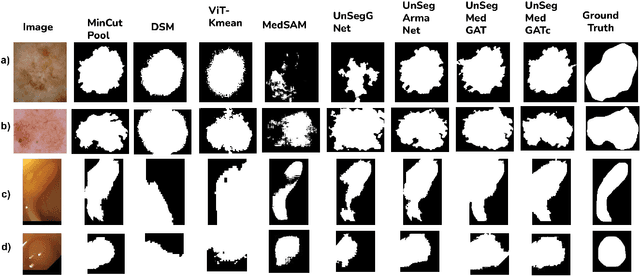
The data-intensive nature of supervised classification drives the interest of the researchers towards unsupervised approaches, especially for problems such as medical image segmentation, where labeled data is scarce. Building on the recent advancements of Vision transformers (ViT) in computer vision, we propose an unsupervised segmentation framework using a pre-trained Dino-ViT. In the proposed method, we leverage the inherent graph structure within the image to realize a significant performance gain for segmentation in medical images. For this, we introduce a modularity-based loss function coupled with a Graph Attention Network (GAT) to effectively capture the inherent graph topology within the image. Our method achieves state-of-the-art performance, even significantly surpassing or matching that of existing (semi)supervised technique such as MedSAM which is a Segment Anything Model in medical images. We demonstrate this using two challenging medical image datasets ISIC-2018 and CVC-ColonDB. This work underscores the potential of unsupervised approaches in advancing medical image analysis in scenarios where labeled data is scarce. The github repository of the code is available on [https://github.com/mudit-adityaja/UnSegMedGAT].
UnSeGArmaNet: Unsupervised Image Segmentation using Graph Neural Networks with Convolutional ARMA Filters
Oct 08, 2024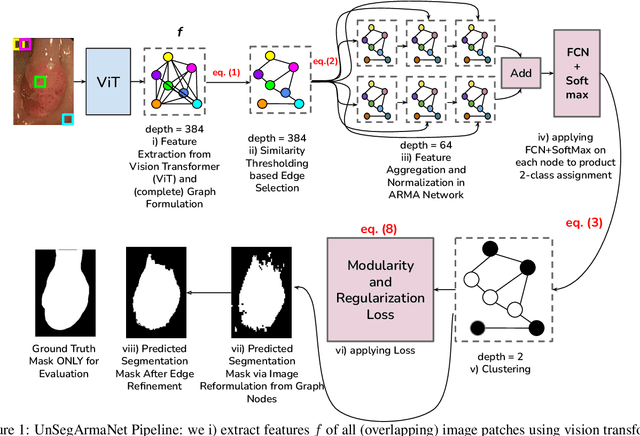

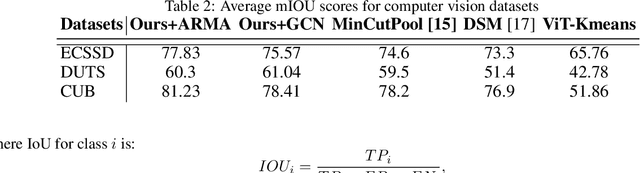
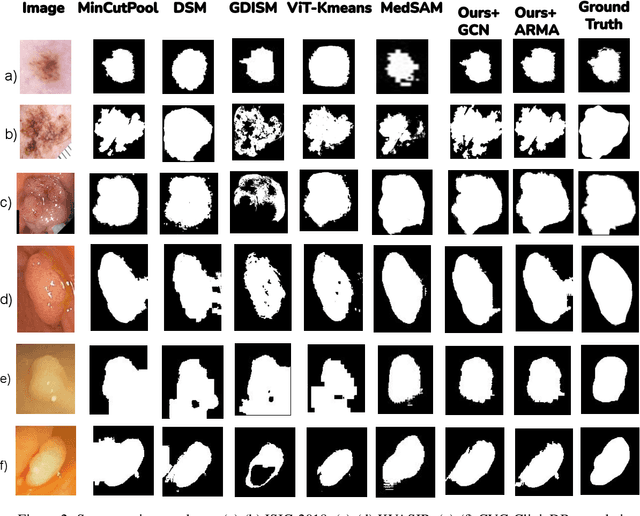
The data-hungry approach of supervised classification drives the interest of the researchers toward unsupervised approaches, especially for problems such as medical image segmentation, where labeled data are difficult to get. Motivated by the recent success of Vision transformers (ViT) in various computer vision tasks, we propose an unsupervised segmentation framework with a pre-trained ViT. Moreover, by harnessing the graph structure inherent within the image, the proposed method achieves a notable performance in segmentation, especially in medical images. We further introduce a modularity-based loss function coupled with an Auto-Regressive Moving Average (ARMA) filter to capture the inherent graph topology within the image. Finally, we observe that employing Scaled Exponential Linear Unit (SELU) and SILU (Swish) activation functions within the proposed Graph Neural Network (GNN) architecture enhances the performance of segmentation. The proposed method provides state-of-the-art performance (even comparable to supervised methods) on benchmark image segmentation datasets such as ECSSD, DUTS, and CUB, as well as challenging medical image segmentation datasets such as KVASIR, CVC-ClinicDB, ISIC-2018. The github repository of the code is available on \url{https://github.com/ksgr5566/UnSeGArmaNet}.
UnSegGNet: Unsupervised Image Segmentation using Graph Neural Networks
May 09, 2024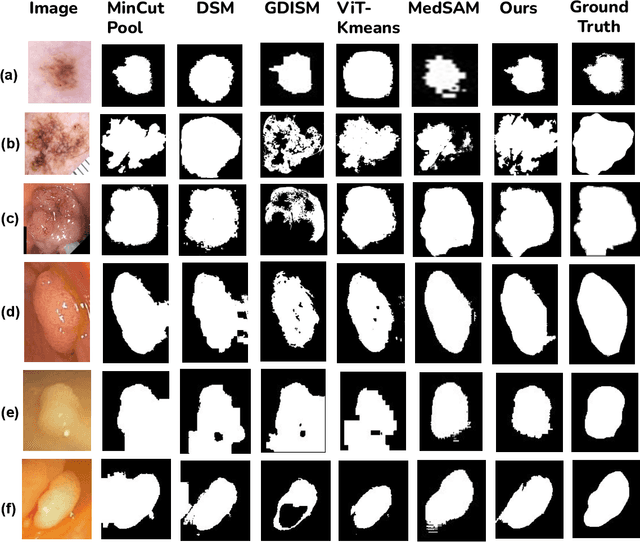


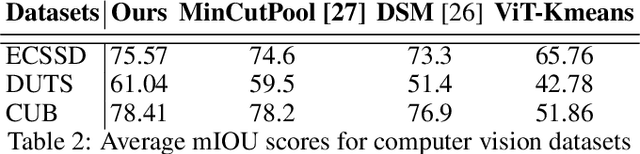
Image segmentation, the process of partitioning an image into meaningful regions, plays a pivotal role in computer vision and medical imaging applications. Unsupervised segmentation, particularly in the absence of labeled data, remains a challenging task due to the inter-class similarity and variations in intensity and resolution. In this study, we extract high-level features of the input image using pretrained vision transformer. Subsequently, the proposed method leverages the underlying graph structures of the images, seeking to discover and delineate meaningful boundaries using graph neural networks and modularity based optimization criteria without relying on pre-labeled training data. Experimental results on benchmark datasets demonstrate the effectiveness and versatility of the proposed approach, showcasing competitive performance compared to the state-of-the-art unsupervised segmentation methods. This research contributes to the broader field of unsupervised medical imaging and computer vision by presenting an innovative methodology for image segmentation that aligns with real-world challenges. The proposed method holds promise for diverse applications, including medical imaging, remote sensing, and object recognition, where labeled data may be scarce or unavailable. The github repository of the code is available on [https://github.com/ksgr5566/unseggnet]