 Add to Chrome
 Add to Firefox
 Add to Edge
GeMi: A Graph-based, Multimodal Recommendation System for Narrative Scroll Paintings
Mar 01, 2026
Recommendation Systems are effective in managing the ever-increasing amount of multimodal data available today and help users discover interesting new items. These systems can handle various media types such as images, text, audio, and video data, and this has made it possible to handle content-based recommendation utilizing features extracted from items while also incorporating user preferences. Graph Neural Network (GNN)-based recommendation systems are a special class of recommendation systems that can handle relationships between items and users, making them particularly attractive for content-based recommendations. Their popularity also stems from the fact that they use advanced machine learning techniques, such as deep learning on graph-structured data, to exploit user-to-item interactions. The nodes in the graph can access higher-order neighbor information along with state-of-the-art vision-language models for processing multimodal content, and there are well-designed algorithms for embedding, message passing, and propagation. In this work, we present the design of a GNN-based recommendation system on a novel data set collected from field research. Designed for an endangered performing art form, the recommendation system uses multimodal content (text and image data) to suggest similar paintings for viewing and purchase. To the best of our knowledge, there is no recommendation system designed for narrative scroll paintings -- our work therefore serves several purposes, including art conservation, a data storage system for endangered art objects, and a state-of-the-art recommendation system that leverages both the novel characteristics of the data and preferences of the user population interested in narrative scroll paintings.

Consensus Based Multi-Layer Perceptrons for Edge Computing
Feb 09, 2021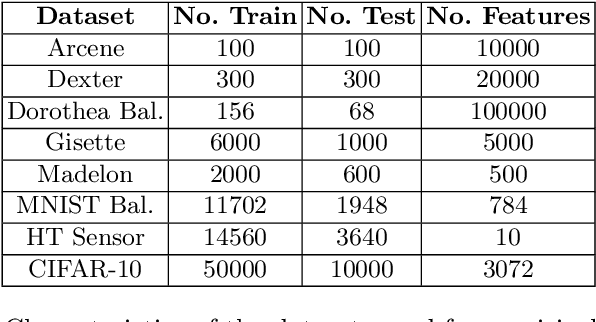
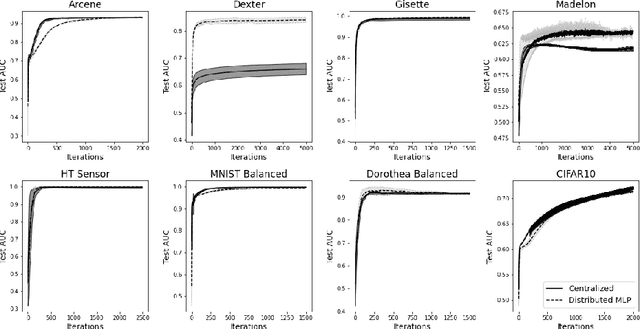
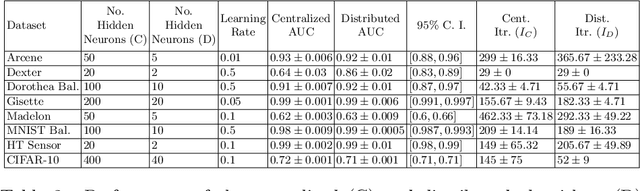
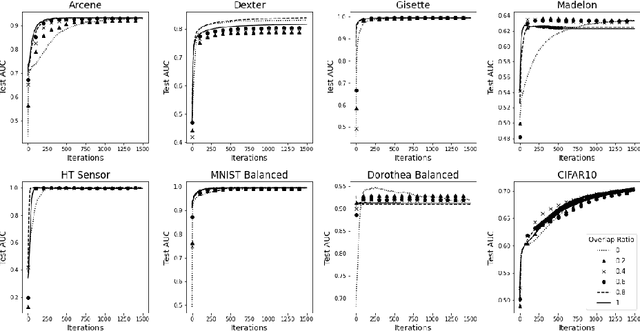
In recent years, storing large volumes of data on distributed devices has become commonplace. Applications involving sensors, for example, capture data in different modalities including image, video, audio, GPS and others. Novel algorithms are required to learn from this rich distributed data. In this paper, we present consensus based multi-layer perceptrons for resource-constrained devices. Assuming nodes (devices) in the distributed system are arranged in a graph and contain vertically partitioned data, the goal is to learn a global function that minimizes the loss. Each node learns a feed-forward multi-layer perceptron and obtains a loss on data stored locally. It then gossips with a neighbor, chosen uniformly at random, and exchanges information about the loss. The updated loss is used to run a back propagation algorithm and adjust weights appropriately. This method enables nodes to learn the global function without exchange of data in the network. Empirical results reveal that the consensus algorithm converges to the centralized model and has performance comparable to centralized multi-layer perceptrons and tree-based algorithms including random forests and gradient boosted decision trees.