 Add to Chrome
 Add to Firefox
 Add to Edge
Breaking the Compression Barrier: Cross-Architecture Compression Boundary Learning via Reverse Regrowth
Aug 17, 2026
Model compression is critical for deploying networks on resource-constrained edge devices. While pruning-based methods can significantly reduce model size, they often suffer from abrupt performance collapse beyond a sparsity thresh-old, making it difficult to identify the feasible compression limit of the model. To address this challenge, we propose a boundary-Learning reverse regrowth framework, BRIDGE, that reformulates compression as a constructive boundary-search problem. Unlike forward pruning, our method first drives the model to an extremely sparse state to expose the collapse region, and then selectively regenerates the critical structure to restore performance. The proposed framework employs a hierarchical regeneration strategy, including coarse-grained layer selection and fine-grained regeneration parameter selection, to accurately identify which parameters require recovery. Experiments show that our method can recover models from the brink of collapse on both CNNs and Transformer architectures, demonstrating its architecture in-dependence. BRIDGE achieves a performance improvement of up to 1.49% in unstructured pruning and up to 4.77% in structured pruning. These results demonstrate that reverse regeneration can effectively extend the compression limit while maintaining stable performance. The source code is available at https://github.com/EnumaCaliber/BRIDGE.

BAP-MOS: Bandit-Based Adaptive Prompting for Boundary-Sensitive Multi-Organ Segmentation
Aug 08, 2026Multi-organ ultrasound segmentation remains challenging when anatomically adjacent structures must be delineated jointly, as localized boundary errors can persist even when Dice scores are high. To address these challenges, we propose Boundary-Adaptive Prompting for Multi-Organ Segmentation (BAP-MOS), a closed-loop adaptive prompting framework. BAP-MOS formulates prompt selection as an organ-specific multi-armed bandit problem over box, point, and combined prompts. An outer Tree-structured Parzen Estimator (TPE) loop selects the prompt-selection parameter vector, while an inner UCB-Tuned loop adapts per-organ prompt preferences during fine-tuning using a bounded Dice--MSD--HD95 validation-probe reward. The framework further introduces an organ-scaled negative prompt ring to adapt sparse prompt geometry across anatomical scales, while keeping the image and prompt encoders frozen and updating only the mask decoder. We evaluate BAP-MOS on pooled prostate-region TRUS cohorts against U-Net, nnU-Net, MedSAM, fixed-prompt SAM/MedSAM, and adaptive policy variants. On this benchmark, BAP-MOS achieves Dice 0.982, HD95 0.482, and MSD 0.204, reducing HD95 by approximately 48% and MSD by 45% relative to the strongest conventional baseline. To verify the generalization ability of the framework, we tested it on the external PFUS1 pelvic-floor ultrasound corpus using MedSAM and its adaptive strategy variants, and the results were good. These results support adaptive prompt allocation as an effective mechanism for improving boundary-sensitive multi-organ ultrasound segmentation without modifying the foundation-model backbone. Source Code is available at: https://github.com/SatvikPraveen/BAP-MOS
Embodied Foundation Models at the Edge: A Survey of Deployment Constraints and Mitigation Strategies
Mar 19, 2026Deploying foundation models in embodied edge systems is fundamentally a systems problem, not just a problem of model compression. Real-time control must operate within strict size, weight, and power constraints, where memory traffic, compute latency, timing variability, and safety margins interact directly. The Deployment Gauntlet organizes these constraints into eight coupled barriers that determine whether embodied foundation models can run reliably in practice. Across representative edge workloads, autoregressive Vision-Language-Action policies are constrained primarily by memory bandwidth, whereas diffusion-based controllers are limited more by compute latency and sustained execution cost. Reliable deployment therefore depends on system-level co-design across memory, scheduling, communication, and model architecture, including decompositions that separate fast control from slower semantic reasoning.
CBAM-STN-TPS-YOLO: Enhancing Agricultural Object Detection through Spatially Adaptive Attention Mechanisms
Jun 09, 2025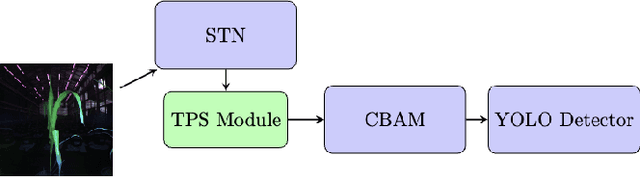
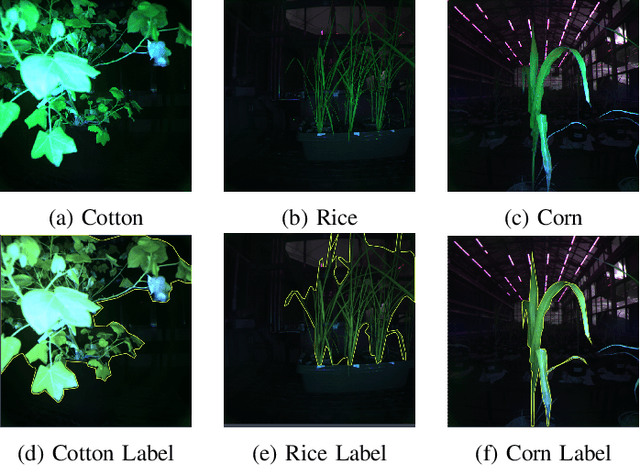
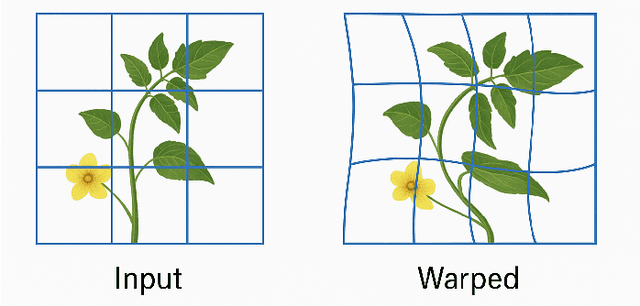
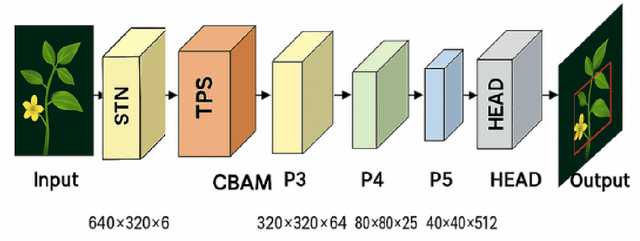
Object detection is vital in precision agriculture for plant monitoring, disease detection, and yield estimation. However, models like YOLO struggle with occlusions, irregular structures, and background noise, reducing detection accuracy. While Spatial Transformer Networks (STNs) improve spatial invariance through learned transformations, affine mappings are insufficient for non-rigid deformations such as bent leaves and overlaps. We propose CBAM-STN-TPS-YOLO, a model integrating Thin-Plate Splines (TPS) into STNs for flexible, non-rigid spatial transformations that better align features. Performance is further enhanced by the Convolutional Block Attention Module (CBAM), which suppresses background noise and emphasizes relevant spatial and channel-wise features. On the occlusion-heavy Plant Growth and Phenotyping (PGP) dataset, our model outperforms STN-YOLO in precision, recall, and mAP. It achieves a 12% reduction in false positives, highlighting the benefits of improved spatial flexibility and attention-guided refinement. We also examine the impact of the TPS regularization parameter in balancing transformation smoothness and detection performance. This lightweight model improves spatial awareness and supports real-time edge deployment, making it ideal for smart farming applications requiring accurate and efficient monitoring.