 Add to Chrome
 Add to Firefox
 Add to Edge
Revisiting Radar Perception With Spectral Point Clouds
Apr 09, 2026
Radar perception models are trained with different inputs, from range-Doppler spectra to sparse point clouds. Dense spectra are assumed to outperform sparse point clouds, yet they can vary considerably across sensors and configurations, which hinders transfer. In this paper, we provide alternatives for incorporating spectral information into radar point clouds and show that, point clouds need not underperform compared to spectra. We introduce the spectral point cloud paradigm, where point clouds are treated as sparse, compressed representations of the radar spectra, and argue that, when enriched with spectral information, they serve as strong candidates for a unified input representation that is more robust against sensor-specific differences. We develop an experimental framework that compares spectral point cloud (PC) models at varying densities against a dense range-Doppler (RD) benchmark, and report the density levels where the PC configurations meet the performance of the RD benchmark. Furthermore, we experiment with two basic spectral enrichment approaches, that inject additional target-relevant information into the point clouds. Contrary to the common belief that the dense RD approach is superior, we show that point clouds can do just as well, and can surpass the RD benchmark when enrichment is applied. Spectral point clouds can therefore serve as strong candidates for unified radar perception, paving the way for future radar foundation models.

ERASE-Net: Efficient Segmentation Networks for Automotive Radar Signals
Sep 26, 2022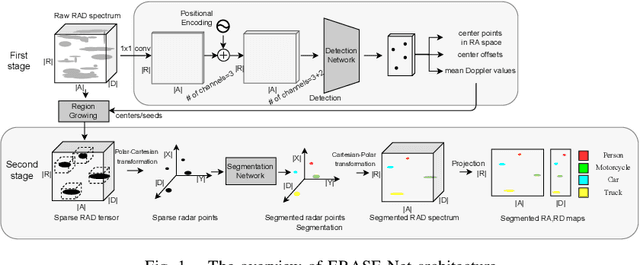
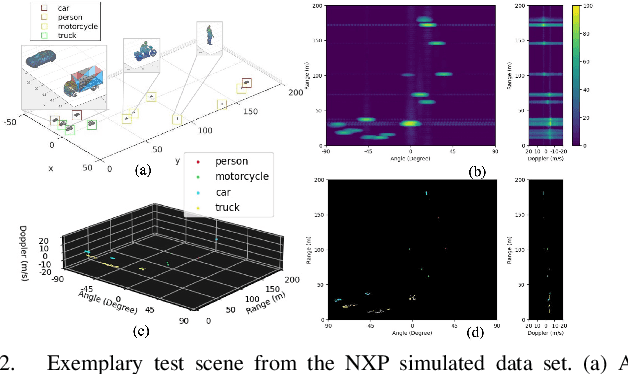
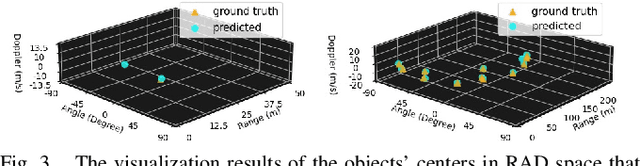
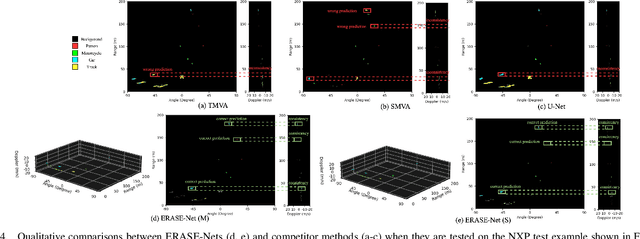
Among various sensors for assisted and autonomous driving systems, automotive radar has been considered as a robust and low-cost solution even in adverse weather or lighting conditions. With the recent development of radar technologies and open-sourced annotated data sets, semantic segmentation with radar signals has become very promising. However, existing methods are either computationally expensive or discard significant amounts of valuable information from raw 3D radar signals by reducing them to 2D planes via averaging. In this work, we introduce ERASE-Net, an Efficient RAdar SEgmentation Network to segment the raw radar signals semantically. The core of our approach is the novel detect-then-segment method for raw radar signals. It first detects the center point of each object, then extracts a compact radar signal representation, and finally performs semantic segmentation. We show that our method can achieve superior performance on radar semantic segmentation task compared to the state-of-the-art (SOTA) technique. Furthermore, our approach requires up to 20x less computational resources. Finally, we show that the proposed ERASE-Net can be compressed by 40% without significant loss in performance, significantly more than the SOTA network, which makes it a more promising candidate for practical automotive applications.