 Add to Chrome
 Add to Firefox
 Add to Edge
REVERB-FL: Server-Side Adversarial and Reserve-Enhanced Federated Learning for Robust Audio Classification
Dec 15, 2025
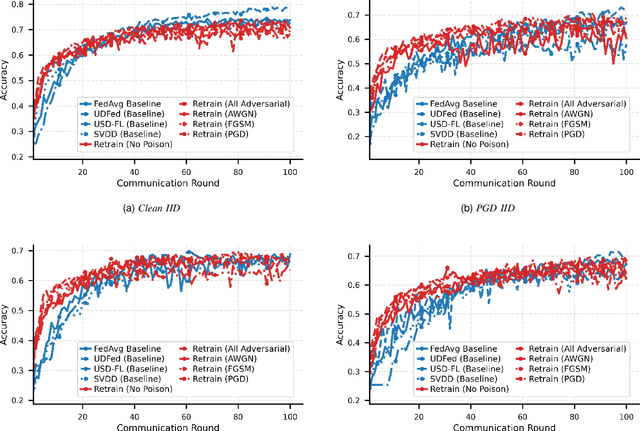
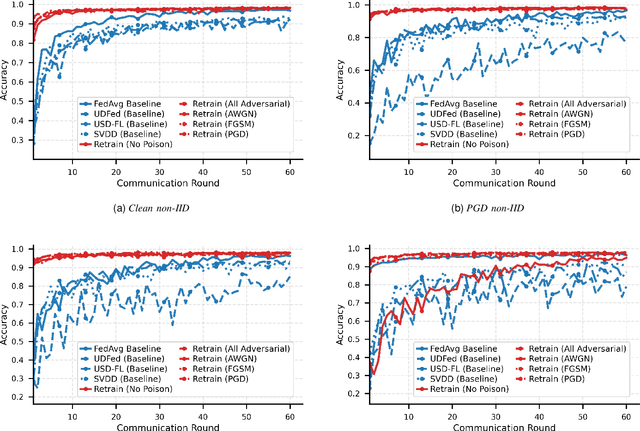
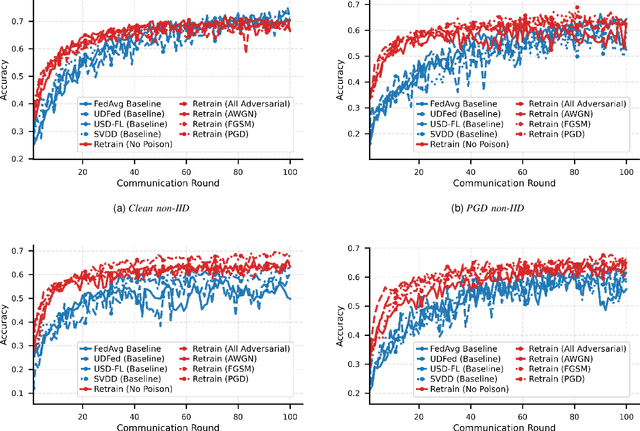
Federated learning (FL) enables a privacy-preserving training paradigm for audio classification but is highly sensitive to client heterogeneity and poisoning attacks, where adversarially compromised clients can bias the global model and hinder the performance of audio classifiers. To mitigate the effects of model poisoning for audio signal classification, we present REVERB-FL, a lightweight, server-side defense that couples a small reserve set (approximately 5%) with pre- and post-aggregation retraining and adversarial training. After each local training round, the server refines the global model on the reserve set with either clean or additional adversarially perturbed data, thereby counteracting non-IID drift and mitigating potential model poisoning without adding substantial client-side cost or altering the aggregation process. We theoretically demonstrate the feasibility of our framework, showing faster convergence and a reduced steady-state error relative to baseline federated averaging. We validate our framework on two open-source audio classification datasets with varying IID and Dirichlet non-IID partitions and demonstrate that REVERB-FL mitigates global model poisoning under multiple designs of local data poisoning.
