 Add to Chrome
 Add to Firefox
 Add to Edge
Thermal Imaging for Contactless Cardiorespiratory and Sudomotor Response Monitoring
Feb 12, 2026
Thermal infrared imaging captures skin temperature changes driven by autonomic regulation and can potentially provide contactless estimation of electrodermal activity (EDA), heart rate (HR), and breathing rate (BR). While visible-light methods address HR and BR, they cannot access EDA, a standard marker of sympathetic activation. This paper characterizes the extraction of these three biosignals from facial thermal video using a signal-processing pipeline that tracks anatomical regions, applies spatial aggregation, and separates slow sudomotor trends from faster cardiorespiratory components. For HR, we apply an orthogonal matrix image transformation (OMIT) decomposition across multiple facial regions of interest (ROIs), and for BR we average nasal and cheek signals before spectral peak detection. We evaluate 288 EDA configurations and the HR/BR pipeline on 31 sessions from the public SIMULATOR STUDY 1 (SIM1) driver monitoring dataset. The best fixed EDA configuration (nose region, exponential moving average) reaches a mean absolute correlation of $0.40 \pm 0.23$ against palm EDA, with individual sessions reaching 0.89. BR estimation achieves a mean absolute error of $3.1 \pm 1.1$ bpm, while HR estimation yields $13.8 \pm 7.5$ bpm MAE, limited by the low camera frame rate (7.5 Hz). We report signal polarity alternation across sessions, short thermodynamic latency for well-tracked signals, and condition-dependent and demographic effects on extraction quality. These results provide baseline performance bounds and design guidance for thermal contactless biosignal estimation.

From Theory to Throughput: CUDA-Optimized APML for Large-Batch 3D Learning
Dec 17, 2025
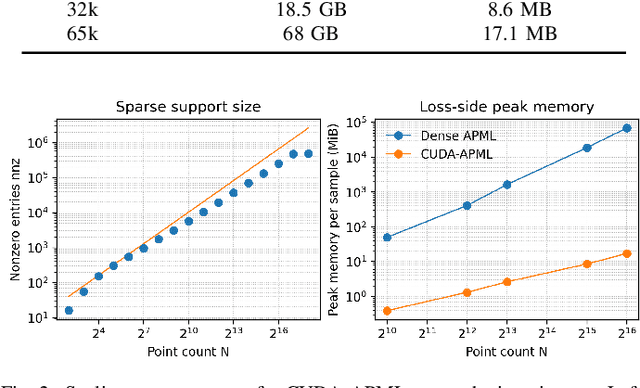
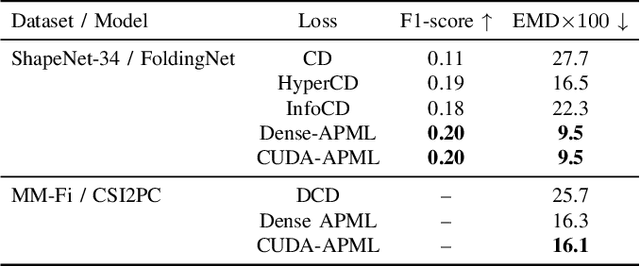
Loss functions are fundamental to learning accurate 3D point cloud models, yet common choices trade geometric fidelity for computational cost. Chamfer Distance is efficient but permits many-to-one correspondences, while Earth Mover Distance better reflects one-to-one transport at high computational cost. APML approximates transport with differentiable Sinkhorn iterations and an analytically derived temperature, but its dense formulation scales quadratically in memory. We present CUDA-APML, a sparse GPU implementation that thresholds negligible assignments and runs adaptive softmax, bidirectional symmetrization, and Sinkhorn normalization directly in COO form. This yields near-linear memory scaling and preserves gradients on the stored support, while pairwise distance evaluation remains quadratic in the current implementation. On ShapeNet and MM-Fi, CUDA-APML matches dense APML within a small tolerance while reducing peak GPU memory by 99.9%. Code available at: https://github.com/Multimodal-Sensing-Lab/apml
APML: Adaptive Probabilistic Matching Loss for Robust 3D Point Cloud Reconstruction
Sep 09, 2025Training deep learning models for point cloud prediction tasks such as shape completion and generation depends critically on loss functions that measure discrepancies between predicted and ground-truth point sets. Commonly used functions such as Chamfer Distance (CD), HyperCD, and InfoCD rely on nearest-neighbor assignments, which often induce many-to-one correspondences, leading to point congestion in dense regions and poor coverage in sparse regions. These losses also involve non-differentiable operations due to index selection, which may affect gradient-based optimization. Earth Mover Distance (EMD) enforces one-to-one correspondences and captures structural similarity more effectively, but its cubic computational complexity limits its practical use. We propose the Adaptive Probabilistic Matching Loss (APML), a fully differentiable approximation of one-to-one matching that leverages Sinkhorn iterations on a temperature-scaled similarity matrix derived from pairwise distances. We analytically compute the temperature to guarantee a minimum assignment probability, eliminating manual tuning. APML achieves near-quadratic runtime, comparable to Chamfer-based losses, and avoids non-differentiable operations. When integrated into state-of-the-art architectures (PoinTr, PCN, FoldingNet) on ShapeNet benchmarks and on a spatiotemporal Transformer (CSI2PC) that generates 3D human point clouds from WiFi CSI measurements, APM loss yields faster convergence, superior spatial distribution, especially in low-density regions, and improved or on-par quantitative performance without additional hyperparameter search. The code is available at: https://github.com/apm-loss/apml.