 Add to Chrome
 Add to Firefox
 Add to Edge
Best Preprocessing Techniques for Sentiment Analysis
Jun 23, 2026
Sentiment analysis in Twitter datasets is important because it enables monitoring public opinion on products and analysis of political and social movements. One critical step is preprocessing: the automated processing of text for machine learning algorithms. Preprocessing plays a critical role in reducing noise and improving efficiency. However, little research has systematically examined the order in which preprocessing techniques are implemented. We find that, when accounting for order, spelling correction is the least impactful preprocessing technique, whereas tokenisation is the most impactful. Stemming and stop-word removal are interchangeable, and it is better to remove stop words without removing negation. The best order for applying the preprocessing techniques was tokenisation, text cleaning, stemming, and then stopword removal. Our results provide a systematic approach for practitioners to deploy preprocessing to improve model output without the costly preprocessing exploratory phase.

Quantifying consistency and accuracy of Latent Dirichlet Allocation
Nov 17, 2025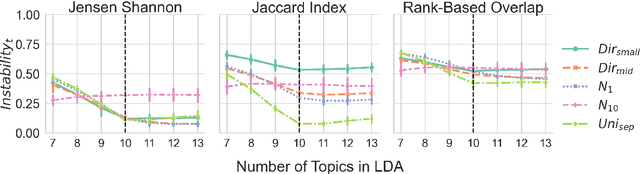
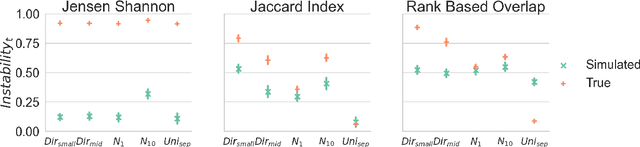
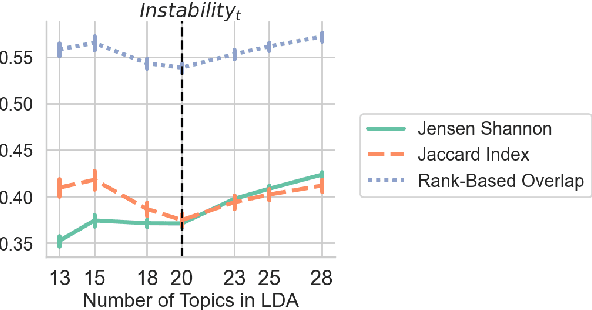
Topic modelling in Natural Language Processing uncovers hidden topics in large, unlabelled text datasets. It is widely applied in fields such as information retrieval, content summarisation, and trend analysis across various disciplines. However, probabilistic topic models can produce different results when rerun due to their stochastic nature, leading to inconsistencies in latent topics. Factors like corpus shuffling, rare text removal, and document elimination contribute to these variations. This instability affects replicability, reliability, and interpretation, raising concerns about whether topic models capture meaningful topics or just noise. To address these problems, we defined a new stability measure that incorporates accuracy and consistency and uses the generative properties of LDA to generate a new corpus with ground truth. These generated corpora are run through LDA 50 times to determine the variability in the output. We show that LDA can correctly determine the underlying number of topics in the documents. We also find that LDA is more internally consistent, as the multiple reruns return similar topics; however, these topics are not the true topics.