 Add to Chrome
 Add to Firefox
 Add to Edge
Learning Causal Orderings for In-Context Tabular Prediction
May 21, 2026
In-context learning for tabular data sets strong predictive standards in observational settings; it however primarily relies on correlational structure, which becomes unreliable under distribution shift or intervention. While established methods to discover causal structure exist, they are often focused on structure identifiability and decoupled from the predictive architectures that could benefit from them. To bridge these perspectives, we study how to simultaneously infer and enforce causal structure in the form of topological variable orderings into tabular prediction. Unlike standard architectures, our model TabOrder uses causal order-constrained attention, basing predictions only on features that precede a target under a learned causal order. Similar to causal discovery methods, TabOrder learns the optimal variable ordering in an unsupervised manner through a likelihood-based objective. We justify this choice under standard functional model classes and also study how sample missingness, a common challenge in tabular data, interacts with causal direction identification. Empirically, we confirm that TabOrder recovers accurate variable orderings while addressing prediction and imputation tasks, as well as gives insight into real-world biological data under intervention.

SpaceTime: Causal Discovery from Non-Stationary Time Series
Jan 17, 2025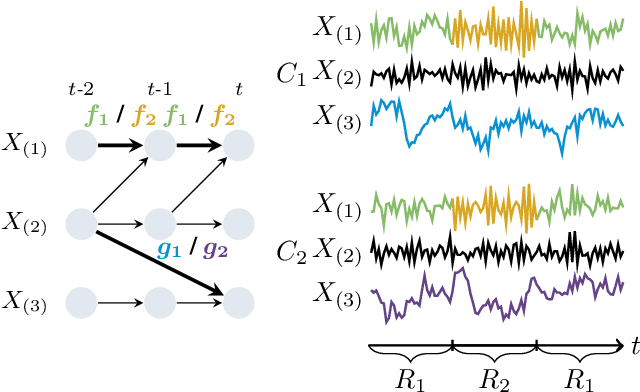
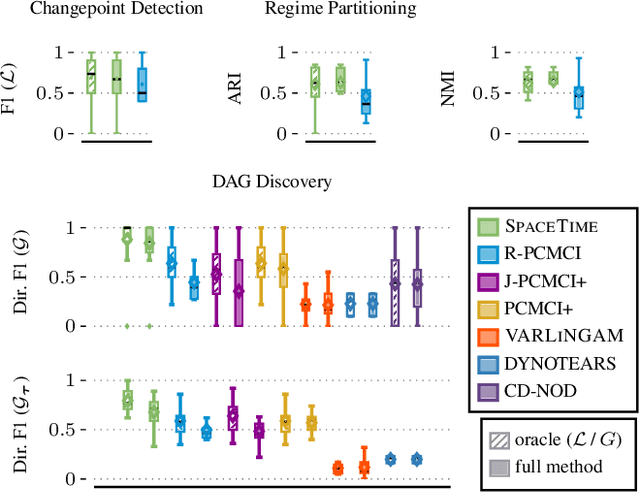
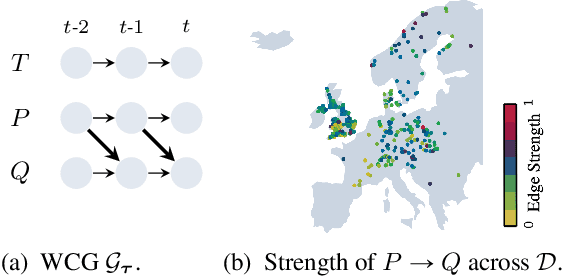
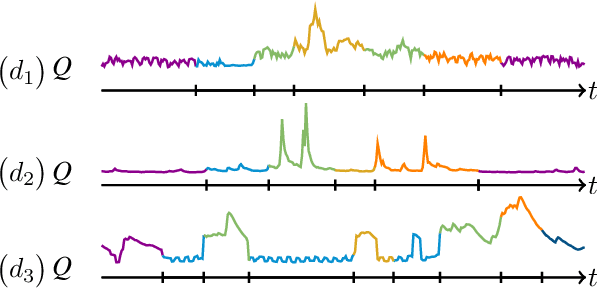
Understanding causality is challenging and often complicated by changing causal relationships over time and across environments. Climate patterns, for example, shift over time with recurring seasonal trends, while also depending on geographical characteristics such as ecosystem variability. Existing methods for discovering causal graphs from time series either assume stationarity, do not permit both temporal and spatial distribution changes, or are unaware of locations with the same causal relationships. In this work, we therefore unify the three tasks of causal graph discovery in the non-stationary multi-context setting, of reconstructing temporal regimes, and of partitioning datasets and time intervals into those where invariant causal relationships hold. To construct a consistent score that forms the basis of our method, we employ the Minimum Description Length principle. Our resulting algorithm SPACETIME simultaneously accounts for heterogeneity across space and non-stationarity over time. Given multiple time series, it discovers regime changepoints and a temporal causal graph using non-parametric functional modeling and kernelized discrepancy testing. We also show that our method provides insights into real-world phenomena such as river-runoff measured at different catchments and biosphere-atmosphere interactions across ecosystems.