 Add to Chrome
 Add to Firefox
 Add to Edge
What Language Models Know But Don't Say: Non-Generative Prior Extraction for Generalization
Jan 24, 2026
In domains like medicine and finance, large-scale labeled data is costly and often unavailable, leading to models trained on small datasets that struggle to generalize to real-world populations. Large language models contain extensive knowledge from years of research across these domains. We propose LoID (Logit-Informed Distributions), a deterministic method for extracting informative prior distributions for Bayesian logistic regression by directly accessing their token-level predictions. Rather than relying on generated text, we probe the model's confidence in opposing semantic directions (positive vs. negative impact) through carefully constructed sentences. By measuring how consistently the LLM favors one direction across diverse phrasings, we extract the strength and reliability of the model's belief about each feature's influence. We evaluate LoID on ten real-world tabular datasets under synthetic out-of-distribution (OOD) settings characterized by covariate shift, where the training data represents only a subset of the population. We compare our approach against (1) standard uninformative priors, (2) AutoElicit, a recent method that prompts LLMs to generate priors via text completions, (3) LLMProcesses, a method that uses LLMs to generate numerical predictions through in-context learning and (4) an oracle-style upper bound derived from fitting logistic regression on the full dataset. We assess performance using Area Under the Curve (AUC). Across datasets, LoID significantly improves performance over logistic regression trained on OOD data, recovering up to \textbf{59\%} of the performance gap relative to the oracle model. LoID outperforms AutoElicit and LLMProcessesc on 8 out of 10 datasets, while providing a reproducible and computationally efficient mechanism for integrating LLM knowledge into Bayesian inference.

A Comparative Study of LLMs, NMT Models, and Their Combination in Persian-English Idiom Translation
Dec 13, 2024
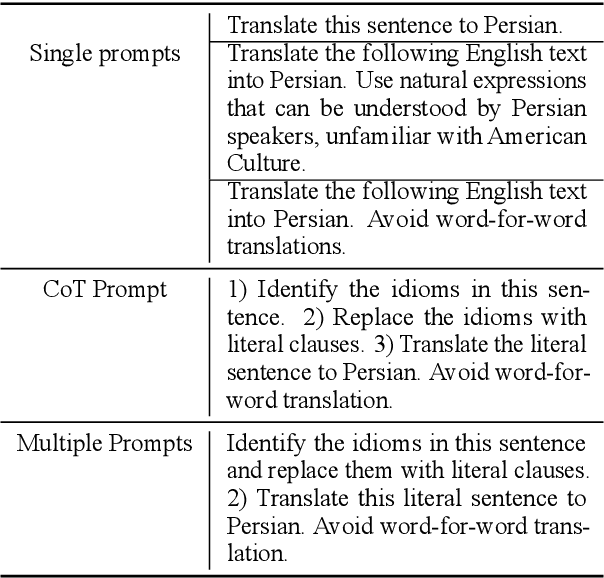

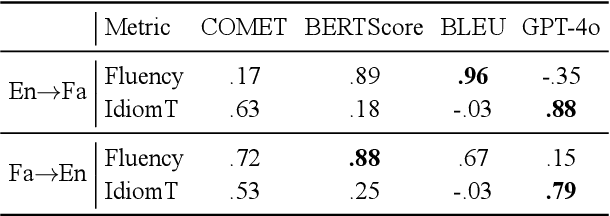
Large language models (LLMs) have shown superior capabilities in translating figurative language compared to neural machine translation (NMT) systems. However, the impact of different prompting methods and LLM-NMT combinations on idiom translation has yet to be thoroughly investigated. This paper introduces two parallel datasets of sentences containing idiomatic expressions for Persian$\rightarrow$English and English$\rightarrow$Persian translations, with Persian idioms sampled from our PersianIdioms resource, a collection of 2,200 idioms and their meanings. Using these datasets, we evaluate various open- and closed-source LLMs, NMT models, and their combinations. Translation quality is assessed through idiom translation accuracy and fluency. We also find that automatic evaluation methods like LLM-as-a-judge, BLEU and BERTScore are effective for comparing different aspects of model performance. Our experiments reveal that Claude-3.5-Sonnet delivers outstanding results in both translation directions. For English$\rightarrow$Persian, combining weaker LLMs with Google Translate improves results, while Persian$\rightarrow$English translations benefit from single prompts for simpler models and complex prompts for advanced ones.