 Add to Chrome
 Add to Firefox
 Add to Edge
DINE: Distance Is Not Enough -- Learning Global Deformation Priors for Robust Soft-Tissue Point Cloud Registration
Jul 16, 2026
Non-rigid point cloud registration is central to soft-tissue shape analysis, but large deformations, noise, and outliers make correspondence estimation challenging. Most learning-based methods rely on local objectives such as Chamfer distance, which encourage point-wise proximity but do not constrain the global plausibility of the predicted deformation field. We address this limitation with DINE, a maximum a posteriori framework that augments distance-based registration with a learned statistical prior over displacement vector fields. DINE is applied to two registration backbones, Robust-DefReg and DefTransNet, using a two-stage strategy: a first-stage model is trained with Chamfer distance, its predicted deformation fields are used to estimate a prior, and the model is then refined with a combined distance and negative log-prior objective. We compare a full-field PCA Gaussian prior with a per-vector normalizing-flow prior. Experiments on DeformedTissue and SynBench show lower mean Chamfer distance under deformation and corruption. On DeformedTissue, DINE-PCA reduces Chamfer distance by approximately 27--69\% relative to the corresponding Stage-1 backbone across deformation levels, and improves robustness by up to 66\% for outliers and 83\% for Gaussian noise. On SynBench, improvements are modest at the smallest deformation levels and reach approximately 59--79\% from moderate to severe deformation. These results suggest that global deformation plausibility is an important constraint for reliable soft-tissue point cloud registration. (The code will be published soon.)

Frequency-Structured Field Learning for Light-Field Disparity Estimation
Jul 16, 2026Light-field disparity estimation requires global consistency in smooth or textureless regions and local precision near occlusion boundaries, thin structures, and abrupt depth transitions. Existing methods address these requirements through EPI matching, cost-volume or focal-stack construction, view aggregation, or direct convolutional regression, often relying on local windows, discrete disparity hypotheses, memory-intensive volumes, or attention-based aggregation. We instead formulate disparity estimation at the field level, predicting disparity from globally and locally updated EPI-derived latent features without explicitly constructing a disparity volume. We introduce FreqLF, an EPI-guided Fourier-local framework that encodes angular parallax cues from horizontal and vertical EPI stacks together with central-view appearance features. These cues are projected into a latent field and updated through stacked hybrid Fourier-local layers. Fourier low-mode updates enable global feature interaction, while local convolutions preserve spatial variations needed for fine disparity detail. A coordinate-conditioned Gaussian-mixture decoder then predicts disparity, using the mixture mean as the final estimate. Experiments on the HCI 4D Light Field Benchmark show that FreqLF approaches the accuracy of strong supervised baselines while avoiding explicit cost-volume construction in the base model. Ablations confirm the complementary roles of the Fourier and local branches, and scaling experiments demonstrate practical behavior across spatial resolutions. These results suggest that Fourier-local latent field learning is a competitive alternative for light-field disparity estimation. The code will be published soon.
DefTransNet: A Transformer-based Method for Non-Rigid Point Cloud Registration in the Simulation of Soft Tissue Deformation
Feb 10, 2025Soft-tissue surgeries, such as tumor resections, are complicated by tissue deformations that can obscure the accurate location and shape of tissues. By representing tissue surfaces as point clouds and applying non-rigid point cloud registration (PCR) methods, surgeons can better understand tissue deformations before, during, and after surgery. Existing non-rigid PCR methods, such as feature-based approaches, struggle with robustness against challenges like noise, outliers, partial data, and large deformations, making accurate point correspondence difficult. Although learning-based PCR methods, particularly Transformer-based approaches, have recently shown promise due to their attention mechanisms for capturing interactions, their robustness remains limited in challenging scenarios. In this paper, we present DefTransNet, a novel end-to-end Transformer-based architecture for non-rigid PCR. DefTransNet is designed to address the key challenges of deformable registration, including large deformations, outliers, noise, and partial data, by inputting source and target point clouds and outputting displacement vector fields. The proposed method incorporates a learnable transformation matrix to enhance robustness to affine transformations, integrates global and local geometric information, and captures long-range dependencies among points using Transformers. We validate our approach on four datasets: ModelNet, SynBench, 4DMatch, and DeformedTissue, using both synthetic and real-world data to demonstrate the generalization of our proposed method. Experimental results demonstrate that DefTransNet outperforms current state-of-the-art registration networks across various challenging conditions. Our code and data are publicly available.
SynBench: A Synthetic Benchmark for Non-rigid 3D Point Cloud Registration
Sep 22, 2024

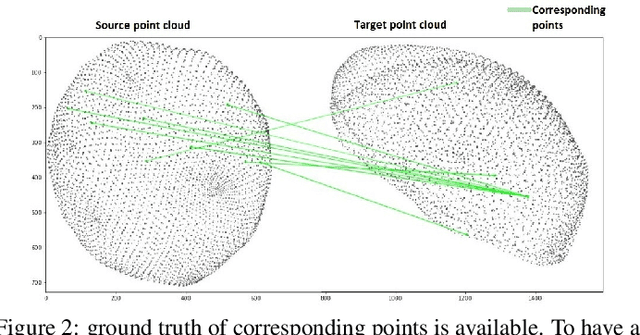
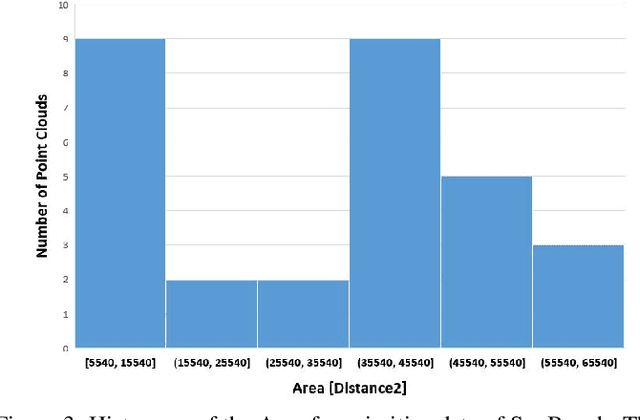
Non-rigid point cloud registration is a crucial task in computer vision. Evaluating a non-rigid point cloud registration method requires a dataset with challenges such as large deformation levels, noise, outliers, and incompleteness. Despite the existence of several datasets for deformable point cloud registration, the absence of a comprehensive benchmark with all challenges makes it difficult to achieve fair evaluations among different methods. This paper introduces SynBench, a new non-rigid point cloud registration dataset created using SimTool, a toolset for soft body simulation in Flex and Unreal Engine. SynBench provides the ground truth of corresponding points between two point sets and encompasses key registration challenges, including varying levels of deformation, noise, outliers, and incompleteness. To the best of the authors' knowledge, compared to existing datasets, SynBench possesses three particular characteristics: (1) it is the first benchmark that provides various challenges for non-rigid point cloud registration, (2) SynBench encompasses challenges of varying difficulty levels, and (3) it includes ground truth corresponding points both before and after deformation. The authors believe that SynBench enables future non-rigid point cloud registration methods to present a fair comparison of their achievements. SynBench is publicly available at: https://doi.org/10.11588/data/R9IKCF.
Robust-DefReg: A Robust Deformable Point Cloud Registration Method based on Graph Convolutional Neural Networks
Jun 07, 2023


Point cloud registration is a fundamental problem in computer vision that aims to estimate the transformation between corresponding sets of points. Non-rigid registration, in particular, involves addressing challenges including various levels of deformation, noise, outliers, and data incompleteness. This paper introduces Robust-DefReg, a robust non-rigid point cloud registration method based on graph convolutional networks (GCNNs). Robust-DefReg is a coarse-to-fine registration approach within an end-to-end pipeline, leveraging the advantages of both coarse and fine methods. The method learns global features to find correspondences between source and target point clouds, to enable appropriate initial alignment, and subsequently fine registration. The simultaneous achievement of high accuracy and robustness across all challenges is reported less frequently in existing studies, making it a key objective of the Robust-DefReg method. The proposed method achieves high accuracy in large deformations while maintaining computational efficiency. This method possesses three primary attributes: high accuracy, robustness to different challenges, and computational efficiency. The experimental results show that the proposed Robust-DefReg holds significant potential as a foundational architecture for future investigations in non-rigid point cloud registration. The source code of Robust-DefReg is available.