 Add to Chrome
 Add to Firefox
 Add to Edge
SCOUT: Semantic scene COverage via Uncertainty-guided Traversal
Jun 04, 2026
Robots that operate over extended periods should not merely visit space; they should progressively understand it. Yet most 3D scene graph pipelines treat perception as a post-processing stage over a fixed dataset, decoupling scene representation from the decisions that determine what is observed in the first place. We present SCOUT, an online semantic exploration framework that closes this loop by coupling active traversal with probabilistic scene graph construction. Given a prior 2D occupancy map and posed RGB-D observations, SCOUT incrementally builds an uncertainty-aware 3D scene graph whose nodes maintain fused geometry and posterior beliefs over open-vocabulary object labels, while edges encode structural relations such as on, inside, belong, and next to. These beliefs are fed back to an uncertainty-guided traversal planner, which selects viewpoints by balancing expected semantic certainty gain, geometric coverage gain, and travel cost. In this way, the robot revisits ambiguous objects when additional evidence matters and expands into unseen free space when the scene remains incomplete. The resulting system treats semantic scene completeness as an operational objective rather than a passive by-product of semantic mapping, moving toward autonomous agents that can patrol, update, and reason about evolving indoor environments with minimal human intervention.

Beyond Accuracy: Cost-Aware Data Representation Exploration for Network Traffic Model Performance
Oct 27, 2020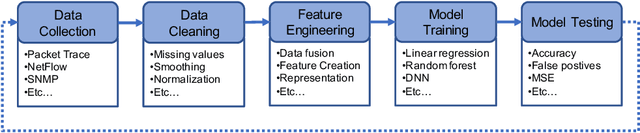
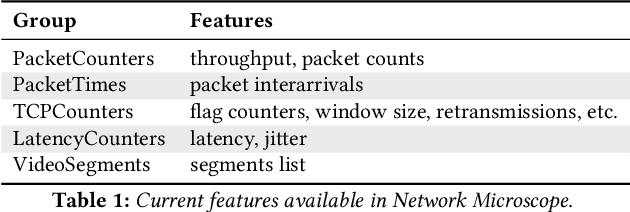
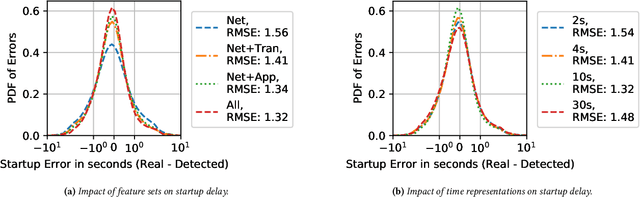
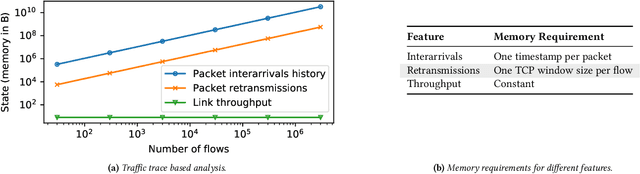
In this paper, we explore how different representations of network traffic affect the performance of machine learning models for a range of network management tasks, including application performance diagnosis and attack detection. We study the relationship between the systems-level costs of different representations of network traffic to the ultimate target performance metric -- e.g., accuracy -- of the models trained from these representations. We demonstrate the benefit of exploring a range of representations of network traffic and present Network Microscope, a proof-of-concept reference implementation that both monitors network traffic at high speed and transforms the traffic in real time to produce a variety of representations for input to machine learning models. Systems like Network Microscope can ultimately help network operators better explore the design space of data representation for learning, balancing systems costs related to feature extraction and model training against resulting model performance.