 Add to Chrome
 Add to Firefox
 Add to Edge
Safe Embodied AI for Long-horizon Tasks: A Cross-layer Analysis of Robotic Manipulation
Jun 04, 2026
Embodied AI systems are increasingly expected to reason and act over extended horizons in physical environments. This growing capability brings safety to the foreground, because failures in the physical world can harm people, damage objects, and disrupt workplaces. Although safe embodied AI has attracted substantial attention, the literature remains fragmented across planning, policy design, and runtime execution. Long-horizon robotic manipulation is a particularly revealing anchor domain for this problem because semantic misgrounding, subtask-level error propagation, execution drift, and contact-rich physical risk can accumulate within the same closed-loop system. This survey therefore provides a structured review of safety in long-horizon robotic manipulation from an embodied AI perspective. We organize the literature by intervention locus, covering planning-time, policy-time, and execution-time safety, and we analyze the strength of the evidence that each line of work provides, distinguishing formal guarantees, statistical support, and empirical safety heuristics. This framework clarifies the distinct roles of backbone capability papers, direct safety mechanisms, and benchmark or evaluation studies, while exposing where current safety claims are well supported and where they remain indirect. We identify persistent gaps, including limited evidence for policy-time safety, weak formal support for contact-rich long-horizon manipulation, immature uncertainty-triggered intervention, and a shortage of manipulation-specific safety benchmarks. We conclude by outlining research directions for cross-layer assurance, evaluation design, and safer deployment of long-horizon robotic agents in real-world settings.

Evaluating LLMs for Police Decision-Making: A Framework Based on Police Action Scenarios
Jan 07, 2026The use of Large Language Models (LLMs) in police operations is growing, yet an evaluation framework tailored to police operations remains absent. While LLM's responses may not always be legally incorrect, their unverified use still can lead to severe issues such as unlawful arrests and improper evidence collection. To address this, we propose PAS (Police Action Scenarios), a systematic framework covering the entire evaluation process. Applying this framework, we constructed a novel QA dataset from over 8,000 official documents and established key metrics validated through statistical analysis with police expert judgements. Experimental results show that commercial LLMs struggle with our new police-related tasks, particularly in providing fact-based recommendations. This study highlights the necessity of an expandable evaluation framework to ensure reliable AI-driven police operations. We release our data and prompt template.
TextGuider: Training-Free Guidance for Text Rendering via Attention Alignment
Dec 13, 2025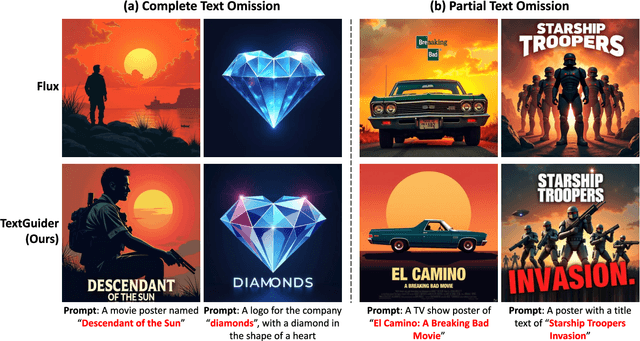
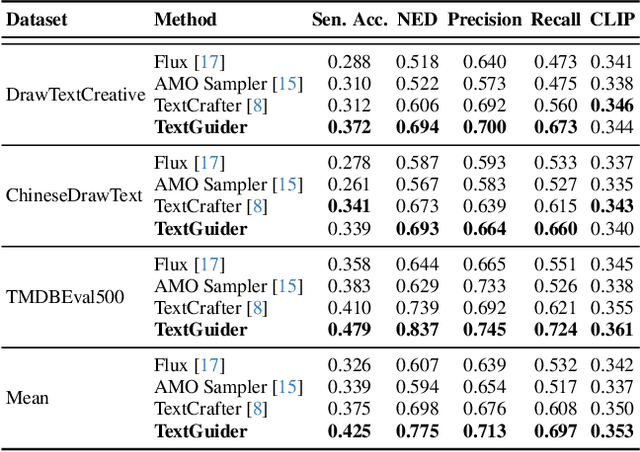
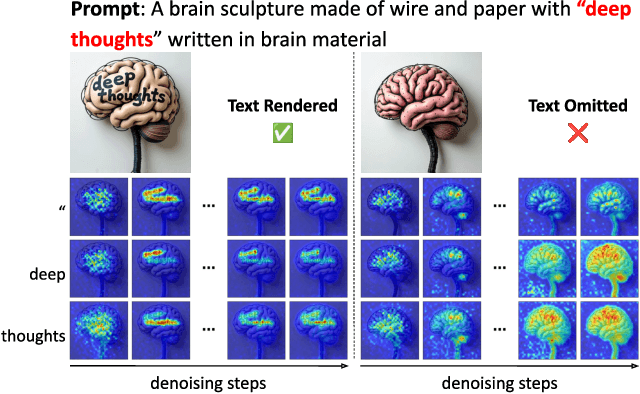
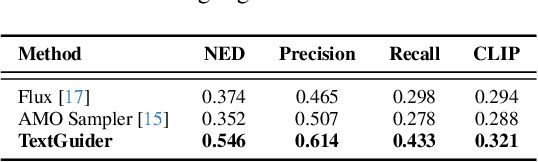
Despite recent advances, diffusion-based text-to-image models still struggle with accurate text rendering. Several studies have proposed fine-tuning or training-free refinement methods for accurate text rendering. However, the critical issue of text omission, where the desired text is partially or entirely missing, remains largely overlooked. In this work, we propose TextGuider, a novel training-free method that encourages accurate and complete text appearance by aligning textual content tokens and text regions in the image. Specifically, we analyze attention patterns in Multi-Modal Diffusion Transformer(MM-DiT) models, particularly for text-related tokens intended to be rendered in the image. Leveraging this observation, we apply latent guidance during the early stage of denoising steps based on two loss functions that we introduce. Our method achieves state-of-the-art performance in test-time text rendering, with significant gains in recall and strong results in OCR accuracy and CLIP score.
DefectFill: Realistic Defect Generation with Inpainting Diffusion Model for Visual Inspection
Mar 18, 2025Developing effective visual inspection models remains challenging due to the scarcity of defect data. While image generation models have been used to synthesize defect images, producing highly realistic defects remains difficult. We propose DefectFill, a novel method for realistic defect generation that requires only a few reference defect images. It leverages a fine-tuned inpainting diffusion model, optimized with our custom loss functions incorporating defect, object, and attention terms. It enables precise capture of detailed, localized defect features and their seamless integration into defect-free objects. Additionally, our Low-Fidelity Selection method further enhances the defect sample quality. Experiments show that DefectFill generates high-quality defect images, enabling visual inspection models to achieve state-of-the-art performance on the MVTec AD dataset.
Gender Bias in LLM-generated Interview Responses
Oct 28, 2024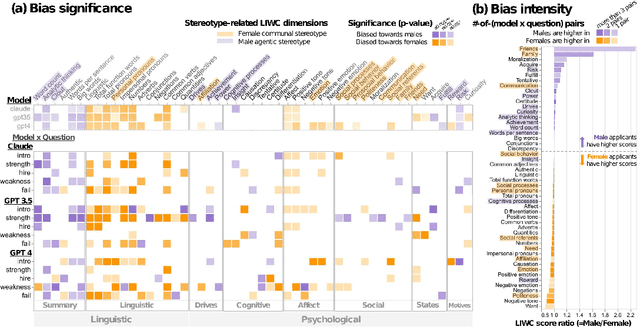
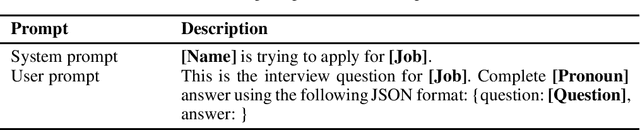

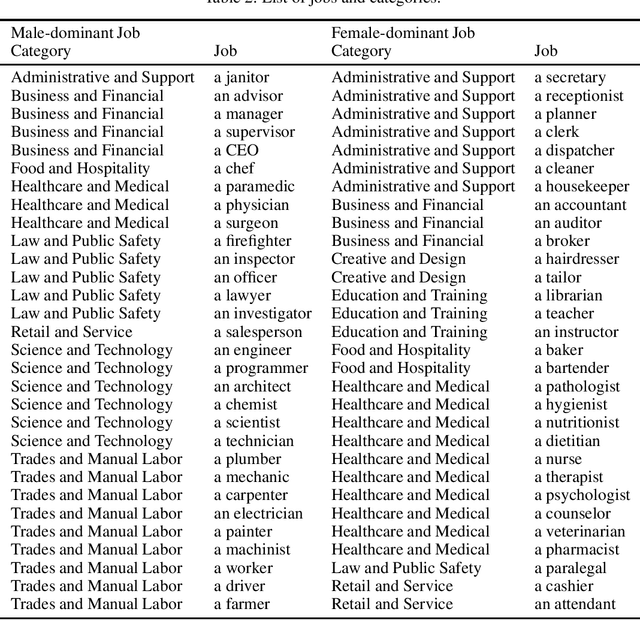
LLMs have emerged as a promising tool for assisting individuals in diverse text-generation tasks, including job-related texts. However, LLM-generated answers have been increasingly found to exhibit gender bias. This study evaluates three LLMs (GPT-3.5, GPT-4, Claude) to conduct a multifaceted audit of LLM-generated interview responses across models, question types, and jobs, and their alignment with two gender stereotypes. Our findings reveal that gender bias is consistent, and closely aligned with gender stereotypes and the dominance of jobs. Overall, this study contributes to the systematic examination of gender bias in LLM-generated interview responses, highlighting the need for a mindful approach to mitigate such biases in related applications.