 Add to Chrome
 Add to Firefox
 Add to Edge
Comparative Study of Neural Surrogate Architectures for Autoregressive Prediction of Internal Battery States
Jun 18, 2026
The Doyle-Fuller-Newman (DFN) model resolves internal electrochemical states in lithium-ion batteries with high fidelity. However, the numerical solution of its governing equations is computationally prohibitive for real-time deployment, limiting scalability from individual cells to pack and fleet-scale applications. While machine learning surrogates can substantially reduce inference latency through GPU acceleration, most existing approaches learn solution approximations tied to specific operating conditions rather than learning generalizable state-evolution dynamics. This work presents a systematic comparison of four neural network architectures (MLP, ResNet, U-Net, FNO) formulated as autoregressive state-transition operators that predict full DFN internal states across a wide range of operating conditions. To ensure a controlled architectural comparison, all models are trained under a unified framework using multi-step unrolling and current-conditioning, isolating the impact of spatial inductive bias. Results demonstrate that the U-Net's multi-scale feature hierarchy achieves a mean final-step nRMSE of 3% averaged across all internal state variables after 300-step autoregressive rollouts, while providing a 5.38x speed-up over the numerical solver. These findings highlight spatial inductive bias as a critical determinant of surrogate performance, advancing the development of surrogates for internal state observability for next-generation battery management systems and digital twins.

A Comparative Study on Energy Consumption Models for Drones
May 30, 2022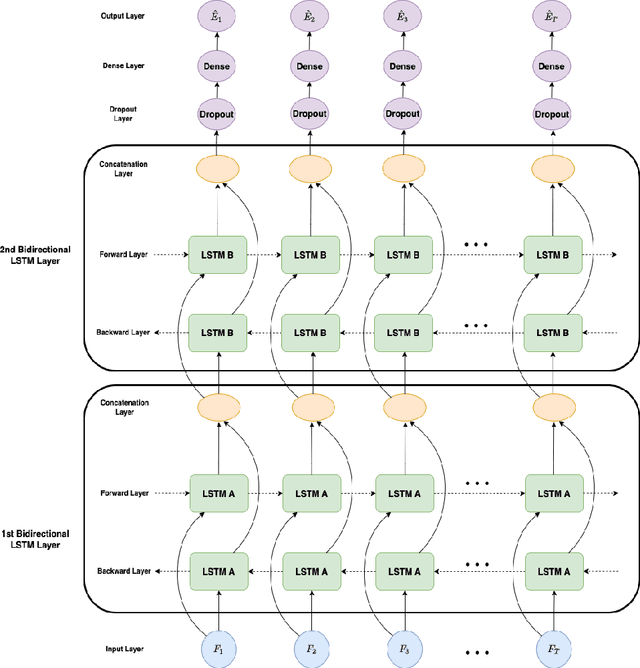
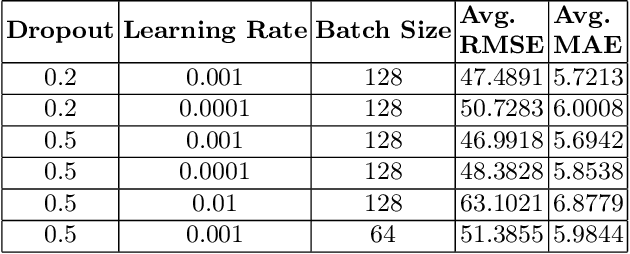
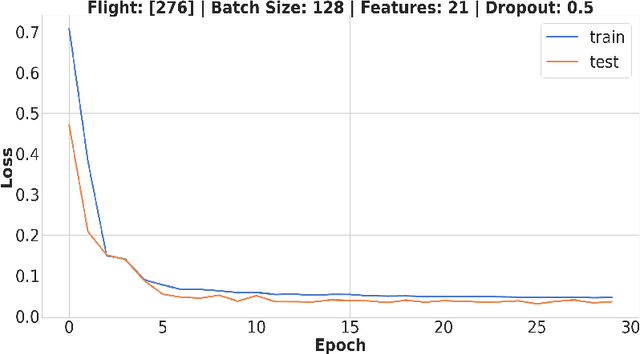
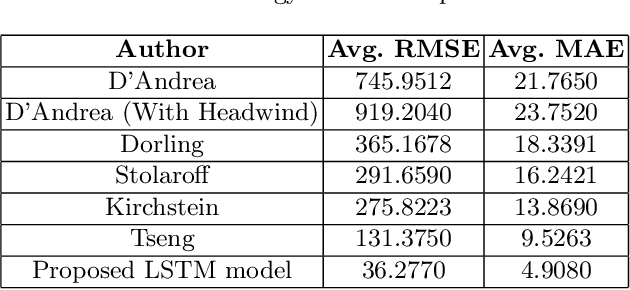
Creating an appropriate energy consumption prediction model is becoming an important topic for drone-related research in the literature. However, a general consensus on the energy consumption model is yet to be reached at present. As a result, there are many variations that attempt to create models that range in complexity with a focus on different aspects. In this paper, we benchmark the five most popular energy consumption models for drones derived from their physical behaviours and point to the difficulties in matching with a realistic energy dataset collected from a delivery drone in flight under different testing conditions. Moreover, we propose a novel data-driven energy model using the Long Short-Term Memory (LSTM) based deep learning architecture and the accuracy is compared based on the dataset. Our experimental results have shown that the LSTM based approach can easily outperform other mathematical models for the dataset under study. Finally, sensitivity analysis has been carried out in order to interpret the model.