 Add to Chrome
 Add to Firefox
 Add to Edge
R2R2: Robust Representation for Intensive Experience Reuse via Redundancy Reduction in Self-Predictive Learning
May 13, 2026
For reinforcement learning in data-scarce domains like real-world robotics, intensive data reuse enhances efficiency but induces overfitting. While prior works focus on critic bias, representation-level instability in Self-Predictive Learning (SPL) under high Update-to-Data (UTD) regimes remains underexplored. To bridge this gap, we propose Robust Representation via Redundancy Reduction (R2R2), a regularization method within SPL. We theoretically identify that standard zero-centering conflicts with SPL's spectral properties and design a non-centered objective accordingly. We verify R2R2 on SPL-native algorithms like TD7. Furthermore, to demonstrate its orthogonality to prior advancements, we extend the state-of-the-art SimbaV2, which originally lacks SPL, by integrating a tailored SPL module, termed SimbaV2-SPL. Experiments across 11 continuous control tasks confirm that R2R2 effectively mitigates overfitting; specifically, at a UTD ratio of 20, it improves TD7 by ~22% and provides additional gains on top of SimbaV2-SPL, which itself establishes a new state-of-the-art. The code can be found at: https://github.com/songsang7/R2R2

Unsupervised Homography Estimation on Multimodal Image Pair via Alternating Optimization
Nov 20, 2024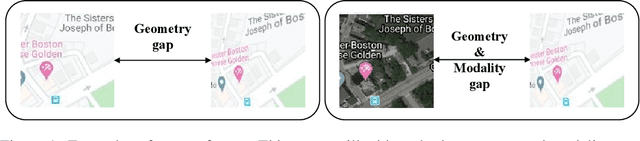
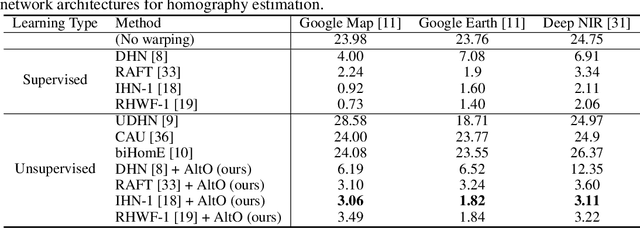
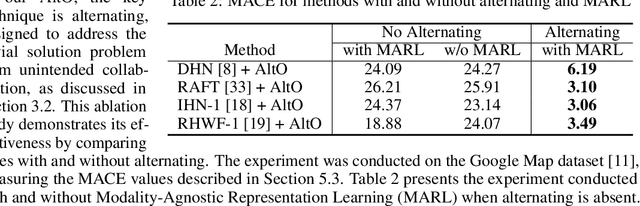
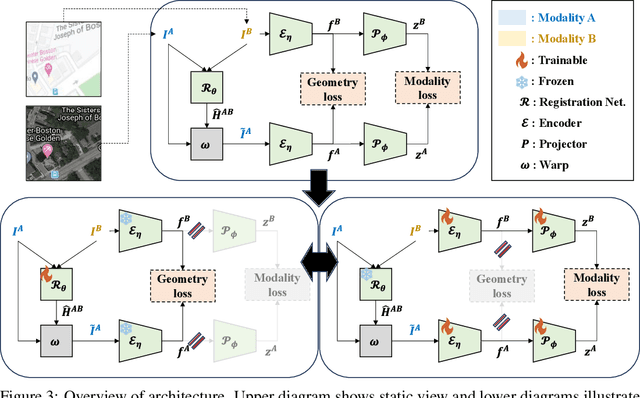
Estimating the homography between two images is crucial for mid- or high-level vision tasks, such as image stitching and fusion. However, using supervised learning methods is often challenging or costly due to the difficulty of collecting ground-truth data. In response, unsupervised learning approaches have emerged. Most early methods, though, assume that the given image pairs are from the same camera or have minor lighting differences. Consequently, while these methods perform effectively under such conditions, they generally fail when input image pairs come from different domains, referred to as multimodal image pairs. To address these limitations, we propose AltO, an unsupervised learning framework for estimating homography in multimodal image pairs. Our method employs a two-phase alternating optimization framework, similar to Expectation-Maximization (EM), where one phase reduces the geometry gap and the other addresses the modality gap. To handle these gaps, we use Barlow Twins loss for the modality gap and propose an extended version, Geometry Barlow Twins, for the geometry gap. As a result, we demonstrate that our method, AltO, can be trained on multimodal datasets without any ground-truth data. It not only outperforms other unsupervised methods but is also compatible with various architectures of homography estimators. The source code can be found at:~\url{https://github.com/songsang7/AltO}