 Add to Chrome
 Add to Firefox
 Add to Edge
Phone2Act: A Low-Cost, Hardware-Agnostic Teleoperation System for Scalable VLA Data Collection
May 03, 2026
Collecting diverse, high-quality manipulation data for Vision-Language-Action (VLA) model training remains prohibitively expensive for many research groups, as existing teleoperation frameworks rely on specialized hardware or are tightly coupled to specific robot platforms. We present Phone2Act, a low-cost, hardware-agnostic teleoperation framework that transforms a commodity smartphone into a 6-DoF robot controller via Google ARCore. Built on a modular ROS 2 architecture, Phone2Act decouples control logic from hardware specifics through interchangeable bridge nodes, supporting platforms from industrial cobots to low-cost bimanual arms without code modification. A Universal Recorder synchronizes multi-camera RGB streams with robot state feedback and exports demonstrations natively in the LeRobot dataset format, eliminating post-processing and enabling immediate VLA fine-tuning. We validate the framework by fine-tuning GR00T-N1.5 on 130 collected episodes, achieving a 90% success rate on a real-world multi-stage pick-and-place task deployed on a physical Dobot CR5.

Real-Time Detection of Drowsiness Among Vehicle Drivers: A Machine Learning Algorithm for Embedded Systems
Nov 04, 2021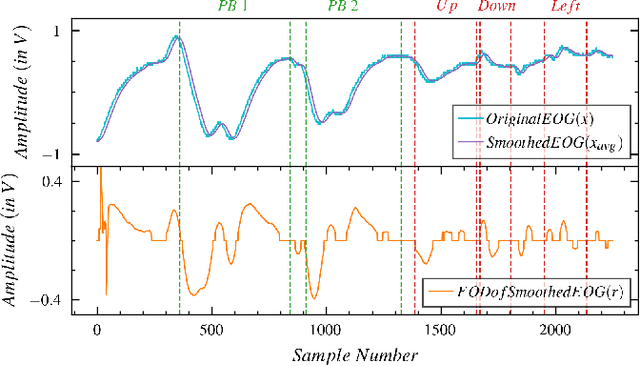
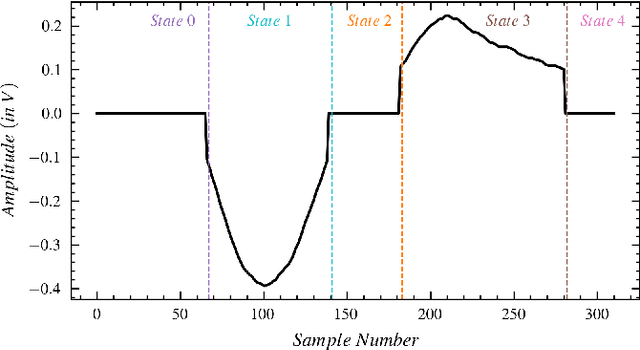
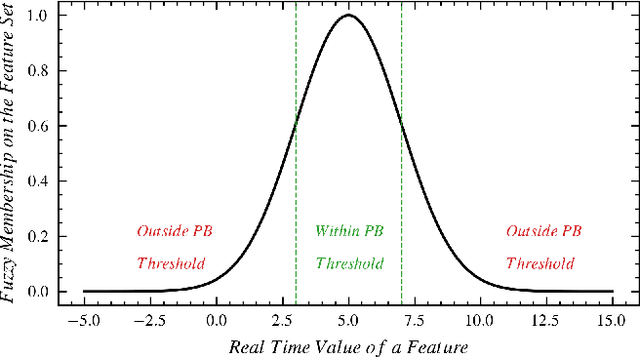

Numerous studies have established the necessity for developing safety equipment to detect drowsiness among vehicle drivers. However, for reliable implementations, such systems must employ dependable sources of stimuli; through Electrooculography (EOG), the tendencies of drowsiness can be directly sensed by measuring blinks of prolonged durations. While conventional machine learning (ML) algorithms can be utilized for the detection and classification of these prolonged blinks (PB), executing them on microcontroller units (MCU) may prove to be a laborious task. Hence, by keeping resource constraints and practicality in mind, an ML algorithm is proposed in this study to identify PBs executed by an individual with desirable accuracy and precision while being efficient enough to be deployed on portable wearables using economic MCUs. Furthermore, the suggested algorithm is subjected to multiple rounds of testing in this study thereby, establishing its possibility as a feasible drowsiness detection measure for wearable systems.