 Add to Chrome
 Add to Firefox
 Add to Edge
Systemic Risk Radar: A Multi-Layer Graph Framework for Early Market Crash Warning
Dec 19, 2025
Financial crises emerge when structural vulnerabilities accumulate across sectors, markets, and investor behavior. Predicting these systemic transitions is challenging because they arise from evolving interactions between market participants, not isolated price movements alone. We present Systemic Risk Radar (SRR), a framework that models financial markets as multi-layer graphs to detect early signs of systemic fragility and crash-regime transitions. We evaluate SRR across three major crises: the Dot-com crash, the Global Financial Crisis, and the COVID-19 shock. Our experiments compare snapshot GNNs, a simplified temporal GNN prototype, and standard baselines (logistic regression and Random Forest). Results show that structural network information provides useful early-warning signals compared to feature-based models alone. This correlation-based instantiation of SRR demonstrates that graph-derived features capture meaningful changes in market structure during stress events. The findings motivate extending SRR with additional graph layers (sector/factor exposure, sentiment) and more expressive temporal architectures (LSTM/GRU or Transformer encoders) to better handle diverse crisis types.

AIMM: An AI-Driven Multimodal Framework for Detecting Social-Media-Influenced Stock Market Manipulation
Dec 18, 2025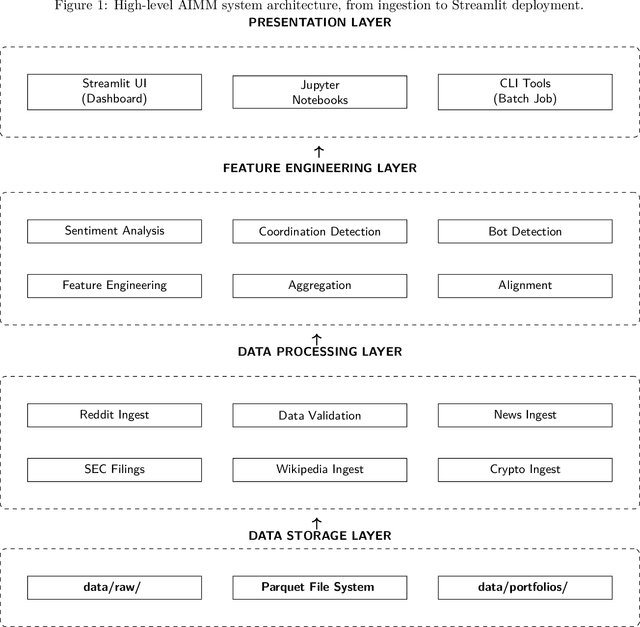

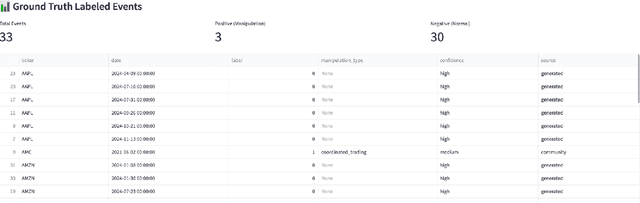
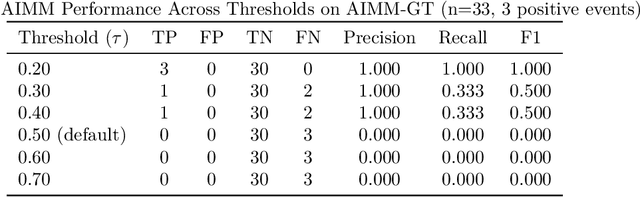
Market manipulation now routinely originates from coordinated social media campaigns, not isolated trades. Retail investors, regulators, and brokerages need tools that connect online narratives and coordination patterns to market behavior. We present AIMM, an AI-driven framework that fuses Reddit activity, bot and coordination indicators, and OHLCV market features into a daily AIMM Manipulation Risk Score for each ticker. The system uses a parquet-native pipeline with a Streamlit dashboard that allows analysts to explore suspicious windows, inspect underlying posts and price action, and log model outputs over time. Due to Reddit API restrictions, we employ calibrated synthetic social features matching documented event characteristics; market data (OHLCV) uses real historical data from Yahoo Finance. This release makes three contributions. First, we build the AIMM Ground Truth dataset (AIMM-GT): 33 labeled ticker-days spanning eight equities, drawing from SEC enforcement actions, community-verified manipulation cases, and matched normal controls. Second, we implement forward-walk evaluation and prospective prediction logging for both retrospective and deployment-style assessment. Third, we analyze lead times and show that AIMM flagged GME 22 days before the January 2021 squeeze peak. The current labeled set is small (33 ticker-days, 3 positive events), but results show preliminary discriminative capability and early warnings for the GME incident. We release the code, dataset schema, and dashboard design to support research on social media-driven market surveillance.
Stock Pattern Assistant (SPA): A Deterministic and Explainable Framework for Structural Price Run Extraction and Event Correlation in Equity Markets
Dec 17, 2025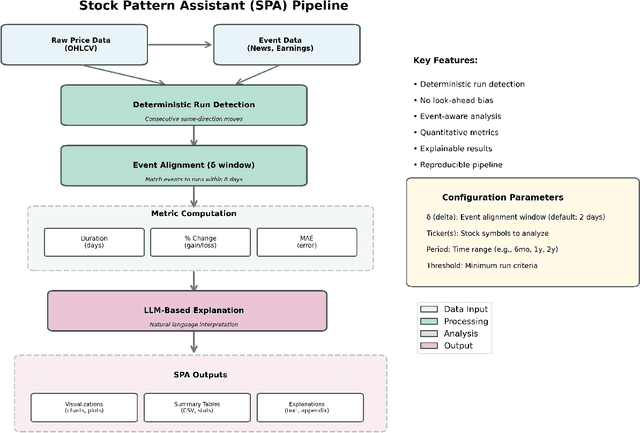
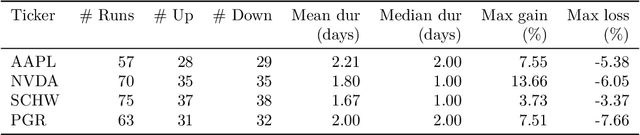
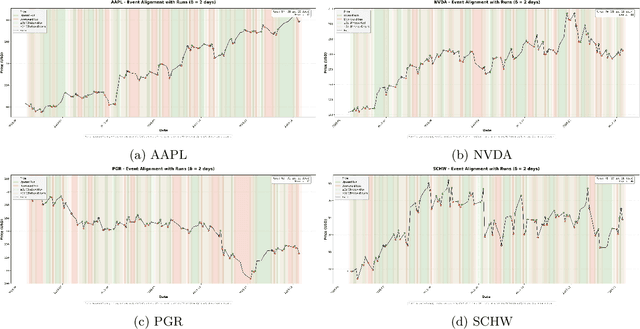

Understanding how prices evolve over time often requires peeling back the layers of market noise to identify clear, structural behavior. Many of the tools commonly used for this purpose technical indicators, chart heuristics, or even sophisticated predictive models leave important questions unanswered. Technical indicators depend on platform-specific rules, and predictive systems typically offer little in terms of explanation. In settings that demand transparency or auditability, this poses a significant challenge. We introduce the Stock Pattern Assistant (SPA), a deterministic framework designed to extract monotonic price runs, attach relevant public events through a symmetric correlation window, and generate explanations that are factual, historical, and guardrailed. SPA relies only on daily OHLCV data and a normalized event stream, making the pipeline straight-forward to audit and easy to reproduce. To illustrate SPA's behavior in practice, we evaluate it across four equities-AAPL, NVDA, SCHW, and PGR-chosen to span a range of volatility regimes and sector characteristics. Although the evaluation period is modest, the results demonstrate how SPA consistently produces stable structural decompositions and contextual narratives. Ablation experiments further show how deterministic segmentation, event alignment, and constrained explanation each contribute to interpretability. SPA is not a forecasting system, nor is it intended to produce trading signals. Its value lies in offering a transparent, reproducible view of historical price structure that can complement analyst workflows, risk reviews, and broader explainable-AI pipelines.