 Add to Chrome
 Add to Firefox
 Add to Edge
Robust inverse material design with physical guarantees using the Voigt-Reuss Net
Nov 14, 2025
We propose a spectrally normalized surrogate for forward and inverse mechanical homogenization with hard physical guarantees. Leveraging the Voigt-Reuss bounds, we factor their difference via a Cholesky-like operator and learn a dimensionless, symmetric positive semi-definite representation with eigenvalues in $[0,1]$; the inverse map returns symmetric positive-definite predictions that lie between the bounds in the Löwner sense. In 3D linear elasticity on an open dataset of stochastic biphasic microstructures, a fully connected Voigt-Reuss net trained on $>\!7.5\times 10^{5}$ FFT-based labels with 236 isotropy-invariant descriptors and three contrast parameters recovers the isotropic projection with near-perfect fidelity (isotropy-related entries: $R^2 \ge 0.998$), while anisotropy-revealing couplings are unidentifiable from $SO(3)$-invariant inputs. Tensor-level relative Frobenius errors have median $\approx 1.7\%$ and mean $\approx 3.4\%$ across splits. For 2D plane strain on thresholded trigonometric microstructures, coupling spectral normalization with a differentiable renderer and a CNN yields $R^2>0.99$ on all components, subpercent normalized losses, accurate tracking of percolation-induced eigenvalue jumps, and robust generalization to out-of-distribution images. Treating the parametric microstructure as design variables, batched first-order optimization with a single surrogate matches target tensors within a few percent and returns diverse near-optimal designs. Overall, the Voigt-Reuss net unifies accurate, physically admissible forward prediction with large-batch, constraint-consistent inverse design, and is generic to elliptic operators and coupled-physics settings.

Spectral Normalization and Voigt-Reuss net: A universal approach to microstructure-property forecasting with physical guarantees
Apr 01, 2025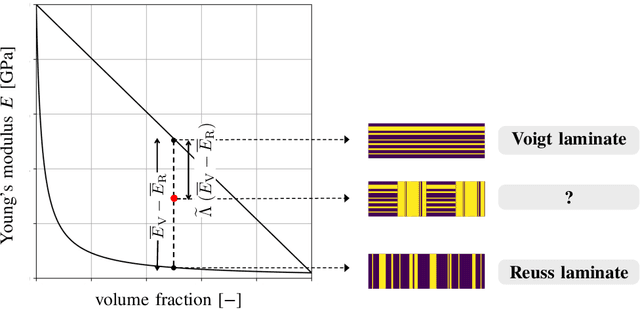
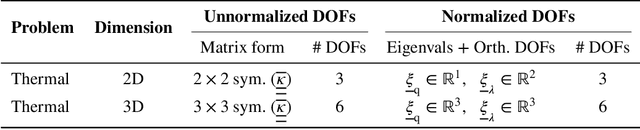
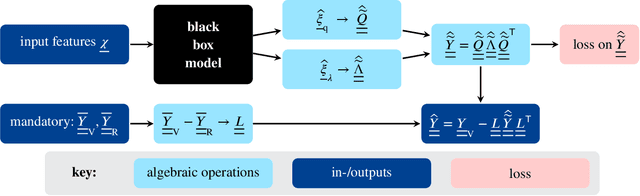
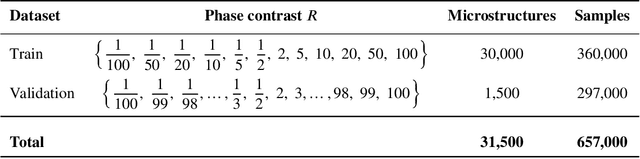
Heterogeneous materials are crucial to producing lightweight components, functional components, and structures composed of them. A crucial step in the design process is the rapid evaluation of their effective mechanical, thermal, or, in general, constitutive properties. The established procedure is to use forward models that accept microstructure geometry and local constitutive properties as inputs. The classical simulation-based approach, which uses, e.g., finite elements and FFT-based solvers, can require substantial computational resources. At the same time, simulation-based models struggle to provide gradients with respect to the microstructure and the constitutive parameters. Such gradients are, however, of paramount importance for microstructure design and for inverting the microstructure-property mapping. Machine learning surrogates can excel in these situations. However, they can lead to unphysical predictions that violate essential bounds on the constitutive response, such as the upper (Voigt-like) or the lower (Reuss-like) bound in linear elasticity. Therefore, we propose a novel spectral normalization scheme that a priori enforces these bounds. The approach is fully agnostic with respect to the chosen microstructural features and the utilized surrogate model. All of these will automatically and strictly predict outputs that obey the upper and lower bounds by construction. The technique can be used for any constitutive tensor that is symmetric and where upper and lower bounds (in the L\"owner sense) exist, i.e., for permeability, thermal conductivity, linear elasticity, and many more. We demonstrate the use of spectral normalization in the Voigt-Reuss net using a simple neural network. Numerical examples on truly extensive datasets illustrate the improved accuracy, robustness, and independence of the type of input features in comparison to much-used neural networks.