 Add to Chrome
 Add to Firefox
 Add to Edge
Reservoir property image slices from the Groningen gas field for image translation and segmentation
May 05, 2026
Reservoir characterization workflows increasingly rely on image-based and machine-learning/deep learning or even generative AI approaches, but openly available geological image datasets suitable for reproducible benchmarking remain limited. Here we describe a high-resolution dataset of reservoir-property image slices derived from the Groningen static geological model. The dataset contains aligned two-dimensional PNG images representing facies, porosity, permeability, and water saturation, generated from three-dimensional reservoir grids and prepared for downstream visualization, segmentation, and image-to-image translation tasks. In addition to the deposited original image corpus, we provide an archived software workflow for reproducing augmentation, mask generation, paired-image construction, and example baseline experiments. The resource is designed to support benchmarking of geological image analysis methods and the study of cross-domain relationships among reservoir properties. By separating the fixed image dataset from the reproducible processing workflow, this work provides a transparent foundation for reuse in geoscience, reservoir modeling, and machine-learning applications.

Robustness and Transferability of Pix2Geomodel for Bidirectional Facies Property Translation in a Complex Reservoir
May 05, 2026Reservoir geomodeling is central to subsurface characterization, but it remains challenging because conditioning data are sparse, geological heterogeneity is strong, and conventional geostatistical workflows often struggle to capture nonlinear relationships between facies and petrophysical properties. This study evaluates the robustness and transferability of Pix2Geomodel on a different and more complex reservoir dataset with reduced vertical support. The new case includes a heterogeneous reservoir-quality classification and only 54 retained layers, providing a stricter test of whether Pix2Pix-based image-to-image translation can preserve facies-property relationships under constrained data conditions. Facies, porosity, permeability, and clay volume (VCL) were extracted from a reference reservoir model, exported as aligned two-dimensional slices, augmented using consistent geometric transformations, and assembled into paired image datasets. Six bidirectional tasks were evaluated: facies to porosity, facies to permeability, facies to VCL, porosity to facies, permeability to facies, and VCL to facies. The Pix2Pix model, consisting of a U-Net generator and PatchGAN discriminator, was evaluated using image-based metrics, visual comparison, and variogram-based spatial-continuity validation. Results show that the model preserves the dominant geological architecture and main spatial-continuity trends. Facies to porosity achieved the highest pixel accuracy and frequency-weighted intersection over union of 0.9326 and 0.8807, while VCL to facies achieved the highest mean pixel accuracy and mean intersection over union of 0.8506 and 0.7049. These findings show that Pix2Geomodel can transfer beyond its original case study as a practical framework for rapid bidirectional facies-property translation in complex reservoir modeling.
Well log data generation and imputation using sequence-based generative adversarial networks
Dec 01, 2024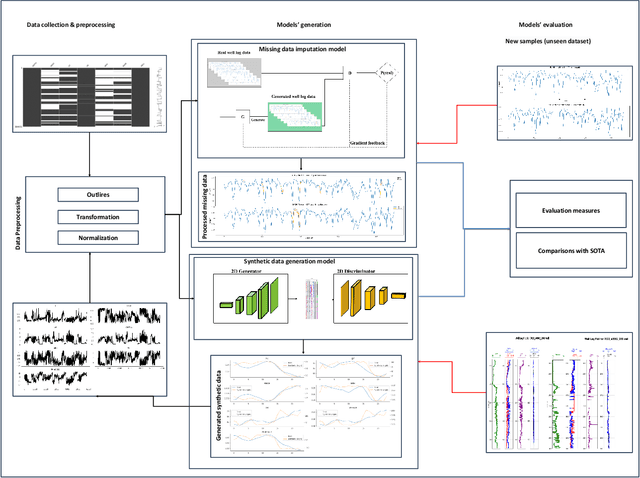

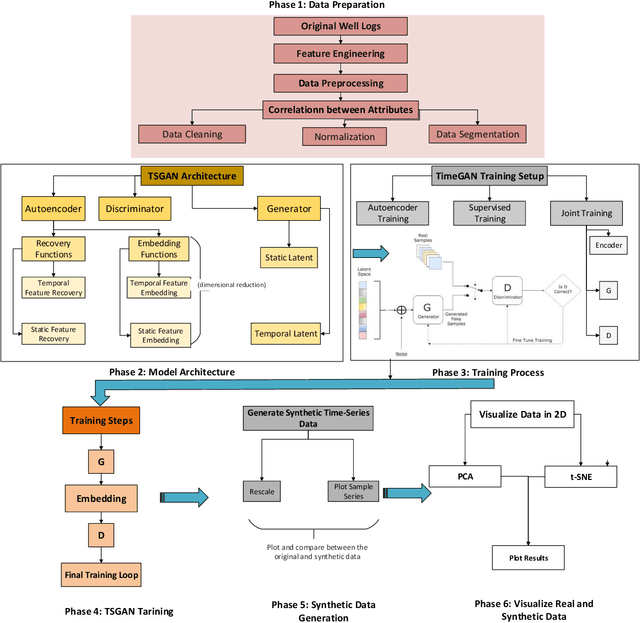

Well log analysis is crucial for hydrocarbon exploration, providing detailed insights into subsurface geological formations. However, gaps and inaccuracies in well log data, often due to equipment limitations, operational challenges, and harsh subsurface conditions, can introduce significant uncertainties in reservoir evaluation. Addressing these challenges requires effective methods for both synthetic data generation and precise imputation of missing data, ensuring data completeness and reliability. This study introduces a novel framework utilizing sequence-based generative adversarial networks (GANs) specifically designed for well log data generation and imputation. The framework integrates two distinct sequence-based GAN models: Time Series GAN (TSGAN) for generating synthetic well log data and Sequence GAN (SeqGAN) for imputing missing data. Both models were tested on a dataset from the North Sea, Netherlands region, focusing on different sections of 5, 10, and 50 data points. Experimental results demonstrate that this approach achieves superior accuracy in filling data gaps compared to other deep learning models for spatial series analysis. The method yielded R^2 values of 0.921, 0.899, and 0.594, with corresponding mean absolute percentage error (MAPE) values of 8.320, 0.005, and 151.154, and mean absolute error (MAE) values of 0.012, 0.005, and 0.032, respectively. These results set a new benchmark for data integrity and utility in geosciences, particularly in well log data analysis.
Enhanced anomaly detection in well log data through the application of ensemble GANs
Nov 29, 2024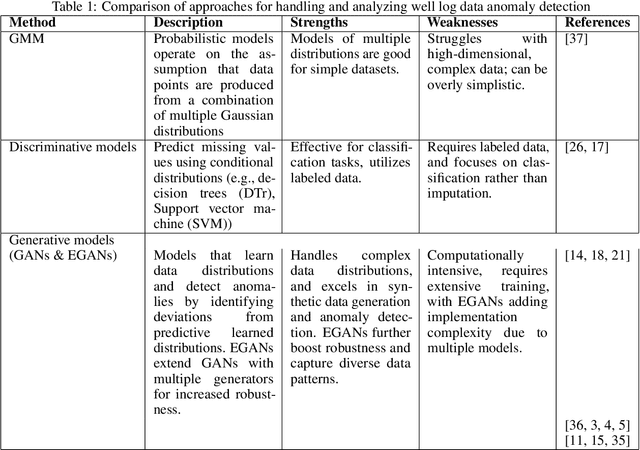
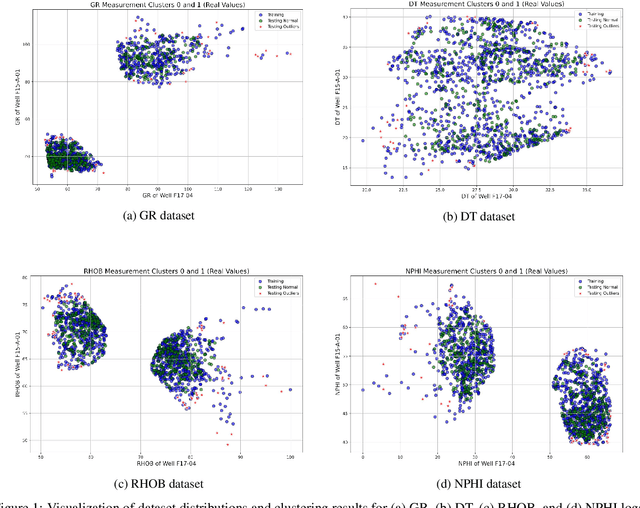
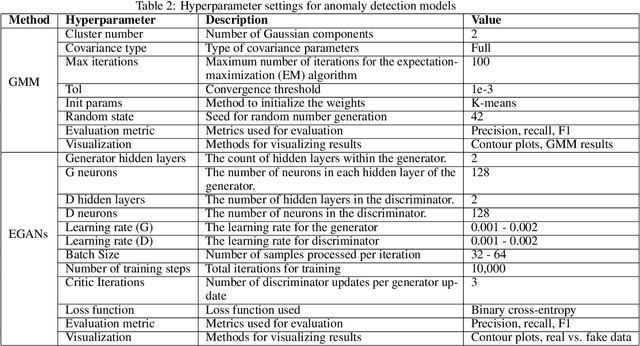
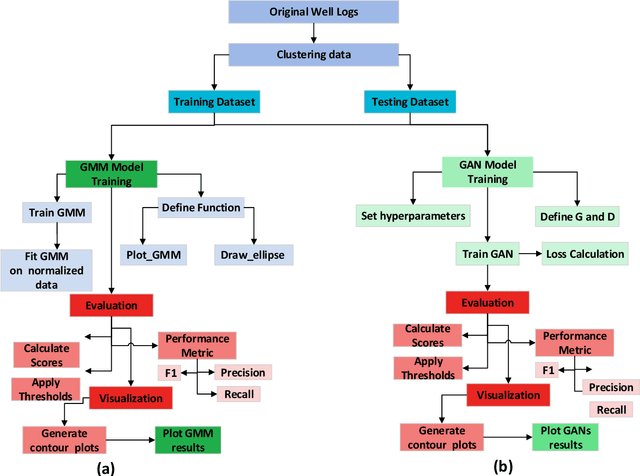
Although generative adversarial networks (GANs) have shown significant success in modeling data distributions for image datasets, their application to structured or tabular data, such as well logs, remains relatively underexplored. This study extends the ensemble GANs (EGANs) framework to capture the distribution of well log data and detect anomalies that fall outside of these distributions. The proposed approach compares the performance of traditional methods, such as Gaussian mixture models (GMMs), with EGANs in detecting anomalies outside the expected data distributions. For the gamma ray (GR) dataset, EGANs achieved a precision of 0.62 and F1 score of 0.76, outperforming GMM's precision of 0.38 and F1 score of 0.54. Similarly, for travel time (DT), EGANs achieved a precision of 0.70 and F1 score of 0.79, surpassing GMM 0.56 and 0.71. In the neutron porosity (NPHI) dataset, EGANs recorded a precision of 0.53 and F1 score of 0.68, outshining GMM 0.47 and 0.61. For the bulk density (RHOB) dataset, EGANs achieved a precision of 0.52 and an F1 score of 0.67, slightly outperforming GMM, which yielded a precision of 0.50 and an F1 score of 0.65. This work's novelty lies in applying EGANs for well log data analysis, showcasing their ability to learn data patterns and identify anomalies that deviate from them. This approach offers more reliable anomaly detection compared to traditional methods like GMM. The findings highlight the potential of EGANs in enhancing anomaly detection for well log data, delivering significant implications for optimizing drilling strategies and reservoir management through more accurate, data-driven insights into subsurface characterization.