 Add to Chrome
 Add to Firefox
 Add to Edge
A Mean-Field Framework for Inference-Time Distributional Control of Diffusion Models
Aug 09, 2026
Diffusion models are increasingly used as controllable samplers, whose generations can be steered at inference time according to a chosen reward function. While such rewards are typically defined on individual samples, for many applications it is desirable to steer according to distribution-level rewards, for example to calibrate with population-level information or to encourage diversity. In both cases, simply incorporating the reward gradient into the dynamics, while often effective, comes with few theoretical guarantees on the sampled distribution. For pointwise rewards, recent work has therefore sought to develop a principled framework for targeting a prescribed tilted distribution using particle reweighting. However, an analogous theoretically-grounded approach for distributional rewards is currently lacking. In this work, we formulate inference-time distributional control as targeting a tilted measure under a mean-field framework, and derive a weighted interacting particle scheme to target it in a principled manner. Our framework recovers pointwise-reward steering as a special case, while providing a theoretical foundation for existing batch-level steering methods. Empirically, we verify that the procedure correctly targets the prescribed distribution in tractable low-dimensional settings, and investigate its behaviour in higher-dimensional protein conformation tasks.

Diffusion Models and the Manifold Hypothesis: Log-Domain Smoothing is Geometry Adaptive
Oct 02, 2025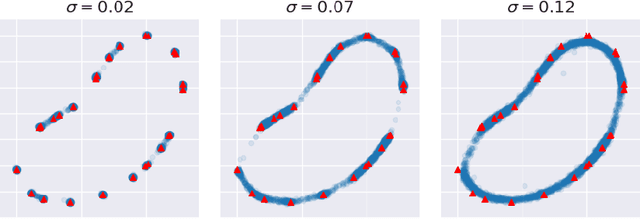
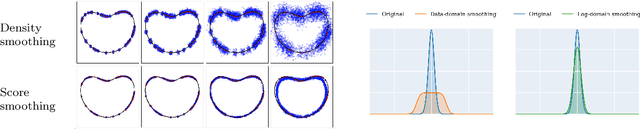
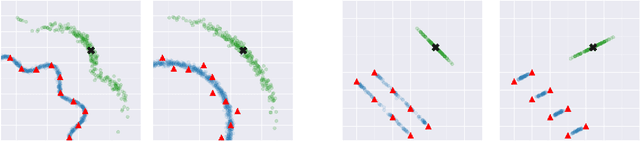
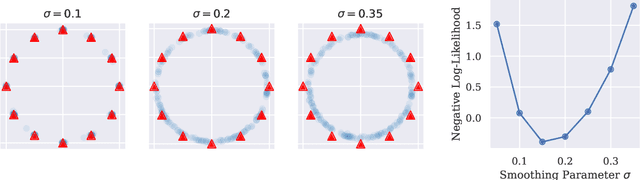
Diffusion models have achieved state-of-the-art performance, demonstrating remarkable generalisation capabilities across diverse domains. However, the mechanisms underpinning these strong capabilities remain only partially understood. A leading conjecture, based on the manifold hypothesis, attributes this success to their ability to adapt to low-dimensional geometric structure within the data. This work provides evidence for this conjecture, focusing on how such phenomena could result from the formulation of the learning problem through score matching. We inspect the role of implicit regularisation by investigating the effect of smoothing minimisers of the empirical score matching objective. Our theoretical and empirical results confirm that smoothing the score function -- or equivalently, smoothing in the log-density domain -- produces smoothing tangential to the data manifold. In addition, we show that the manifold along which the diffusion model generalises can be controlled by choosing an appropriate smoothing.
Differentiable Cost-Parameterized Monge Map Estimators
Jun 12, 2024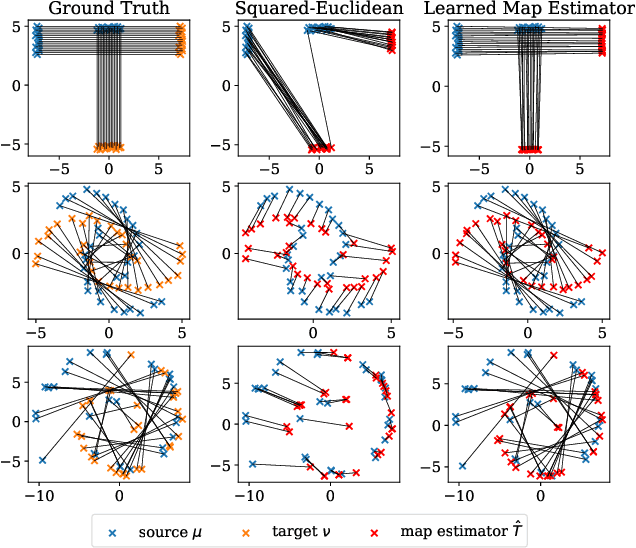
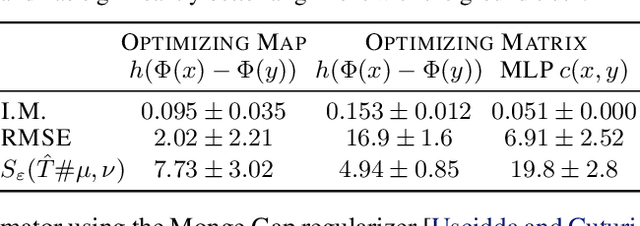
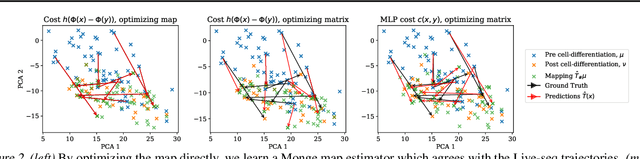
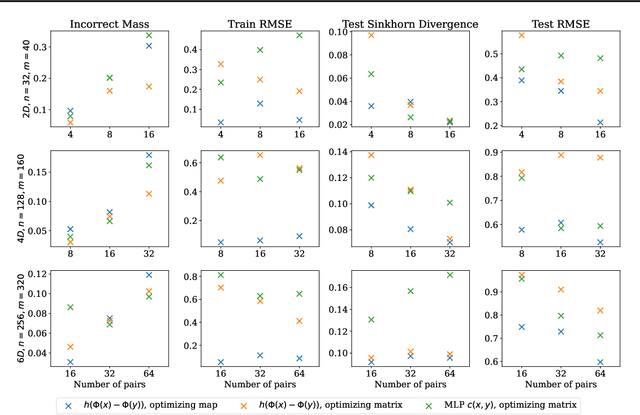
Within the field of optimal transport (OT), the choice of ground cost is crucial to ensuring that the optimality of a transport map corresponds to usefulness in real-world applications. It is therefore desirable to use known information to tailor cost functions and hence learn OT maps which are adapted to the problem at hand. By considering a class of neural ground costs whose Monge maps have a known form, we construct a differentiable Monge map estimator which can be optimized to be consistent with known information about an OT map. In doing so, we simultaneously learn both an OT map estimator and a corresponding adapted cost function. Through suitable choices of loss function, our method provides a general approach for incorporating prior information about the Monge map itself when learning adapted OT maps and cost functions.