 Add to Chrome
 Add to Firefox
 Add to Edge
Integrating Neural Encoders in Bayesian Generalized Linear Mixed Models for Multimodal Data
Jul 06, 2026
Scalable Bayesian inference for generalized linear mixed models (GLMMs) provides uncertainty-aware analysis of correlated longitudinal data, but existing scalable approaches largely assume low-dimensional tabular predictors and do not directly accommodate high-dimensional modalities such as images and text. We address this limitation by learning one or more modality-specific neural encoders jointly with a GLMM objective, then performing variance-corrected stochasticgradient MCMC for the GLMM parameters conditional on the learned representation. This conditional-Bayes design combines supervised representation learning with posterior uncertainty quantification for population-level effects, subjectspecific heterogeneity, and modality-level random slopes. The resulting model preserves interpretable fixed and random effects for structured covariates and learned modalities while scaling gracefully to large longitudinal datasets. In simulation studies, our method recovers posterior means and variance estimates from full-data MCMC benchmarks after covariance correction. We further evaluate uncertainty through parameter-level interval coverage in simulations and predictive calibration on held-out data. Applications to glaucoma progression and adolescent mental health demonstrate that the framework allows nuanced assessment of the relative importance of each modality on both individual and population levels without sacrificing predictive performance.

Neural Conditional Event Time Models
Apr 03, 2020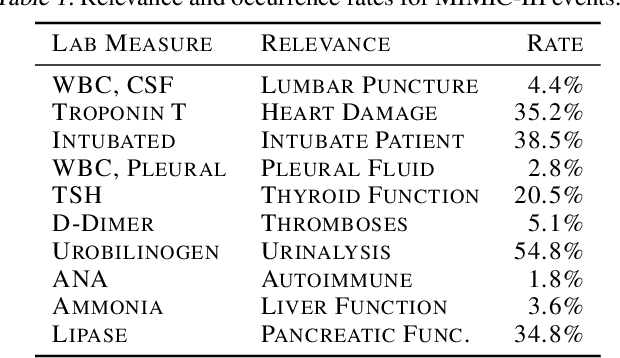
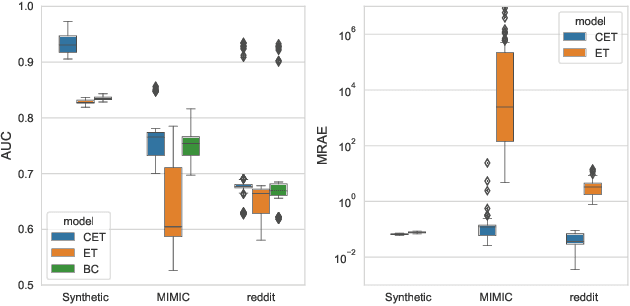
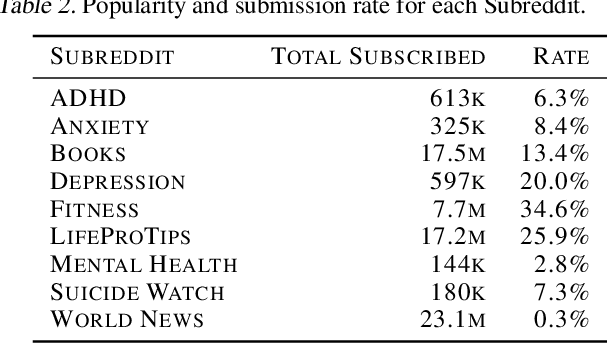
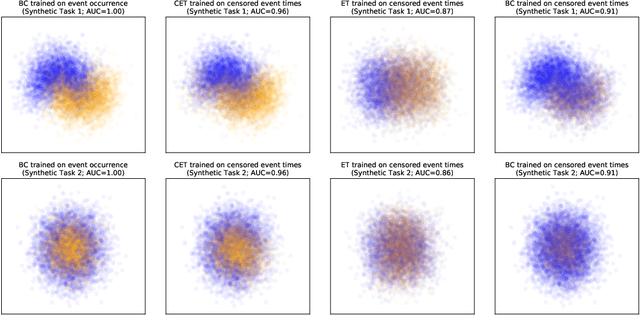
Event time models predict occurrence times of an event of interest based on known features. Recent work has demonstrated that neural networks achieve state-of-the-art event time predictions in a variety of settings. However, standard event time models suppose that the event occurs, eventually, in all cases. Consequently, no distinction is made between a) the probability of event occurrence, and b) the predicted time of occurrence. This distinction is critical when predicting medical diagnoses, equipment defects, social media posts, and other events that or may not occur, and for which the features affecting a) may be different from those affecting b). In this work, we develop a conditional event time model that distinguishes between these components, implement it as a neural network with a binary stochastic layer representing finite event occurrence, and show how it may be learned from right-censored event times via maximum likelihood estimation. Results demonstrate superior event occurrence and event time predictions on synthetic data, medical events (MIMIC-III), and social media posts (Reddit), comprising 21 total prediction tasks.