 Add to Chrome
 Add to Firefox
 Add to Edge
Learning Who Disagrees: Demographic Importance Weighting for Modeling Annotator Distributions with DiADEM
Apr 09, 2026
When humans label subjective content, they disagree, and that disagreement is not noise. It reflects genuine differences in perspective shaped by annotators' social identities and lived experiences. Yet standard practice still flattens these judgments into a single majority label, and recent LLM-based approaches fare no better: we show that prompted large language models, even with chain-of-thought reasoning, fail to recover the structure of human disagreement. We introduce DiADEM, a neural architecture that learns "how much each demographic axis matters" for predicting who will disagree and on what. DiADEM encodes annotators through per-demographic projections governed by a learned importance vector $\boldsymbolα$, fuses annotator and item representations via complementary concatenation and Hadamard interactions, and is trained with a novel item-level disagreement loss that directly penalizes mispredicted annotation variance. On the DICES conversational-safety and VOICED political-offense benchmarks, DiADEM substantially outperforms both the LLM-as-a-judge and neural model baselines across standard and perspectivist metrics, achieving strong disagreement tracking ($r{=}0.75$ on DICES). The learned $\boldsymbolα$ weights reveal that race and age consistently emerge as the most influential demographic factors driving annotator disagreement across both datasets. Our results demonstrate that explicitly modeling who annotators are not just what they label is essential for NLP systems that aim to faithfully represent human interpretive diversity.

LPI-RIT at LeWiDi-2025: Improving Distributional Predictions via Metadata and Loss Reweighting with DisCo
Aug 11, 2025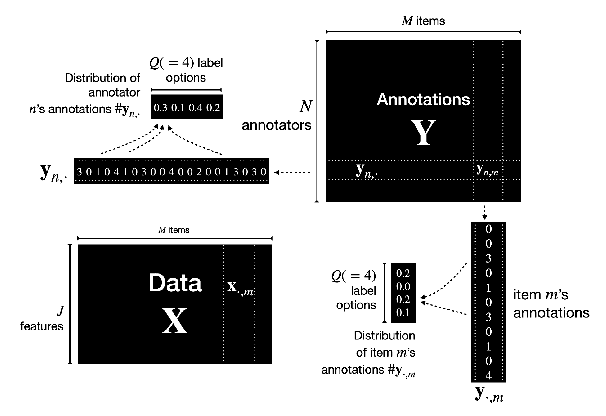
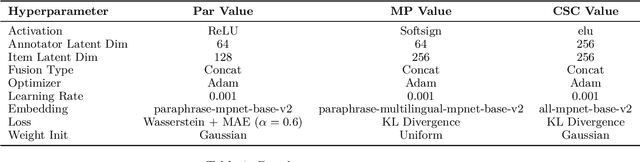
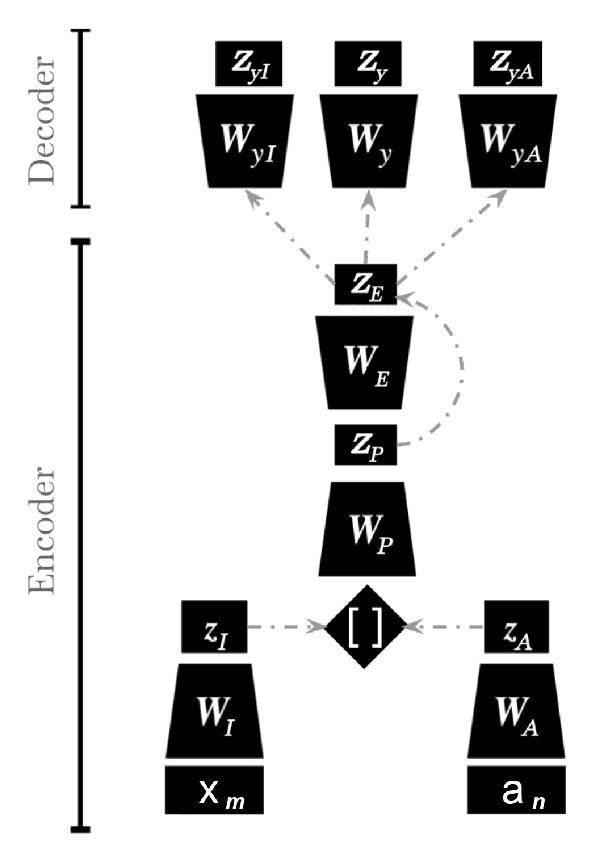

The Learning With Disagreements (LeWiDi) 2025 shared task is to model annotator disagreement through soft label distribution prediction and perspectivist evaluation, modeling annotators. We adapt DisCo (Distribution from Context), a neural architecture that jointly models item-level and annotator-level label distributions, and present detailed analysis and improvements. In this paper, we extend the DisCo by incorporating annotator metadata, enhancing input representations, and modifying the loss functions to capture disagreement patterns better. Through extensive experiments, we demonstrate substantial improvements in both soft and perspectivist evaluation metrics across three datasets. We also conduct in-depth error and calibration analyses, highlighting the conditions under which improvements occur. Our findings underscore the value of disagreement-aware modeling and offer insights into how system components interact with the complexity of human-annotated data.