 Add to Chrome
 Add to Firefox
 Add to Edge
Emergence: Overcoming Privileged Information Bias in Asymmetric Embodied Agents via Active Querying
Dec 13, 2025
Large Language Models (LLMs) act as powerful reasoning engines but struggle with "symbol grounding" in embodied environments, particularly when information is asymmetrically distributed. We investigate the Privileged Information Bias (or "Curse of Knowledge"), where a knowledgeable "Leader" agent fails to guide a sensor-limited "Follower" due to a lack of Theory of Mind. To quantify this phenomenon, we propose a novel Asymmetric Assistive Reasoning framework within AI2-THOR. Our experiments reveal a significant "Success Gap": while the Leader successfully perceives the target in 35.0% of episodes, the collaborative team succeeds only 17.0% of the time, implying that nearly 50% of feasible plans fail solely due to communicative grounding errors. We demonstrate that a "Pull-based" protocol (active querying) is significantly more robust than standard "Push-based" instruction, with successful episodes featuring 2x the frequency of clarification requests. This research isolates the mechanism of active uncertainty reduction as a prerequisite for safe human-AI and robot-robot collaboration.

Domain Wall Magnetic Tunnel Junction Reliable Integrate and Fire Neuron
May 23, 2024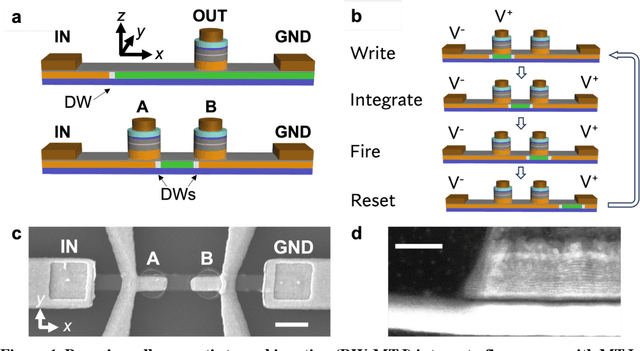
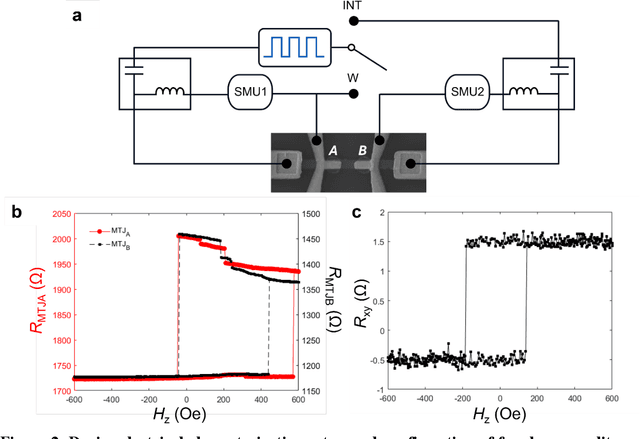
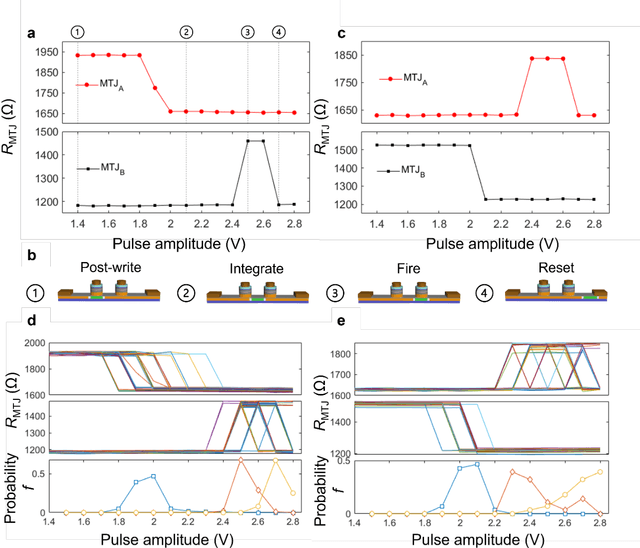
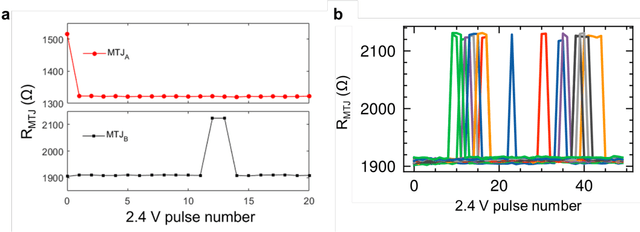
In spiking neural networks, neuron dynamics are described by the biologically realistic integrate-and-fire model that captures membrane potential accumulation and above-threshold firing behaviors. Among the hardware implementations of integrate-and-fire neuron devices, one important feature, reset, has been largely ignored. Here, we present the design and fabrication of a magnetic domain wall and magnetic tunnel junction based artificial integrate-and-fire neuron device that achieves reliable reset at the end of the integrate-fire cycle. We demonstrate the domain propagation in the domain wall racetrack (integration), reading using a magnetic tunnel junction (fire), and reset as the domain is ejected from the racetrack, showing the artificial neuron can be operated continuously over 100 integrate-fire-reset cycles. Both pulse amplitude and pulse number encoding is demonstrated. The device data is applied on an image classification task using a spiking neural network and shown to have comparable performance to an ideal leaky, integrate-and-fire neural network. These results achieve the first demonstration of reliable integrate-fire-reset in domain wall-magnetic tunnel junction-based neuron devices and shows the promise of spintronics for neuromorphic computing.