 Add to Chrome
 Add to Firefox
 Add to Edge
DichroGAN: Towards Restoration of in-air Colours of Seafloor from Satellite Imagery
Jan 01, 2026
Recovering the in-air colours of seafloor from satellite imagery is a challenging task due to the exponential attenuation of light with depth in the water column. In this study, we present DichroGAN, a conditional generative adversarial network (cGAN) designed for this purpose. DichroGAN employs a two-steps simultaneous training: first, two generators utilise a hyperspectral image cube to estimate diffuse and specular reflections, thereby obtaining atmospheric scene radiance. Next, a third generator receives as input the generated scene radiance containing the features of each spectral band, while a fourth generator estimates the underwater light transmission. These generators work together to remove the effects of light absorption and scattering, restoring the in-air colours of seafloor based on the underwater image formation equation. DichroGAN is trained on a compact dataset derived from PRISMA satellite imagery, comprising RGB images paired with their corresponding spectral bands and masks. Extensive experiments on both satellite and underwater datasets demonstrate that DichroGAN achieves competitive performance compared to state-of-the-art underwater restoration techniques.

DGD-cGAN: A Dual Generator for Image Dewatering and Restoration
Nov 18, 2022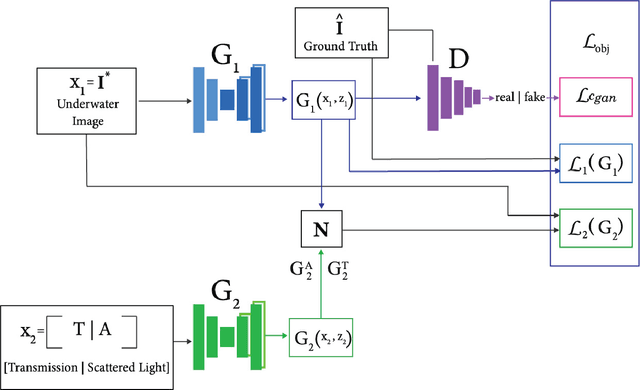
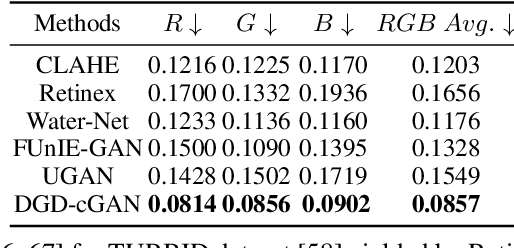
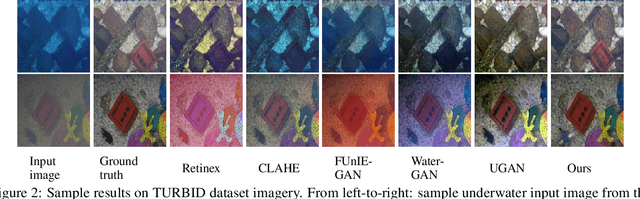
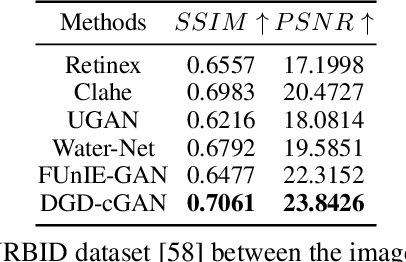
Underwater images are usually covered with a blue-greenish colour cast, making them distorted, blurry or low in contrast. This phenomenon occurs due to the light attenuation given by the scattering and absorption in the water column. In this paper, we present an image enhancement approach for dewatering which employs a conditional generative adversarial network (cGAN) with two generators. Our Dual Generator Dewatering cGAN (DGD-cGAN) removes the haze and colour cast induced by the water column and restores the true colours of underwater scenes whereby the effects of various attenuation and scattering phenomena that occur in underwater images are tackled by the two generators. The first generator takes at input the underwater image and predicts the dewatered scene, while the second generator learns the underwater image formation process by implementing a custom loss function based upon the transmission and the veiling light components of the image formation model. Our experiments show that DGD-cGAN consistently delivers a margin of improvement as compared with the state-of-the-art methods on several widely available datasets.