 Add to Chrome
 Add to Firefox
 Add to Edge
Virtual Process Dossier: A Process-Aware Data Catalogue
Jul 30, 2026
We propose the Virtual Process Dossier (VPD), a Knowledge Graph-based data catalogue that also captures workflow provenance. We developed VPD for multi-stage manufacturing use-cases where downstream AI-based optimization tasks require to distinct between datasets generated during individual workflow steps. VPD provides these datasets in a FAIR manner and makes both prospective and retrospective workflow provenance explicit. Our contributions are: (1) the VPD ontology that serves as the catalogue's semantic core; (2) the VPD provenance framework that integrates ontology instantiation into the production environment; and (3) the VPD user interface that provides human-centered interaction with the VPD Knowledge Graph. The ontology and code are available at https://github.com/kubeluk/VirtualProcessDossier .

Partially Observable Gaussian Process Network and Doubly Stochastic Variational Inference
Feb 19, 2025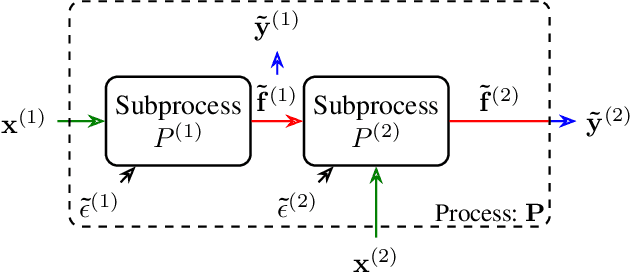
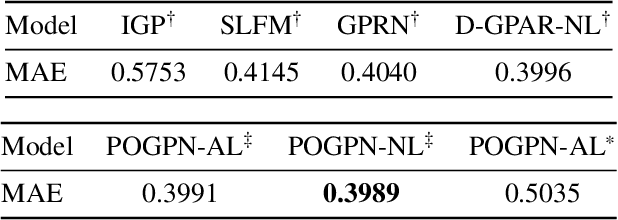
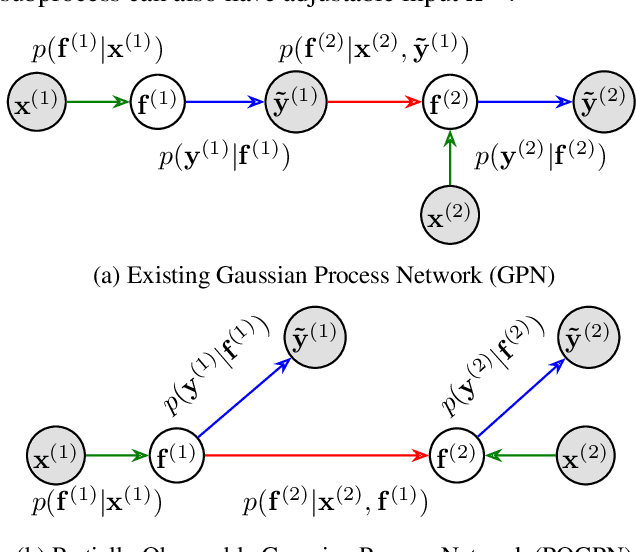
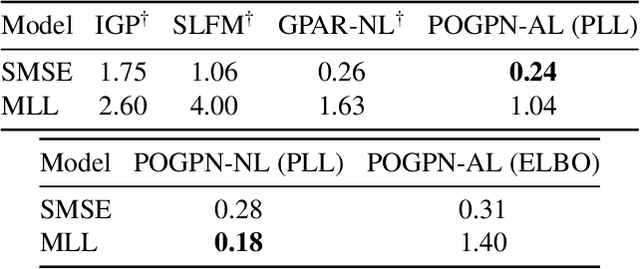
To reduce the curse of dimensionality for Gaussian processes (GP), they can be decomposed into a Gaussian Process Network (GPN) of coupled subprocesses with lower dimensionality. In some cases, intermediate observations are available within the GPN. However, intermediate observations are often indirect, noisy, and incomplete in most real-world systems. This work introduces the Partially Observable Gaussian Process Network (POGPN) to model real-world process networks. We model a joint distribution of latent functions of subprocesses and make inferences using observations from all subprocesses. POGPN incorporates observation lenses (observation likelihoods) into the well-established inference method of deep Gaussian processes. We also introduce two training methods for POPGN to make inferences on the whole network using node observations. The application to benchmark problems demonstrates how incorporating partial observations during training and inference can improve the predictive performance of the overall network, offering a promising outlook for its practical application.