 Add to Chrome
 Add to Firefox
 Add to Edge
Think Deep, Speak Once: Relit, A Recursive Latent Implicit Transformer Framework
Aug 08, 2026
Chain-of-Thought (CoT) prompting has become the dominant paradigm for eliciting reasoning in Large Language Models (LLMs), yet it creates substantial computational overhead by forcing models to externalize intermediate reasoning steps as discrete tokens. Recent latent reasoning approaches attempt to internalize this process within continuous hidden states. One of the latest advancements in the field of latent reasoning, Tiny Recursive Models (TRMs) excel at symbolic reasoning but struggle to preserve semantic coherence in natural language settings. To bridge this gap, we introduce ReLIT (Recursive Latent Implicit Transformer), a hybrid framework that grounds deep recursive reasoning within the rich semantic representations of a foundational model. ReLIT augments a frozen LLM backbone (TinyLlama-1.1B) with a lightweight, trainable recursive block that iteratively refines its latent thinking (z) before committing to a final output, structurally solving linguistic intuition from algorithmic processing and enabling "deep thinking" via gradient-isolated recurrent loops without the latency of explicit token generation. Empirically, ReLIT achieves high parameter efficiency on the GLoRE logical reasoning benchmark, matching or outperforming significantly larger models on challenging tasks such as ProofWriter and RuleTaker despite minimal supervision. These results demonstrate that reasoning capability can be scaled efficiently through recurrent depth rather than parameter width, offering a principled framework for semantically grounded implicit reasoning.

Small LLMs with Expert Blocks Are Good Enough for Hyperparamter Tuning
Sep 19, 2025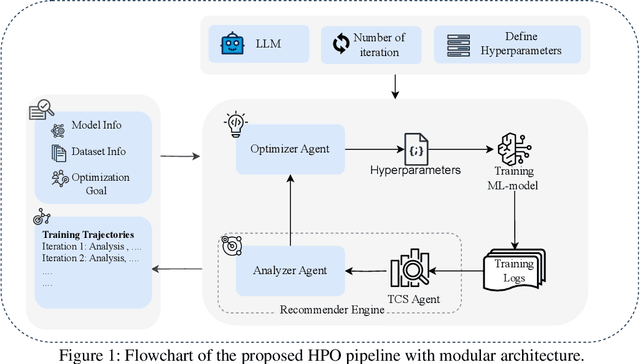

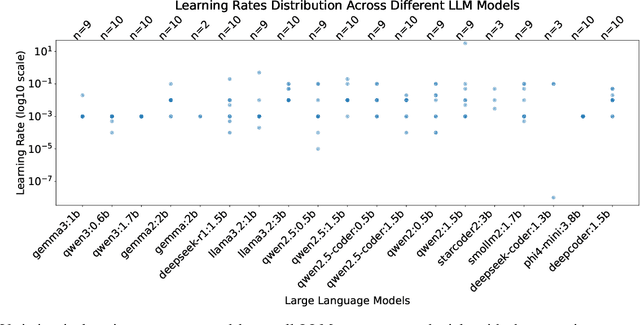
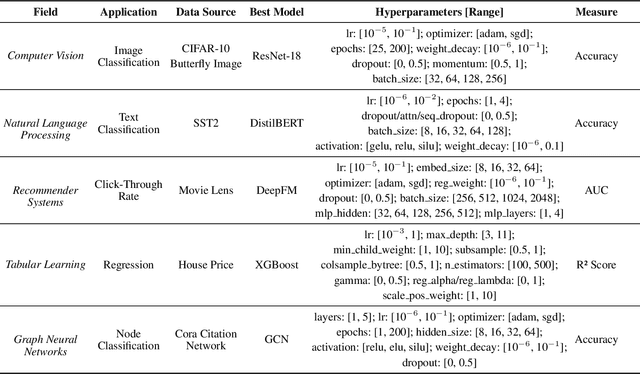
Hyper-parameter Tuning (HPT) is a necessary step in machine learning (ML) pipelines but becomes computationally expensive and opaque with larger models. Recently, Large Language Models (LLMs) have been explored for HPT, yet most rely on models exceeding 100 billion parameters. We propose an Expert Block Framework for HPT using Small LLMs. At its core is the Trajectory Context Summarizer (TCS), a deterministic block that transforms raw training trajectories into structured context, enabling small LLMs to analyze optimization progress with reliability comparable to larger models. Using two locally-run LLMs (phi4:reasoning14B and qwen2.5-coder:32B) and a 10-trial budget, our TCS-enabled HPT pipeline achieves average performance within ~0.9 percentage points of GPT-4 across six diverse tasks.