 Add to Chrome
 Add to Firefox
 Add to Edge
APIC: Amortized Physics-Informed Calibration using Neural Processes
Jun 02, 2026
Physics models are inherently imperfect due to misspecified or missing mechanisms, resulting in systematic discrepancies between model predictions and real-world observations. The Kennedy-O'Hagan (KOH) framework addresses this issue through explicit discrepancy modeling. However, its non-amortized, per-instance formulation limits scalability across families of related systems. We introduce Amortized Physics-Informed Calibration (APIC), a population-level extension of KOH that leverages Neural Processes to perform scalable Bayesian inference across realizations. Our framework employs a two-branch latent architecture to disentangle instance-specific physical parameters from shared, state-dependent structural discrepancies. By integrating differentiable physics into an amortized inference backbone, APIC enables rapid calibration of unseen realizations from sparse observations while quantifying uncertainty. Experiments on the damped spring oscillator, the Lotka-Volterra system, and the advection-diffusion PDE with misspecified physics demonstrate improved parameter recovery and consistent identification of the systemic discrepancy structure compared to other calibration approaches.

Uncertainty-aware Physics-informed Neural Networks for Robust CARS-to-Raman Signal Reconstruction
Nov 17, 2025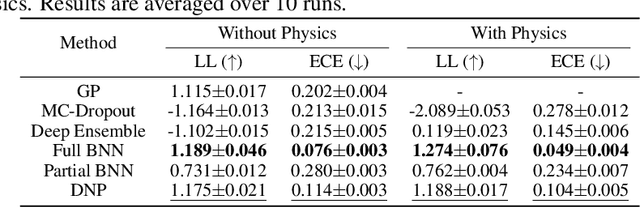
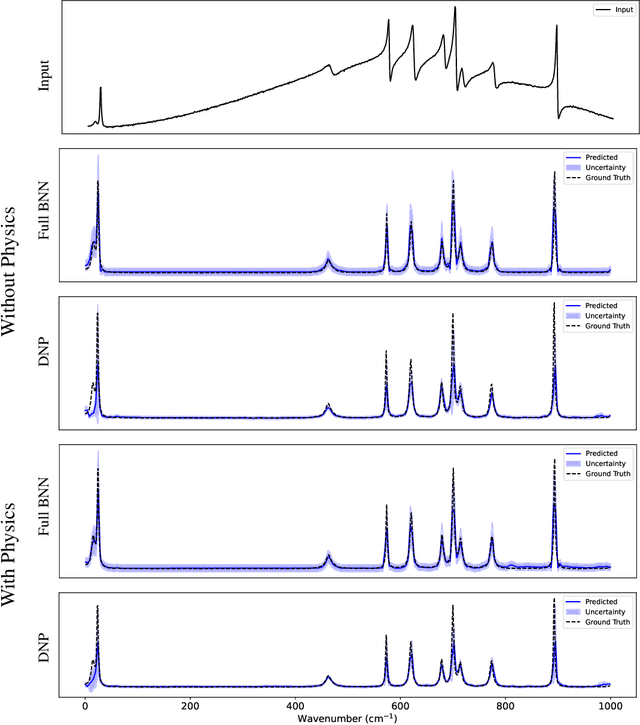
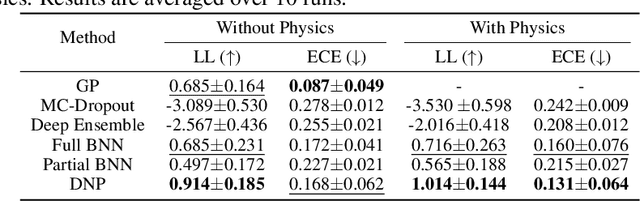
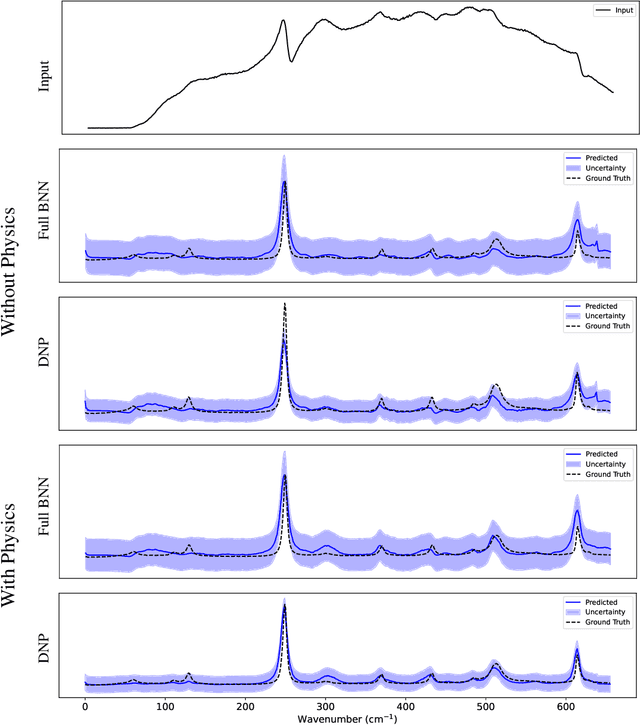
Coherent anti-Stokes Raman scattering (CARS) spectroscopy is a powerful and rapid technique widely used in medicine, material science, and chemical analyses. However, its effectiveness is hindered by the presence of a non-resonant background that interferes with and distorts the true Raman signal. Deep learning methods have been employed to reconstruct the true Raman spectrum from measured CARS data using labeled datasets. A more recent development integrates the domain knowledge of Kramers-Kronig relationships and smoothness constraints in the form of physics-informed loss functions. However, these deterministic models lack the ability to quantify uncertainty, an essential feature for reliable deployment in high-stakes scientific and biomedical applications. In this work, we evaluate and compare various uncertainty quantification (UQ) techniques within the context of CARS-to-Raman signal reconstruction. Furthermore, we demonstrate that incorporating physics-informed constraints into these models improves their calibration, offering a promising path toward more trustworthy CARS data analysis.
F-INR: Functional Tensor Decomposition for Implicit Neural Representations
Mar 27, 2025Implicit Neural Representation (INR) has emerged as a powerful tool for encoding discrete signals into continuous, differentiable functions using neural networks. However, these models often have an unfortunate reliance on monolithic architectures to represent high-dimensional data, leading to prohibitive computational costs as dimensionality grows. We propose F-INR, a framework that reformulates INR learning through functional tensor decomposition, breaking down high-dimensional tasks into lightweight, axis-specific sub-networks. Each sub-network learns a low-dimensional data component (e.g., spatial or temporal). Then, we combine these components via tensor operations, reducing forward pass complexity while improving accuracy through specialized learning. F-INR is modular and, therefore, architecture-agnostic, compatible with MLPs, SIREN, WIRE, or other state-of-the-art INR architecture. It is also decomposition-agnostic, supporting CP, TT, and Tucker modes with user-defined rank for speed-accuracy control. In our experiments, F-INR trains $100\times$ faster than existing approaches on video tasks while achieving higher fidelity (+3.4 dB PSNR). Similar gains hold for image compression, physics simulations, and 3D geometry reconstruction. Through this, F-INR offers a new scalable, flexible solution for high-dimensional signal modeling.
Functional Tensor Decompositions for Physics-Informed Neural Networks
Aug 23, 2024
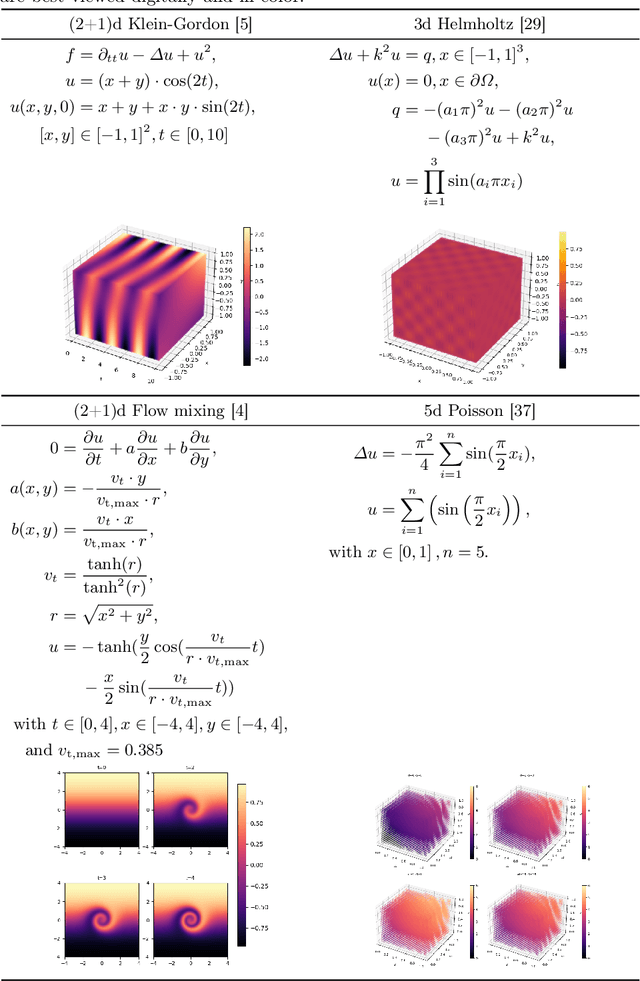

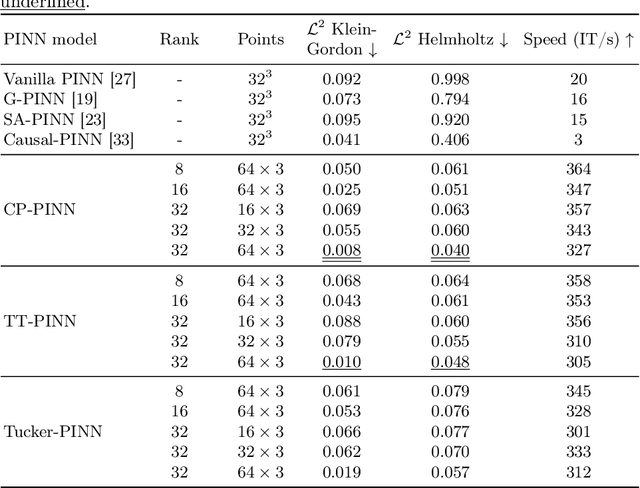
Physics-Informed Neural Networks (PINNs) have shown continuous and increasing promise in approximating partial differential equations (PDEs), although they remain constrained by the curse of dimensionality. In this paper, we propose a generalized PINN version of the classical variable separable method. To do this, we first show that, using the universal approximation theorem, a multivariate function can be approximated by the outer product of neural networks, whose inputs are separated variables. We leverage tensor decomposition forms to separate the variables in a PINN setting. By employing Canonic Polyadic (CP), Tensor-Train (TT), and Tucker decomposition forms within the PINN framework, we create robust architectures for learning multivariate functions from separate neural networks connected by outer products. Our methodology significantly enhances the performance of PINNs, as evidenced by improved results on complex high-dimensional PDEs, including the 3d Helmholtz and 5d Poisson equations, among others. This research underscores the potential of tensor decomposition-based variably separated PINNs to surpass the state-of-the-art, offering a compelling solution to the dimensionality challenge in PDE approximation.