 Add to Chrome
 Add to Firefox
 Add to Edge
Out-of-Distribution Object Detection in Street Scenes via Synthetic Outlier Exposure and Transfer Learning
Mar 17, 2026
Out-of-distribution (OOD) object detection is an important yet underexplored task. A reliable object detector should be able to handle OOD objects by localizing and correctly classifying them as OOD. However, a critical issue arises when such atypical objects are completely missed by the object detector and incorrectly treated as background. Existing OOD detection approaches in object detection often rely on complex architectures or auxiliary branches and typically do not provide a framework that treats in-distribution (ID) and OOD in a unified way. In this work, we address these limitations by enabling a single detector to detect OOD objects, that are otherwise silently overlooked, alongside ID objects. We present \textbf{SynOE-OD}, a \textbf{Syn}thetic \textbf{O}utlier-\textbf{E}xposure-based \textbf{O}bject \textbf{D}etection framework, that leverages strong generative models, like Stable Diffusion, and Open-Vocabulary Object Detectors (OVODs) to generate semantically meaningful, object-level data that serve as outliers during training. The generated data is used for transfer-learning to establish strong ID task performance and supplement detection models with OOD object detection robustness. Our approach achieves state-of-the-art average precision on an established OOD object detection benchmark, where OVODs, such as GroundingDINO, show limited zero-shot performance in detecting OOD objects in street-scenes.

On the Potential of Open-Vocabulary Models for Object Detection in Unusual Street Scenes
Aug 20, 2024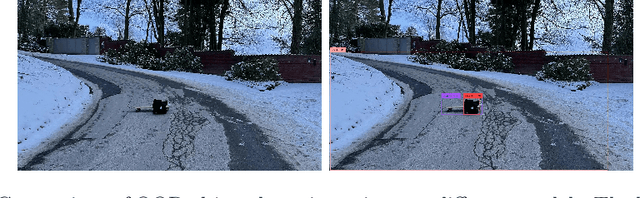
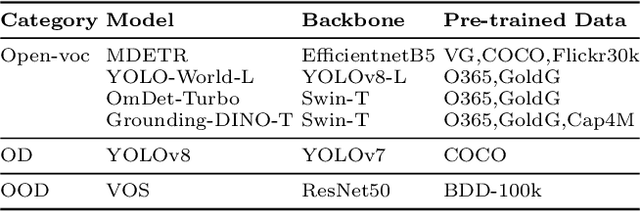
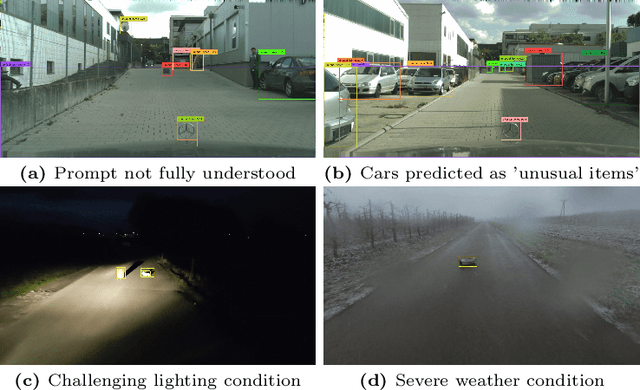
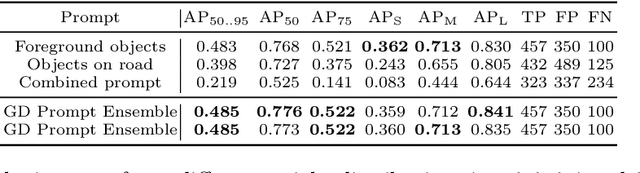
Out-of-distribution (OOD) object detection is a critical task focused on detecting objects that originate from a data distribution different from that of the training data. In this study, we investigate to what extent state-of-the-art open-vocabulary object detectors can detect unusual objects in street scenes, which are considered as OOD or rare scenarios with respect to common street scene datasets. Specifically, we evaluate their performance on the OoDIS Benchmark, which extends RoadAnomaly21 and RoadObstacle21 from SegmentMeIfYouCan, as well as LostAndFound, which was recently extended to object level annotations. The objective of our study is to uncover short-comings of contemporary object detectors in challenging real-world, and particularly in open-world scenarios. Our experiments reveal that open vocabulary models are promising for OOD object detection scenarios, however far from perfect. Substantial improvements are required before they can be reliably deployed in real-world applications. We benchmark four state-of-the-art open-vocabulary object detection models on three different datasets. Noteworthily, Grounding DINO achieves the best results on RoadObstacle21 and LostAndFound in our study with an AP of 48.3% and 25.4% respectively. YOLO-World excels on RoadAnomaly21 with an AP of 21.2%.