 Add to Chrome
 Add to Firefox
 Add to Edge
The Path of Least Resistance: Guiding LLM Reasining Trajectories with Prefix Consensus
Jan 29, 2026
Large language models achieve strong reasoning performance, but inference strategies such as Self-Consistency (SC) are computationally expensive, as they fully expand all reasoning traces. We introduce PoLR (Path of Least Resistance), the first inference-time method to leverage prefix consistency for compute-efficient reasoning. PoLR clusters short prefixes of reasoning traces, identifies the dominant cluster, and expands all paths in that cluster, preserving the accuracy benefits of SC while substantially reducing token usage and latency. Our theoretical analysis, framed via mutual information and entropy, explains why early reasoning steps encode strong signals predictive of final correctness. Empirically, PoLR consistently matches or exceeds SC across GSM8K, MATH500, AIME24/25, and GPQA-DIAMOND, reducing token usage by up to 60% and wall-clock latency by up to 50%. Moreover, PoLR is fully complementary to adaptive inference methods (e.g., Adaptive Consistency, Early-Stopping SC) and can serve as a drop-in pre-filter, making SC substantially more efficient and scalable without requiring model fine-tuning.

Balancing Continuous Pre-Training and Instruction Fine-Tuning: Optimizing Instruction-Following in LLMs
Oct 14, 2024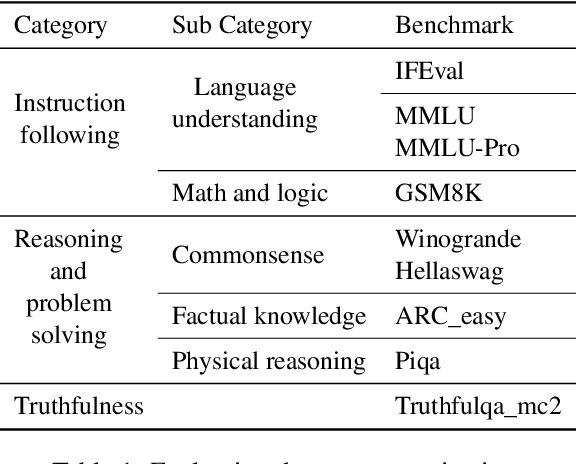
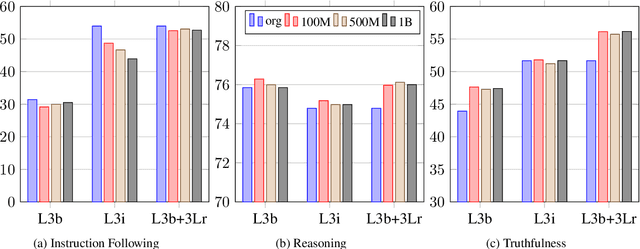
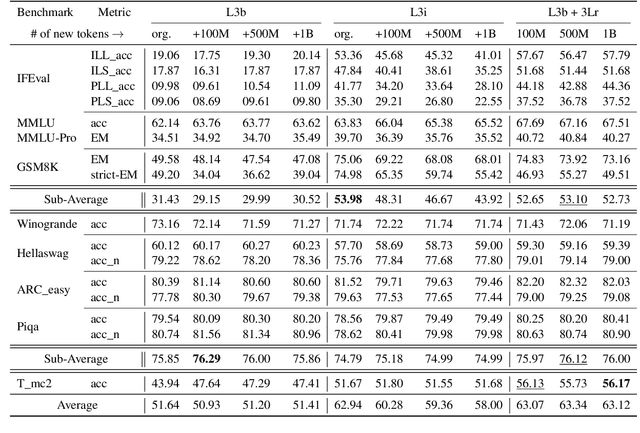
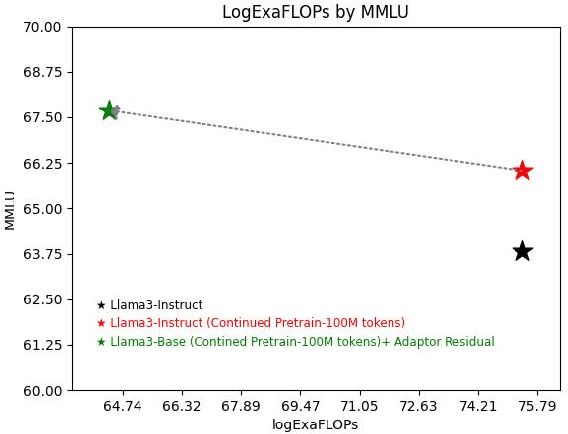
Large Language Models (LLMs) for public use require continuous pre-training to remain up-to-date with the latest data. The models also need to be fine-tuned with specific instructions to maintain their ability to follow instructions accurately. Typically, LLMs are released in two versions: the Base LLM, pre-trained on diverse data, and the instruction-refined LLM, additionally trained with specific instructions for better instruction following. The question arises as to which model should undergo continuous pre-training to maintain its instruction-following abilities while also staying current with the latest data. In this study, we delve into the intricate relationship between continuous pre-training and instruction fine-tuning of the LLMs and investigate the impact of continuous pre-training on the instruction following abilities of both the base and its instruction finetuned model. Further, the instruction fine-tuning process is computationally intense and requires a substantial number of hand-annotated examples for the model to learn effectively. This study aims to find the most compute-efficient strategy to gain up-to-date knowledge and instruction-following capabilities without requiring any instruction data and fine-tuning. We empirically prove our findings on the LLaMa 3, 3.1 and Qwen 2, 2.5 family of base and instruction models, providing a comprehensive exploration of our hypotheses across varying sizes of pre-training data corpus and different LLMs settings.