 Add to Chrome
 Add to Firefox
 Add to Edge
Conceptual Software Engineering Applied to Movie Scripts and Stories
Dec 17, 2020


This study introduces another application of software engineering tools, conceptual modeling, which can be applied to other fields of research. One way to strengthen the relationship between software engineering and other fields is to develop a good way to perform conceptual modeling that is capable of addressing the peculiarities of these fields of study. This study concentrates on humanities and social sciences, which are usually considered softer and further away from abstractions and (abstract) machines. Specifically, we focus on conceptual modeling as a software engineering tool (e.g., UML) in the area of stories and movie scripts. Researchers in the humanities and social sciences might not use the same degree of formalization that engineers do, but they still find conceptual modeling useful. Current modeling techniques (e.g., UML) fail in this task because they are geared toward the creation of software systems. Similar Conceptual Modeling Language (e.g., ConML) has been proposed with the humanities and social sciences in mind and, as claimed, can be used to model anything. This study is a venture in this direction, where a software modeling technique, Thinging Machine (TM), is applied to movie scripts and stories. The paper presents a novel approach to developing diagrammatic static/dynamic models of movie scripts and stories. The TM model diagram serves as a neutral and independent representation for narrative discourse and can be used as a communication instrument among participants. The examples presented include examples from Propp s model of fairytales; the railway children and an actual movie script seem to point to the viability of the approach.
* 13 pages, 16 figures

High-Level Description of Robot Architecture
Nov 25, 2020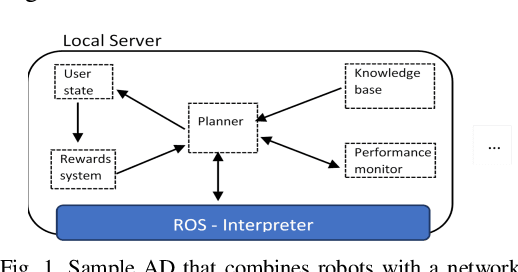

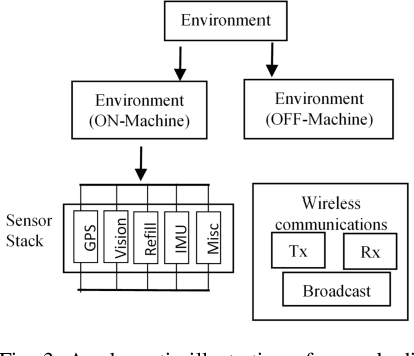
Architectural Description (AD) is the backbone that facilitates the implementation and validation of robotic systems. In general, current high-level ADs reflect great variation and lead to various difficulties, including mixing ADs with implementation issues. They lack the qualities of being systematic and coherent, as well as lacking technical-related forms (e.g., icons of faces, computer screens). Additionally, a variety of languages exist for eliciting requirements, such as object-oriented analysis methods susceptible to inconsistency (e.g., those using multiple diagrams in UML and SysML). In this paper, we orient our research toward a more generic conceptualization of ADs in robotics. We apply a new modeling methodology, namely the Thinging Machine (TM), to describe the architecture in robotic systems. The focus of such an application is on high-level specification, which is one important aspect for realizing the design and implementation in such systems. TM modeling can be utilized in documentation and communication and as the first step in the system s design phase. Accordingly, sample robot architectures are re-expressed in terms of TM, thus developing (1) a static model that captures the robot s atemporal aspects, (2) a dynamic model that identifies states, and (3) a behavioral model that specifies the chronology of events in the system. This result shows a viable approach in robot modeling that determines a robot system s behavior through its static description.
* 10 pages, 18 figures
Conceptual Modeling of Time for Computational Ontologies
Jul 16, 2020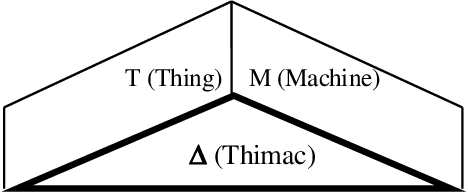
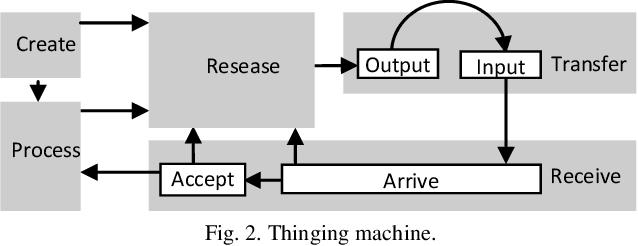
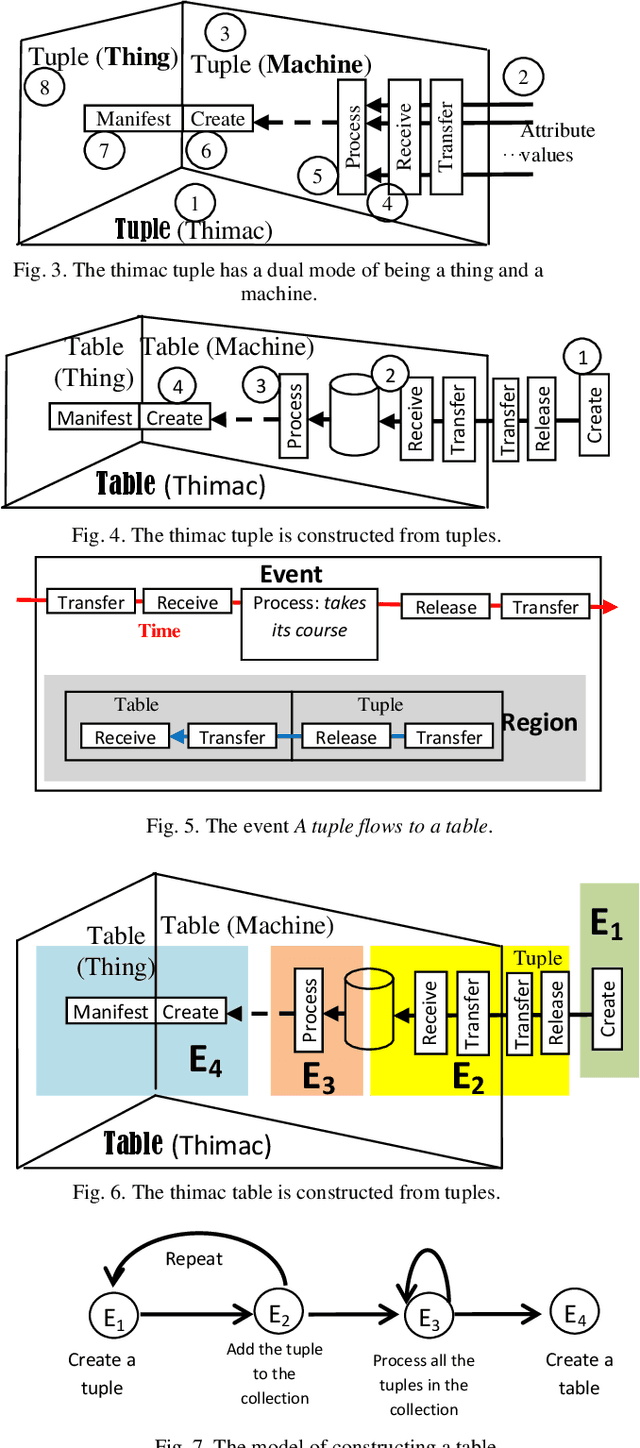
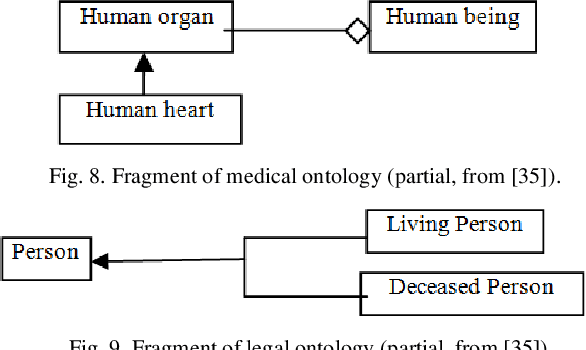
To provide a foundation for conceptual modeling, ontologies have been introduced to specify the entities, the existences of which are acknowledged in the model. Ontologies are essential components as mechanisms to model a portion of reality in software engineering. In this context, a model refers to a description of objects and processes that populate a system. Developing such a description constrains and directs the design, development, and use of the corresponding system, thus avoiding such difficulties as conflicts and lack of a common understanding. In this cross-area research between modeling and ontology, there has been a growing interest in the development and use of domain ontologies (e.g., Resource Description Framework, Ontology Web Language). This paper contributes to the establishment of a broad ontological foundation for conceptual modeling in a specific domain through proposing a workable ontology (abbreviated as TM). A TM is a one-category ontology called a thimac (things/machines) that is used to elaborate the design and analysis of ontological presumptions. The focus of the study is on such notions as change, event, and time. Several current ontological difficulties are reviewed and remodeled in the TM. TM modeling is also contrasted with time representation in SysML. The results demonstrate that a TM is a useful tool for addressing these ontological problems.
* 14 pages, 27 figures
Thinging-Oriented Modeling of Unmanned Aerial Vehicles
May 30, 2020


In recent years, there has been a dramatic increase in both practical and research applications of unmanned aerial vehicles (UAVs). According to the literature, there is a need in this area to develop a more refined model of UAV system architecture, in other words, a conceptual model that defines the system s structure and behavior. The existing models mostly are fractional and do not account for the entire important dynamic attributes. Progress in this area could reduce ambiguity and increase reliability in the design of such systems. This paper aims to advance the modeling of UAV system architecture by adopting a conceptual model called a thinging (abstract) machine in which all of the UAV s software and hardware components are viewed in terms of the flow of things and five generic operations. We apply this model to a real case study of a drone. The results, an integrated conceptual representation of the drone, support the viability of this approach.
* 10 pages, 15 figures
Modeling Events as Machines
Apr 26, 2017


The notion of events has occupied a central role in modeling and has an influence in computer science and philosophy. Recent developments in diagrammatic modeling have made it possible to examine conceptual representation of events. This paper explores some aspects of the notion of events that are produced by applying a new diagrammatic methodology with a focus on the interaction of events with such concepts as time and space, objects. The proposed description applies to abstract machines where events form the dynamic phases of a system. The results of this nontechnical research can be utilized in many fields where the notion of an event is typically used in interdisciplinary application.