 Add to Chrome
 Add to Firefox
 Add to Edge
Online Fair Division with Budget Constraints
Jul 25, 2026
We study an online variant of discrete fair division under generalized assignment budget constraints. Goods arrive one at a time and must be assigned irrevocably to a feasible agent or to charity, which holds all unallocated goods, while fairness is evaluated only against budget-feasible subsets of every recipient's bundle. We first show that, without additional structure, no deterministic online algorithm can guarantee any fixed approximation to feasible envy-freeness, even in highly symmetric instances. We then identify bounded density spread as a structural condition that restores meaningful guarantees, obtaining approximation algorithms for arbitrary item sizes and showing that, under common valuations and sufficiently small goods, these guarantees can be strengthened to an optimal deterministic frontier. We further study resource augmentation, where the online algorithm is allowed slightly larger budgets than the fairness benchmark, and characterize the resulting improvement in the achievable guarantees. Finally, we develop a learning-augmented framework based on predicting joint value-size types, proving consistency under perfect predictions, robustness to prediction error, and showing that separate predictions of value and size marginals are insufficient to recover strong fairness guarantees.

Offline Learning of Nash Stable Coalition Structures with Possibly Overlapping Coalitions
Feb 15, 2026Coalition formation concerns strategic collaborations of selfish agents that form coalitions based on their preferences. It is often assumed that coalitions are disjoint and preferences are fully known, which may not hold in practice. In this paper, we thus present a new model of coalition formation with possibly overlapping coalitions under partial information, where selfish agents may be part of multiple coalitions simultaneously and their full preferences are initially unknown. Instead, information about past interactions and associated utility feedback is stored in a fixed offline dataset, and we aim to efficiently infer the agents' preferences from this dataset. We analyze the impact of diverse dataset information constraints by studying two types of utility feedback that can be stored in the dataset: agent- and coalition-level utility feedback. For both feedback models, we identify assumptions under which the dataset covers sufficient information for an offline learning algorithm to infer preferences and use them to recover a partition that is (approximately) Nash stable, in which no agent can improve her utility by unilaterally deviating. Our additional goal is devising algorithms with low sample complexity, requiring only a small dataset to obtain a desired approximation to Nash stability. Under agent-level feedback, we provide a sample-efficient algorithm proven to obtain an approximately Nash stable partition under a sufficient and necessary assumption on the information covered by the dataset. However, under coalition-level feedback, we show that only under a stricter assumption is sufficient for sample-efficient learning. Still, in multiple cases, our algorithms' sample complexity bounds have optimality guarantees up to logarithmic factors. Finally, extensive experiments show that our algorithm converges to a low approximation level to Nash stability across diverse settings.
Delayed Assignments in Online Non-Centroid Clustering with Stochastic Arrivals
Jan 22, 2026Clustering is a fundamental problem, aiming to partition a set of elements, like agents or data points, into clusters such that elements in the same cluster are closer to each other than to those in other clusters. In this paper, we present a new framework for studying online non-centroid clustering with delays, where elements, that arrive one at a time as points in a finite metric space, should be assigned to clusters, but assignments need not be immediate. Specifically, upon arrival, each point's location is revealed, and an online algorithm has to irrevocably assign it to an existing cluster or create a new one containing, at this moment, only this point. However, we allow decisions to be postponed at a delay cost, instead of following the more common assumption of immediate decisions upon arrival. This poses a critical challenge: the goal is to minimize both the total distance costs between points in each cluster and the overall delay costs incurred by postponing assignments. In the classic worst-case arrival model, where points arrive in an arbitrary order, no algorithm has a competitive ratio better than sublogarithmic in the number of points. To overcome this strong impossibility, we focus on a stochastic arrival model, where points' locations are drawn independently across time from an unknown and fixed probability distribution over the finite metric space. We offer hope for beyond worst-case adversaries: we devise an algorithm that is constant competitive in the sense that, as the number of points grows, the ratio between the expected overall costs of the output clustering and an optimal offline clustering is bounded by a constant.
Convexified Message-Passing Graph Neural Networks
May 23, 2025
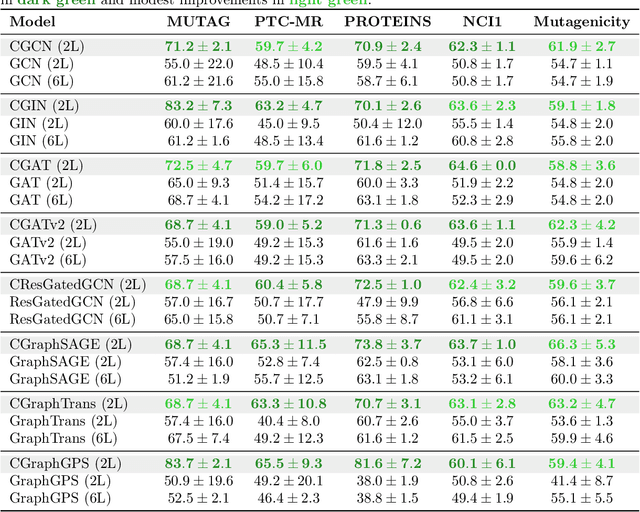
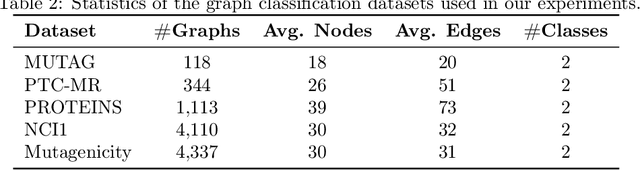
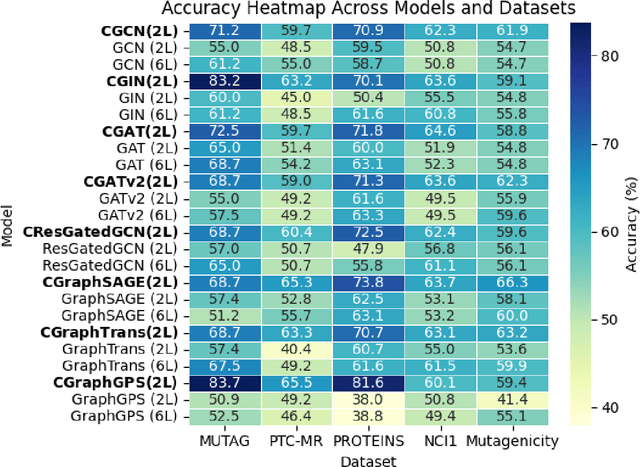
Graph Neural Networks (GNNs) have become prominent methods for graph representation learning, demonstrating strong empirical results on diverse graph prediction tasks. In this paper, we introduce Convexified Message Passing Graph Neural Networks (CGNNs), a novel and general framework that combines the power of message-passing GNNs with the tractability of convex optimization. By mapping their nonlinear filters into a reproducing kernel Hilbert space, CGNNs transform training into a convex optimization problem, which can be solved efficiently and optimally by projected gradient methods. This convexity further allows the statistical properties of CGNNs to be analyzed accurately and rigorously. For two-layer CGNNs, we establish rigorous generalization guarantees, showing convergence to the performance of the optimal GNN. To scale to deeper architectures, we adopt a principled layer-wise training strategy. Experiments on benchmark datasets show that CGNNs significantly exceed the performance of leading GNN models, achieving 10 to 40 percent higher accuracy in most cases, underscoring their promise as a powerful and principled method with strong theoretical foundations. In rare cases where improvements are not quantitatively substantial, the convex models either slightly exceed or match the baselines, stressing their robustness and wide applicability. Though over-parameterization is often employed to enhance performance in nonconvex models, we show that our CGNNs framework yields shallow convex models that can surpass these models in both accuracy and resource efficiency.