 Add to Chrome
 Add to Firefox
 Add to Edge
Quantifying Weighted Morphological Content of Large-Scale Structures via Simulation-Based Inference
Nov 05, 2025
In this work, we perform a simulation-based forecasting analysis to compare the constraining power of two higher-order summary statistics of the large-scale structure (LSS), the Minkowski Functionals (MFs) and the Conditional Moments of Derivative (CMD), with a particular focus on their sensitivity to nonlinear and anisotropic features in redshift-space. Our analysis relies on halo catalogs from the Big Sobol Sequence(BSQ) simulations at redshift $z=0.5$, employing a likelihood-free inference framework implemented via neural posterior estimation. At the fiducial cosmology of the Quijote simulations $(\Omega_{m}=0.3175,\,\sigma_{8}=0.834)$, and for the smoothing scale $R=15\,h^{-1}$Mpc, we find that the CMD yields tighter forecasts for $(\Omega_{m}},\,\sigma_{8})$ than the zeroth- to third-order MFs components, improving the constraint precision by ${\sim}(44\%,\,52\%)$, ${\sim}(30\%,\,45\%)$, ${\sim}(27\%,\,17\%)$, and ${\sim}(26\%,\,17\%)$, respectively. A joint configuration combining the MFs and CMD further enhances the precision by approximately ${\sim}27\%$ compared to the standard MFs alone, highlighting the complementary anisotropy-sensitive information captured by the CMD in contrast to the scalar morphological content encapsulated by the MFs. We further extend the forecasting analysis to a continuous range of cosmological parameter values and multiple smoothing scales. Our results show that, although the absolute forecast uncertainty for each component of summary statistics depends on the underlying parameter values and the adopted smoothing scale, the relative constraining power among the summary statistics remains nearly constant throughout.

Cosmic String Detection with Tree-Based Machine Learning
Jan 12, 2018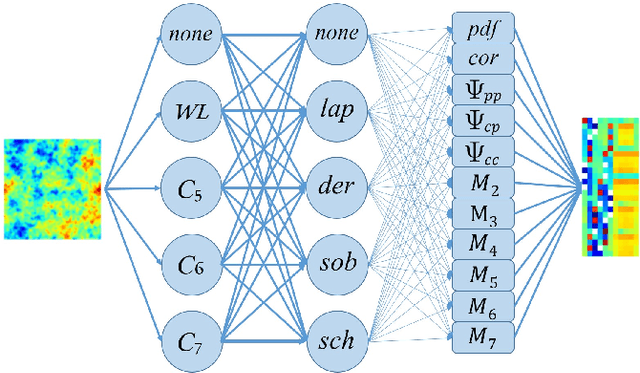
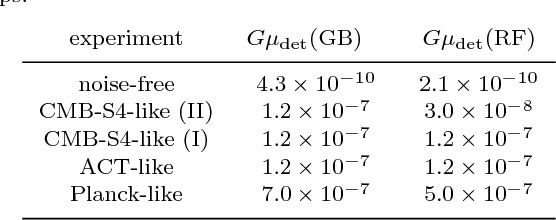
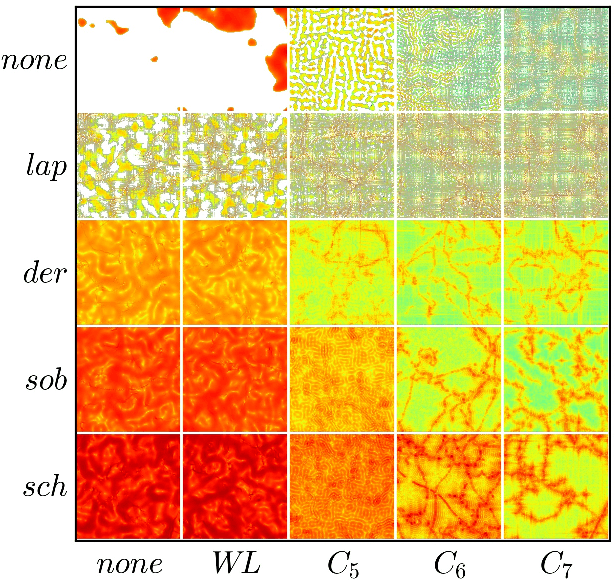
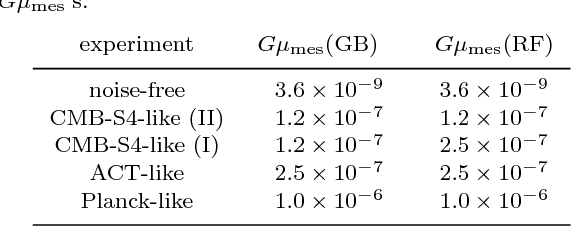
We explore the use of random forest and gradient boosting, two powerful tree-based machine learning algorithms, for the detection of cosmic strings in maps of the cosmic microwave background (CMB), through their unique Gott-Kaiser-Stebbins effect on the temperature anisotropies.The information in the maps is compressed into feature vectors before being passed to the learning units. The feature vectors contain various statistical measures of processed CMB maps that boost the cosmic string detectability. Our proposed classifiers, after training, give results improved over or similar to the claimed detectability levels of the existing methods for string tension, $G\mu$. They can make $3\sigma$ detection of strings with $G\mu \gtrsim 2.1\times 10^{-10}$ for noise-free, $0.9'$-resolution CMB observations. The minimum detectable tension increases to $G\mu \gtrsim 3.0\times 10^{-8}$ for a more realistic, CMB S4-like (II) strategy, still a significant improvement over the previous results.
* 7 pages, 3 figures, 2 tables, Comments are welcome