 Add to Chrome
 Add to Firefox
 Add to Edge
Ideological Sublations: Resolution of Dialectic in Population-based Optimization
Sep 03, 2017


A population-based optimization algorithm was designed, inspired by two main thinking modes in philosophy, both based on dialectic concept and thesis-antithesis paradigm. They impose two different kinds of dialectics. Idealistic and materialistic antitheses are formulated as optimization models. Based on the models, the population is coordinated for dialectical interactions. At the population-based context, the formulated optimization models are reduced to a simple detection problem for each thinker (particle). According to the assigned thinking mode to each thinker and her/his measurements of corresponding dialectic with other candidate particles, they deterministically decide to interact with a thinker in maximum dialectic with their theses. The position of a thinker at maximum dialectic is known as an available antithesis among the existing solutions. The dialectical interactions at each ideological community are distinguished by meaningful distributions of step-sizes for each thinking mode. In fact, the thinking modes are regarded as exploration and exploitation elements of the proposed algorithm. The result is a delicate balance without any requirement for adjustment of step-size coefficients. Main parameter of the proposed algorithm is the number of particles appointed to each thinking modes, or equivalently for each kind of motions. An additional integer parameter is defined to boost the stability of the final algorithm in some particular problems. The proposed algorithm is evaluated by a testbed of 12 single-objective continuous benchmark functions. Moreover, its performance and speed were highlighted in sparse reconstruction and antenna selection problems, at the context of compressed sensing and massive MIMO, respectively. The results indicate fast and efficient performance in comparison with well-known evolutionary algorithms and dedicated state-of-the-art algorithms.

Simulated Tornado Optimization
Dec 31, 2016

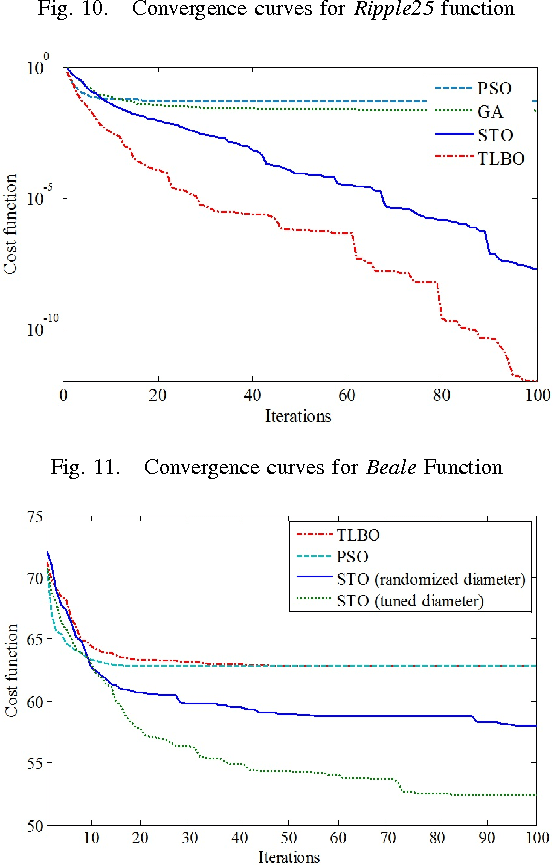
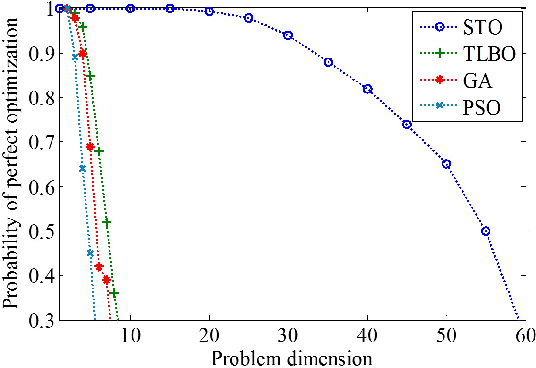
We propose a swarm-based optimization algorithm inspired by air currents of a tornado. Two main air currents - spiral and updraft - are mimicked. Spiral motion is designed for exploration of new search areas and updraft movements is deployed for exploitation of a promising candidate solution. Assignment of just one search direction to each particle at each iteration, leads to low computational complexity of the proposed algorithm respect to the conventional algorithms. Regardless of the step size parameters, the only parameter of the proposed algorithm, called tornado diameter, can be efficiently adjusted by randomization. Numerical results over six different benchmark cost functions indicate comparable and, in some cases, better performance of the proposed algorithm respect to some other metaheuristics.