 Add to Chrome
 Add to Firefox
 Add to Edge
Detecting and Characterising Mobile App Metamorphosis in Google Play Store
Jul 19, 2024
App markets have evolved into highly competitive and dynamic environments for developers. While the traditional app life cycle involves incremental updates for feature enhancements and issue resolution, some apps deviate from this norm by undergoing significant transformations in their use cases or market positioning. We define this previously unstudied phenomenon as 'app metamorphosis'. In this paper, we propose a novel and efficient multi-modal search methodology to identify apps undergoing metamorphosis and apply it to analyse two snapshots of the Google Play Store taken five years apart. Our methodology uncovers various metamorphosis scenarios, including re-births, re-branding, re-purposing, and others, enabling comprehensive characterisation. Although these transformations may register as successful for app developers based on our defined success score metric (e.g., re-branded apps performing approximately 11.3% better than an average top app), we shed light on the concealed security and privacy risks that lurk within, potentially impacting even tech-savvy end-users.

Nazr-CNN: Fine-Grained Classification of UAV Imagery for Damage Assessment
Aug 22, 2017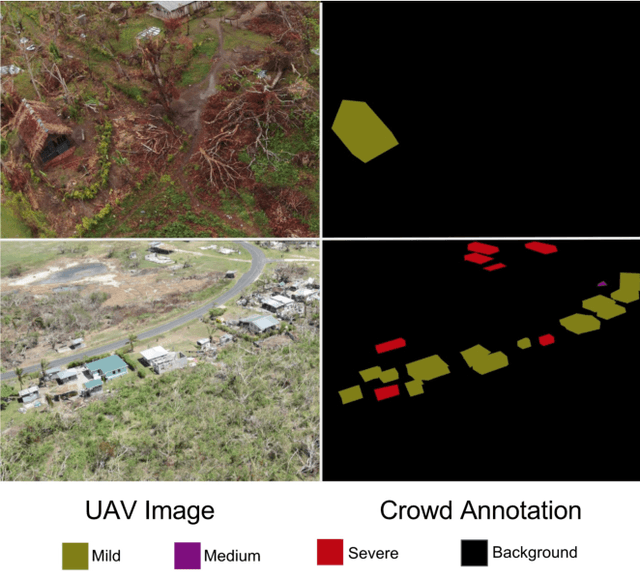
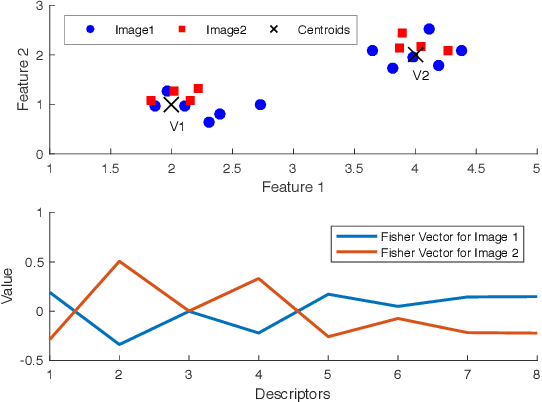

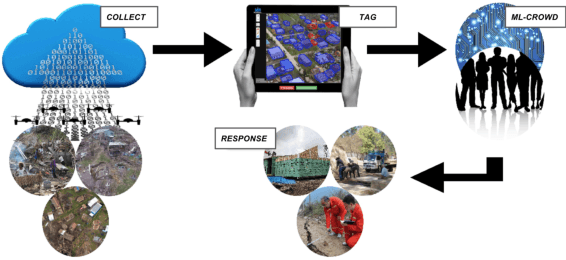
We propose Nazr-CNN1, a deep learning pipeline for object detection and fine-grained classification in images acquired from Unmanned Aerial Vehicles (UAVs) for damage assessment and monitoring. Nazr-CNN consists of two components. The function of the first component is to localize objects (e.g. houses or infrastructure) in an image by carrying out a pixel-level classification. In the second component, a hidden layer of a Convolutional Neural Network (CNN) is used to encode Fisher Vectors (FV) of the segments generated from the first component in order to help discriminate between different levels of damage. To showcase our approach we use data from UAVs that were deployed to assess the level of damage in the aftermath of a devastating cyclone that hit the island of Vanuatu in 2015. The collected images were labeled by a crowdsourcing effort and the labeling categories consisted of fine-grained levels of damage to built structures. Since our data set is relatively small, a pre- trained network for pixel-level classification and FV encoding was used. Nazr-CNN attains promising results both for object detection and damage assessment suggesting that the integrated pipeline is robust in the face of small data sets and labeling errors by annotators. While the focus of Nazr-CNN is on assessment of UAV images in a post-disaster scenario, our solution is general and can be applied in many diverse settings. We show one such case of transfer learning to assess the level of damage in aerial images collected after a typhoon in Philippines.