 Add to Chrome
 Add to Firefox
 Add to Edge
Are Statistical Methods Obsolete in the Era of Deep Learning?
May 27, 2025
In the era of AI, neural networks have become increasingly popular for modeling, inference, and prediction, largely due to their potential for universal approximation. With the proliferation of such deep learning models, a question arises: are leaner statistical methods still relevant? To shed insight on this question, we employ the mechanistic nonlinear ordinary differential equation (ODE) inverse problem as a testbed, using physics-informed neural network (PINN) as a representative of the deep learning paradigm and manifold-constrained Gaussian process inference (MAGI) as a representative of statistically principled methods. Through case studies involving the SEIR model from epidemiology and the Lorenz model from chaotic dynamics, we demonstrate that statistical methods are far from obsolete, especially when working with sparse and noisy observations. On tasks such as parameter inference and trajectory reconstruction, statistically principled methods consistently achieve lower bias and variance, while using far fewer parameters and requiring less hyperparameter tuning. Statistical methods can also decisively outperform deep learning models on out-of-sample future prediction, where the absence of relevant data often leads overparameterized models astray. Additionally, we find that statistically principled approaches are more robust to accumulation of numerical imprecision and can represent the underlying system more faithful to the true governing ODEs.

Accurate estimation of influenza epidemics using Google search data via ARGO
Nov 16, 2015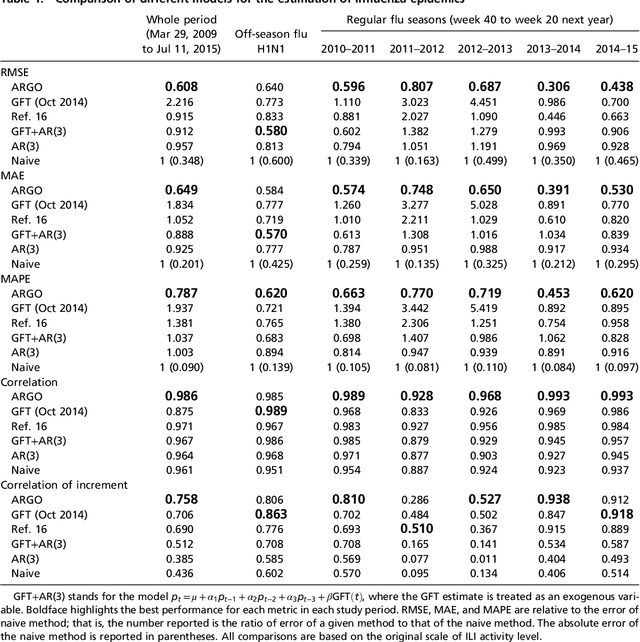
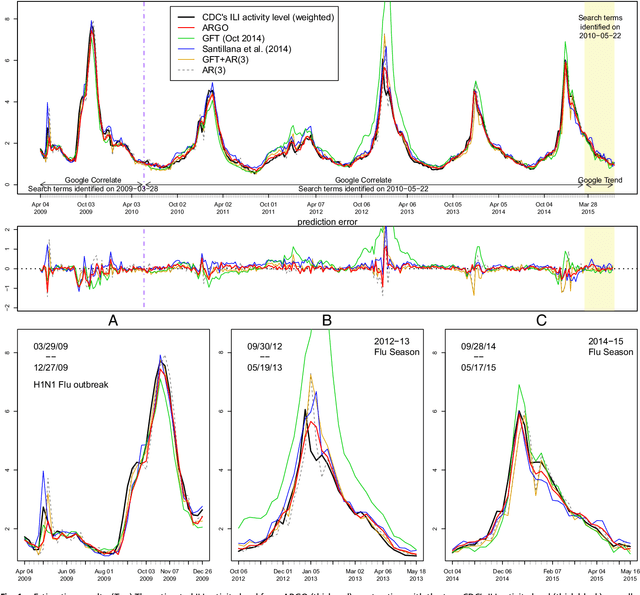
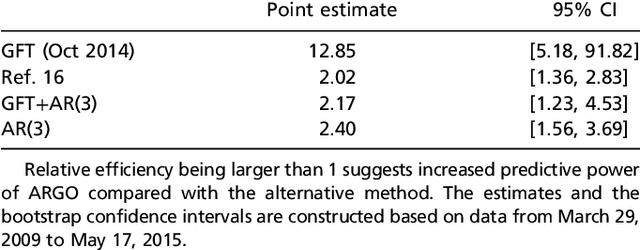
Accurate real-time tracking of influenza outbreaks helps public health officials make timely and meaningful decisions that could save lives. We propose an influenza tracking model, ARGO (AutoRegression with GOogle search data), that uses publicly available online search data. In addition to having a rigorous statistical foundation, ARGO outperforms all previously available Google-search-based tracking models, including the latest version of Google Flu Trends, even though it uses only low-quality search data as input from publicly available Google Trends and Google Correlate websites. ARGO not only incorporates the seasonality in influenza epidemics but also captures changes in people's online search behavior over time. ARGO is also flexible, self-correcting, robust, and scalable, making it a potentially powerful tool that can be used for real-time tracking of other social events at multiple temporal and spatial resolutions.