 Add to Chrome
 Add to Firefox
 Add to Edge
Exterior sound field estimation based on physics-constrained kernel
Feb 05, 2026
Exterior sound field interpolation is a challenging problem that often requires specific array configurations and prior knowledge on the source conditions. We propose an interpolation method based on Gaussian processes using a point source reproducing kernel with a trainable inner product formulation made to fit exterior sound fields. While this estimation does not have a closed formula, it allows for the definition of a flexible estimator that is not restricted by microphone distribution and attenuates higher harmonic orders automatically with parameters directly optimized from the recordings, meaning an arbitrary distribution of microphones can be used. The proposed kernel estimator is compared in simulated experiments to the conventional method using spherical wave functions and an established physics-informed machine learning model, achieving lower interpolation error by approximately 2 dB on average within the analyzed frequencies of 100 Hz and 2.5 kHz and reconstructing the ground truth sound field more consistently within the target region.

Multizone sound field reproduction with direction-of-arrival-distribution-based regularization and its application to binaural-centered mode-matching
Feb 22, 2025In higher-order Ambisonics, a framework for sound field reproduction, secondary-source driving signals are generally obtained by regularized mode matching. The authors have proposed a regularization technique based on direction-of-arrival (DoA) distribution of wavefronts in the primary sound field. Such DoA-distribution-based regularization enables a suppression of excessively large driving signal gains for secondary sources that are in the directions far from the primary source direction. This improves the reproduction accuracy at regions away from the reproduction center. First, this study applies the DoA-distribution-based regularization to a multizone sound field reproduction based on the addition theorem. Furthermore, the regularized multizone sound field reproduction is extended to a binaural-centered mode matching (BCMM), which produces two reproduction points, one at each ear, to avoid a degraded reproduction accuracy due to a shrinking sweet spot at higher frequencies. Free-field and binaural simulations were numerically performed to examine the effectiveness of the DoA-distribution-based regularization on the multizone sound field reproduction and the BCMM.
Sound field decomposition based on two-stage neural networks
Sep 13, 2023
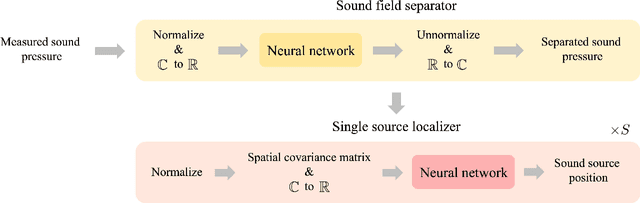
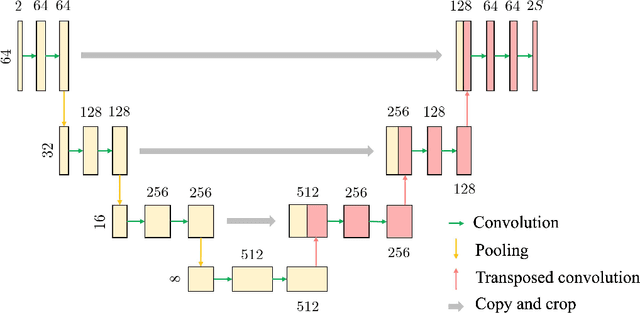
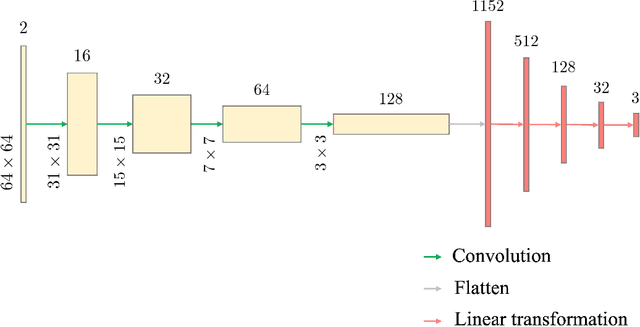
A method for sound field decomposition based on neural networks is proposed. The method comprises two stages: a sound field separation stage and a single-source localization stage. In the first stage, the sound pressure at microphones synthesized by multiple sources is separated into one excited by each sound source. In the second stage, the source location is obtained as a regression from the sound pressure at microphones consisting of a single sound source. The estimated location is not affected by discretization because the second stage is designed as a regression rather than a classification. Datasets are generated by simulation using Green's function, and the neural network is trained for each frequency. Numerical experiments reveal that, compared with conventional methods, the proposed method can achieve higher source-localization accuracy and higher sound-field-reconstruction accuracy.