 Add to Chrome
 Add to Firefox
 Add to Edge
Zero-Shot Traffic Accident Detection via a Coarse-to-Fine VLM-Tracking Pipeline
Aug 09, 2026
Traffic surveillance cameras capture accidents continuously, yet converting raw CCTV footage into structured event records that pinpoint when, where, and what type of collision occurred remains unsolved at scale. The ACCIDENT @ CVPR benchmark evaluates exactly this joint prediction under a strict constraint: no labeled real-world training data is available. We introduce a training-free, two-pass coarse-to-fine pipeline that pairs a frozen Qwen3-VL-32B-Instruct vision-language model with YOLO11x object detection and BoT-SORT tracking. A first pass sparsely samples the full clip to anchor the collision moment in time; a second pass re-examines a tight window around that estimate using frames annotated with stable vehicle identities and normalized bounding-box coordinates, which gives the model both a visual overlay and an explicit numeric description of the same scene. On the official 2,027-clip real-CCTV test set, our system achieves a three-way harmonic mean score of 0.504, surpassing all organizer-published baselines including the best multi-model ensemble (0.412) by a 22% relative margin.

When English Rewrites Local Knowledge: Global Narrative Dominance in Large Language Models
May 28, 2026Large language models (LLMs) are widely used as cross-lingual knowledge interfaces. However, culturally grounded questions often reflect globally dominant narratives rather than local contexts. We study this failure mode as \textit{global narrative dominance} in Bangla, a low-resource cultural context. We introduce \texttt{CulturalNB}, a dataset of 717 manually curated Bengali cultural instances with parallel Bangla--English question--answer pairs and supporting evidence, metadata, and sociocultural annotations. Using question-only and evidence-based prompting, we evaluate nine state-of-the-art LLMs with human and two independent LLM judges across metrics for cross-lingual consistency, language anchoring, global substitution, institutional bias, and epistemic perspective coverage. Results show that questions asked in English systematically increase global substitution and institutional framing while reducing local perspective coverage. Local evidence improves factual consistency and perspective coverage, but does not eliminate language-induced epistemic shifts. These findings suggest that cultural failures in LLMs are not only missing-knowledge errors but also failures of grounding and narrative prioritization.
Too Late to Train, Too Early To Use? A Study on Necessity and Viability of Low-Resource Bengali LLMs
Jun 29, 2024
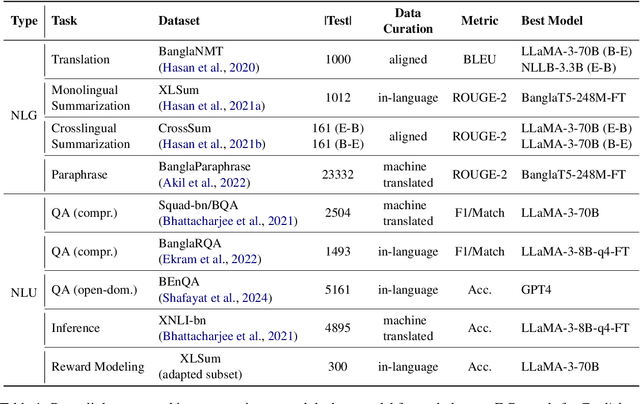
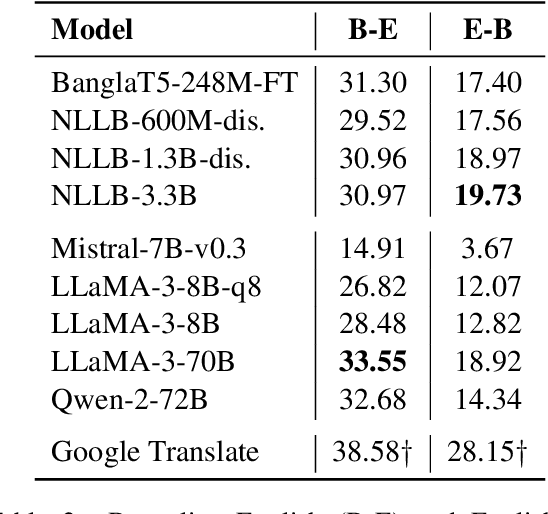
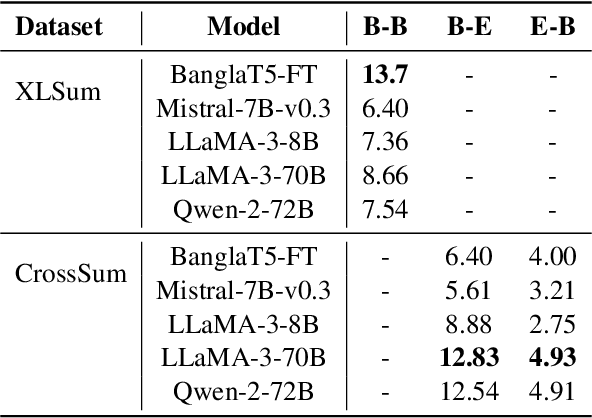
Each new generation of English-oriented Large Language Models (LLMs) exhibits enhanced cross-lingual transfer capabilities and significantly outperforms older LLMs on low-resource languages. This prompts the question: Is there a need for LLMs dedicated to a particular low-resource language? We aim to explore this question for Bengali, a low-to-moderate resource Indo-Aryan language native to the Bengal region of South Asia. We compare the performance of open-weight and closed-source LLMs such as LLaMA-3 and GPT-4 against fine-tuned encoder-decoder models across a diverse set of Bengali downstream tasks, including translation, summarization, paraphrasing, question-answering, and natural language inference. Our findings reveal that while LLMs generally excel in reasoning tasks, their performance in tasks requiring Bengali script generation is inconsistent. Key challenges include inefficient tokenization of Bengali script by existing LLMs, leading to increased computational costs and potential performance degradation. Additionally, we highlight biases in machine-translated datasets commonly used for Bengali NLP tasks. We conclude that there is a significant need for a Bengali-oriented LLM, but the field currently lacks the high-quality pretraining and instruction-tuning datasets necessary to develop a highly effective model.