 Add to Chrome
 Add to Firefox
 Add to Edge
Targeted learning of heterogeneous treatment effect curves for right censored or left truncated time-to-event data
Mar 27, 2026
In recent years, there has been growing interest in causal machine learning estimators for quantifying subject-specific effects of a binary treatment on time-to-event outcomes. Estimation approaches have been proposed which attenuate the inherent regularisation bias in machine learning predictions, with each of these estimators addressing measured confounding, right censoring, and in some cases, left truncation. However, the existing approaches are found to exhibit suboptimal finite-sample performance, with none of the existing estimators fully leveraging the temporal structure of the data, yielding non-smooth treatment effects over time. We address these limitations by introducing surv-iTMLE, a targeted learning procedure for estimating the difference in the conditional survival probabilities under two treatments. Unlike existing estimators, surv-iTMLE accommodates both left truncation and right censoring while enforcing smoothness and boundedness of the estimated treatment effect curve over time. Through extensive simulation studies under both right censoring and left truncation scenarios, we demonstrate that surv-iTMLE outperforms existing methods in terms of bias and smoothness of time-varying effect estimates in finite samples. We then illustrate surv-iTMLE's practical utility by exploring heterogeneity in the effects of immunotherapy on survival among non-small cell lung cancer (NSCLC) patients, revealing clinically meaningful temporal patterns that existing estimators may obscure.

Causal machine learning for heterogeneous treatment effects in the presence of missing outcome data
Dec 27, 2024
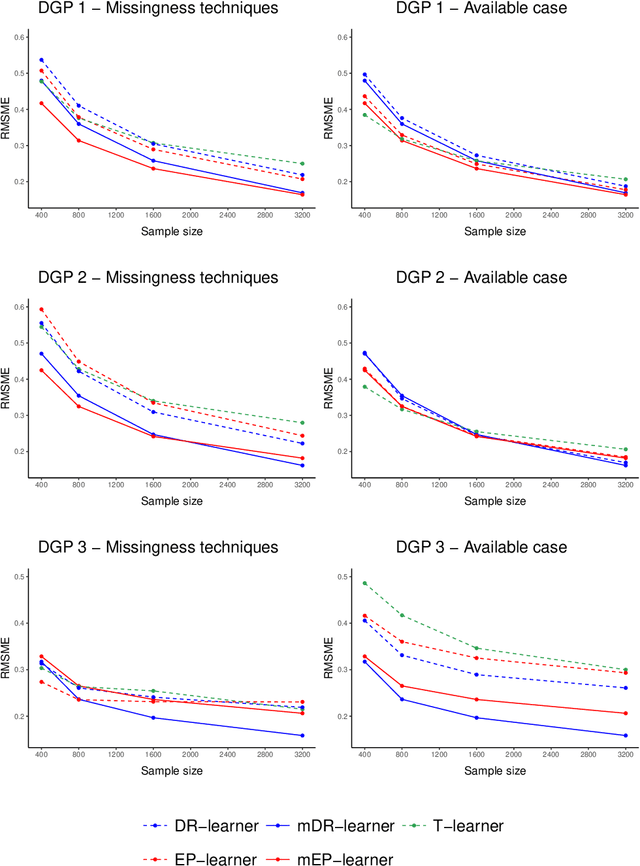
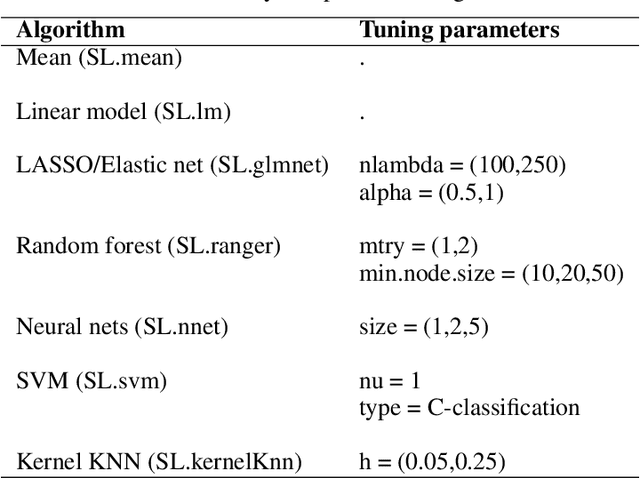
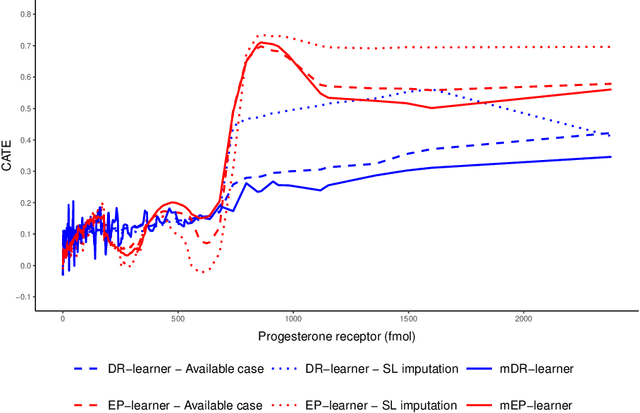
When estimating heterogeneous treatment effects, missing outcome data can complicate treatment effect estimation, causing certain subgroups of the population to be poorly represented. In this work, we discuss this commonly overlooked problem and consider the impact that missing at random (MAR) outcome data has on causal machine learning estimators for the conditional average treatment effect (CATE). We then propose two de-biased machine learning estimators for the CATE, the mDR-learner and mEP-learner, which address the issue of under-representation by integrating inverse probability of censoring weights into the DR-learner and EP-learner respectively. We show that under reasonable conditions, these estimators are oracle efficient, and illustrate their favorable performance through simulated data settings, comparing them to existing CATE estimators, including comparison to estimators which use common missing data techniques. Guidance on the implementation of these estimators is provided and we present an example of their application using the ACTG175 trial, exploring treatment effect heterogeneity when comparing Zidovudine mono-therapy against alternative antiretroviral therapies among HIV-1-infected individuals.